
Loading, please wait...
LOT 0628
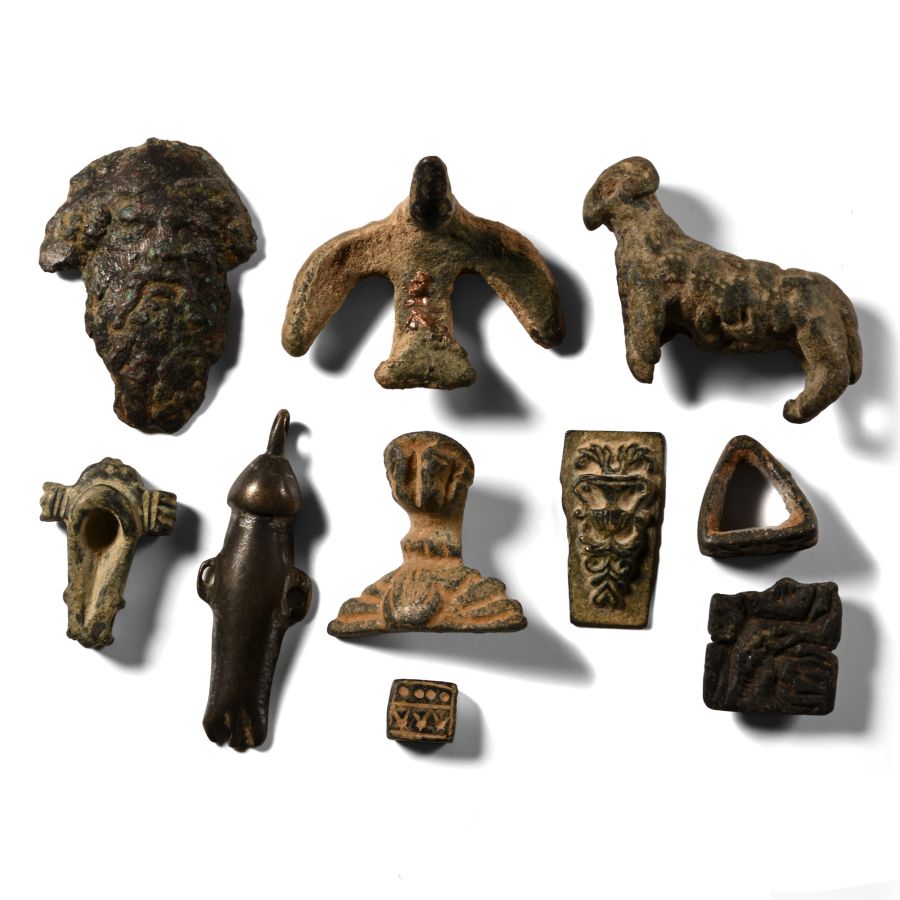
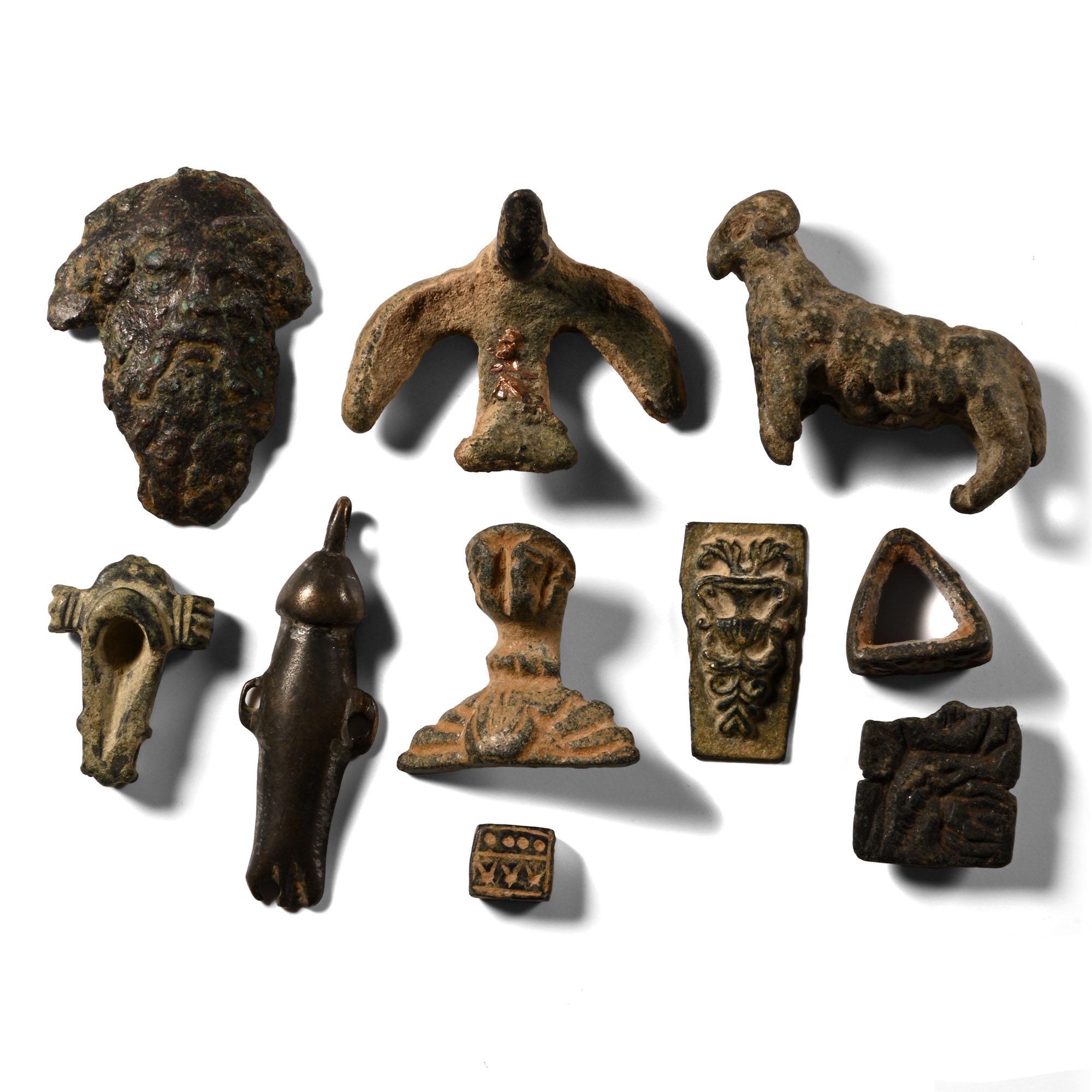
Roman and Other Bronze Artefact Group
1ST-4TH CENTURY A.D. AND LATER
1/4 - 1 3/4 in. (118 grams total, 8-44 mm).
Including bust appliqué, model ram and other types. [10]
ProvenanceFrom the collection of a gentleman, acquired on the London art market in the 1990s.
This lot is accompanied by an illustrated lot declaration signed by the Head of the Antiquities Department, Dr Raffaele D'Amato.
TimeLine Auctions follows a vetting process to ensure the authenticity and legality of all items, reinforcing our commitment to integrity and responsible trading. Each antiquity, antique, and coin lot undergoes thorough examination by a vetting committee of at least ten external specialists, professional trade association members, scientists, and archaeologists: Our Vetting Process
AUCTIONS:
TimeLine is a leading auction house specialising in antiquities, ancient art, collectables, natural history, coins, medals, and books. Our auctions offer museums, collectors, historians, and enthusiasts the opportunity to acquire unique and historically significant pieces.
LOT 0628
Roman and Other Bronze Artefact Group
Estimate £180 - 240€210 - 280 (for guidance only)$240 - 320 (for guidance only)
-
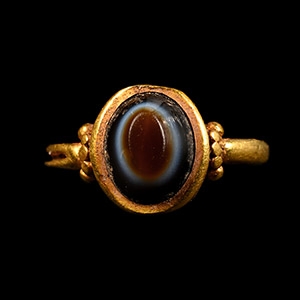
Roman Gold Ring with Eye Cabochon
3rd-4th century A.D.Sold for (Inc. bp): £715
Round-section hoop with granule cluster to each shoulder, ellipsoid cell with inset sardonyx cabochon; one end of bezel and outer edge of hoop damaged. 2.45 grams, 20.32 mm overall, 11.79 x 16.35 mm internal diameter (approximate size British E 1/2, USA 2 1/2, Europe 3, Japan 3)
Private family collection, acquired in the 1980s. with Christie's, New York, Ancient Jewellery, 11 December 2003, no.506. Property of a European collection. Accompanied by a copy of an Art Loss Register certificate, no.S00029664 This lot is accompanied by an illustrated lot declaration signed by the Head of the Antiquities Department, Dr Raffaele D'Amato. -
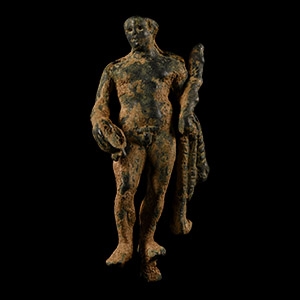
Roman Bronze Figure of Hercules
2nd-3rd century A.D.Estimate: £1,800 - 2,400 (‡+bp*)
Opening Bid: £900
Depicted nude in a contrapposto stance with the weight on his left leg, holding a club on the crook of his left hand with lion skin draped over the arm, and a cup in his right hand. 115 grams, 86 mm
Acquired in the 1980s. Private collection, Switzerland, thence by descent. Private collection, since the late 1990s. This lot has been checked against the Interpol Database of stolen works of art and is accompanied by search certificate number no.12615-234681. This lot has been cleared against the Art Loss Register database, and is accompanied by an illustrated lot declaration signed by the Head of the Antiquities Department, Dr Raffaele D'Amato.
The statuette, perhaps of Gallo-Roman origin, was likely part of a private lararium. It is a provincial work, but is well-proportioned. Unlike other statuettes of this type, Hercules is beardless. The upper part of the head was probably covered by a laurel crown. -
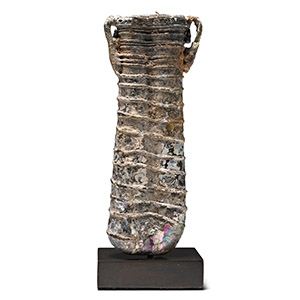
Roman Glass Double Unguentarium
4th-5th century A.D.Estimate: £400 - 600 (+bp*)
Opening Bid: £200
Composed of two conjoined tapering tubular cells, lateral applied handles at the shoulder, decorated with applied trails; mounted on a custom-made stand. 53.7 grams, 11.6 cm (116 grams total, 13.5 cm including stand)
From an important London collection of glass, 1990s. This lot is accompanied by an illustrated lot declaration signed by the Head of the Antiquities Department, Dr Raffaele D'Amato.
