
Loading, please wait...
_900x900.jpg "Roman and Later Lead Weight Collection")
_200x200.jpg "Roman and Later Lead Weight Collection")
.jpg "Roman and Later Lead Weight Collection")
LOT 0697
Roman and Later Lead Weight Collection
1ST-18TH CENTURY A.D.
3/4 - 1 3/4 in. (889 grams total, 20-45 mm).
Including tabular, plano-convex and conical types. [10, No Reserve]
ProvenanceFound whilst fieldwalking in Somerset and Devon, UK.
CONDITIONTimeLine Auctions follows a vetting process to ensure the authenticity and legality of all items, reinforcing our commitment to integrity and responsible trading. Each antiquity, antique, and coin lot undergoes thorough examination by a vetting committee of at least ten external specialists, professional trade association members, scientists, and archaeologists: Our Vetting Process
AUCTIONS:
TimeLine is a leading auction house specialising in antiquities, ancient art, collectables, natural history, coins, medals, and books. Our auctions offer museums, collectors, historians, and enthusiasts the opportunity to acquire unique and historically significant pieces.
-
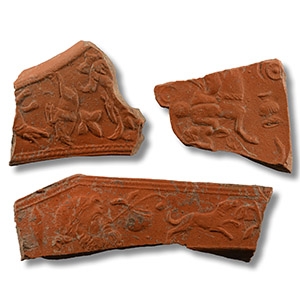
Roman Redware Fragment Collection
Circa 4th century A.D.Sold for (Inc. bp): £325
Comprising three edge fragments: one with a centaur carrying away a woman, amphora below; one showing a butting goat defending itself against a large hound; one showing a profile head of a bearded man with a staff and bag, possibly the god Mercury, a leaping hound before him. 53.1 grams total, 50-97 mm
Ex German art market, 2000s. Acquired from an EU collector living in London. From the collection of Surrey, UK, gentleman. -
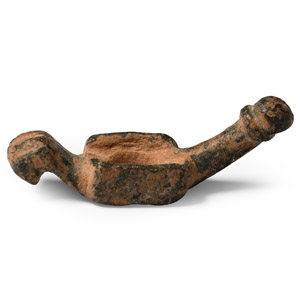
Roman Bronze Phallic Dagger Quillon
1st-2nd century A.D.Estimate: £120 - 170 (+bp*)
Opening Bid: £60
With a rectangular plaque with central void, phallus to one short edge and a stylised fist to the other. 25.5 grams, 55 mm
Acquired 1980-2015. Ex Abelita family collection. -
.jpg)
Roman Limestone Gaming Counter Group
1st-4th century A.D.Sold for (Inc. bp): £59
Twenty discoid limestone counters each with an incuse cinquefoil to both faces. 36 grams total, 13-19 mm
Private collection formed in the 1990s. Acquired from a central London gallery. Property of an Essex gentleman.
