
Loading, please wait...
_900x900.jpg "Roman and Byzantine Ceramic Oil Lamp Collection")
_200x200.jpg "Roman and Byzantine Ceramic Oil Lamp Collection")
.jpg "Roman and Byzantine Ceramic Oil Lamp Collection")
LOT 0613
Roman and Byzantine Ceramic Oil Lamp Collection
2ND-8TH CENTURY A.D.
3 1/2 - 3 3/4 in. (159 grams total, 88-94 mm).
Comprising: a slipper-shaped lamp with low-relief linear decoration; a rounded lamp with large nozzle, a band of omega motifs around the central filler hole; a drum-shaped lamp with low discus with raised double border, short nozzle with ring-and-dot motifs. [3]
Provenancewith Galerie Rhéa, Zurich, Switzerland.
This lot is accompanied by an illustrated lot declaration signed by the Head of the Antiquities Department, Dr Raffaele D'Amato.
TimeLine Auctions follows a vetting process to ensure the authenticity and legality of all items, reinforcing our commitment to integrity and responsible trading. Each antiquity, antique, and coin lot undergoes thorough examination by a vetting committee of at least ten external specialists, professional trade association members, scientists, and archaeologists: Our Vetting Process
AUCTIONS:
TimeLine is a leading auction house specialising in antiquities, ancient art, collectables, natural history, coins, medals, and books. Our auctions offer museums, collectors, historians, and enthusiasts the opportunity to acquire unique and historically significant pieces.
LOT 0613
Roman and Byzantine Ceramic Oil Lamp Collection
Estimate £300 - 400€350 - 460 (for guidance only)$410 - 540 (for guidance only)
-
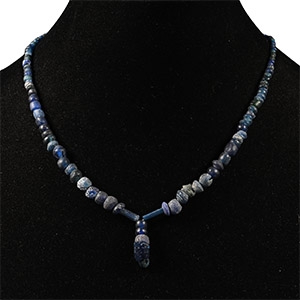
Roman Blue Glass Bead Necklace String
1st-4th century A.D. and laterSold for (Inc. bp): £85
Restrung to a Y-shape comprising mainly graduated oblate beads, central feature composed of oblate and annular beads with a reused bracelet fragment. 16.66 grams, 37 cm
Ex London, UK, collection, 1990s. This lot is accompanied by an illustrated lot declaration signed by the Head of the Antiquities Department, Dr Raffaele D'Amato. -

Roman Vessel Lid with Male Youth Wearing a Chlamys
1st-3rd century A.D.Estimate: £500 - 700 (+bp*)
Opening Bid: £250
Discoid base supporting a seated youth with legs crossed wearing a chlamys, his left hand supporting fruit in the folds of the cloth and right hand holding one; base pierced; transverse wire to sides of the head, ring above. 366 grams, 80 mm
From the collection of a gentleman, acquired on the London art market in the 1990s. This lot is accompanied by an illustrated lot declaration signed by the Head of the Antiquities Department, Dr Raffaele D'Amato. -
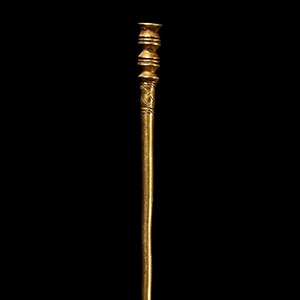
Roman Decorated Gold Dress Pin
1st-4th century A.D.Estimate: £800 - 1,000 (‡+bp*)
Opening Bid: £400
Slender body with balustered finial, a band of hatched herringbone decoration beneath the finial. 2.74 grams, 72 mm
Ex 'Neuburg' Collection, Germany, 1970. with Gorny & Mosch, Munich, Germany. with Galerie Rhéa, Zurich, Switzerland. This lot is accompanied by an illustrated lot declaration signed by the Head of the Antiquities Department, Dr Raffaele D'Amato.
