
Loading, please wait...
_900x900.jpg "Rolled Aramaic Lead Magical Text Scroll")
_200x200.jpg "Rolled Aramaic Lead Magical Text Scroll")
.jpg "Rolled Aramaic Lead Magical Text Scroll")
LOT 0263
Rolled Aramaic Lead Magical Text Scroll
2ND-8TH CENTURY A.D.
2 3/8 in. (41 grams, 60 mm).
A rolled sheet-metal magical document with inscribed text in Aramaic.
ProvenanceAcquired 1979-1999.
London collection of the late Mr S.M., thence by descent.
TimeLine Auctions follows a vetting process to ensure the authenticity and legality of all items, reinforcing our commitment to integrity and responsible trading. Each antiquity, antique, and coin lot undergoes thorough examination by a vetting committee of at least ten external specialists, professional trade association members, scientists, and archaeologists: Our Vetting Process
AUCTIONS:
TimeLine is a leading auction house specialising in antiquities, ancient art, collectables, natural history, coins, medals, and books. Our auctions offer museums, collectors, historians, and enthusiasts the opportunity to acquire unique and historically significant pieces.
LOT 0263
Rolled Aramaic Lead Magical Text Scroll
Estimate £500 - 700€580 - 810 (for guidance only)$680 - 950 (for guidance only)
-
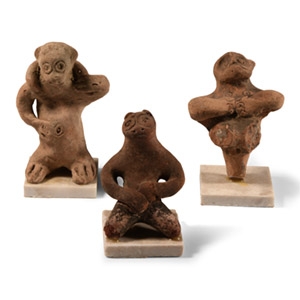
Indus Valley Terracotta Monkey Figurine Group
1st millennium B.C.Sold for (Inc. bp): £143
Each a simian with exaggerated eyes, mounted on a stand. 428 grams total, 8.2-10.3 cm
From a collection acquired on the UK art market from various auction houses and collections mostly before 2000. From an important Cambridgeshire estate; thence by descent. -
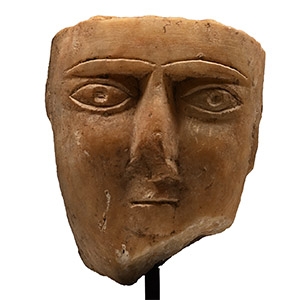
South Arabian Alabaster Head of a Woman
1st century B.C.-1st century A.D.Sold for (Inc. bp): £1,170
Carved in the half-round, the eyes with drilled pupils to accept inserts; mounted on a custom-made display stand. 3.49 kg total, 22.5 cm high including stand
From the collection of Dr Mohammed Saïd Farsi (1936-2019), acquired between 1960-1990 at Christie's, Sotheby's and Mayfair galleries.
The eyes of these beautiful statues were inlaid with blue glass or lapis lazuli. These portraits could have been inserted in a funerary stele, but most probably this portrait comes from a statue similar to the 'Myriam of Tamna', as can be understood from the flat back, to which braided hair in plaster was probably attached. -
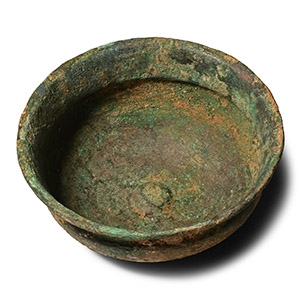
Achaemenid Bronze Flared Phiale Mesomphalos
Circa 6th-4th century B.C.Sold for (Inc. bp): £59
Squat in profile with flared rime to the mouth and carination to the sidewall, central repoussé dome to the underside. 169 grams, 13.5 cm
Acquired 1980-2015. Ex Abelita family collection.
