
Loading, please wait...
LOT 1998
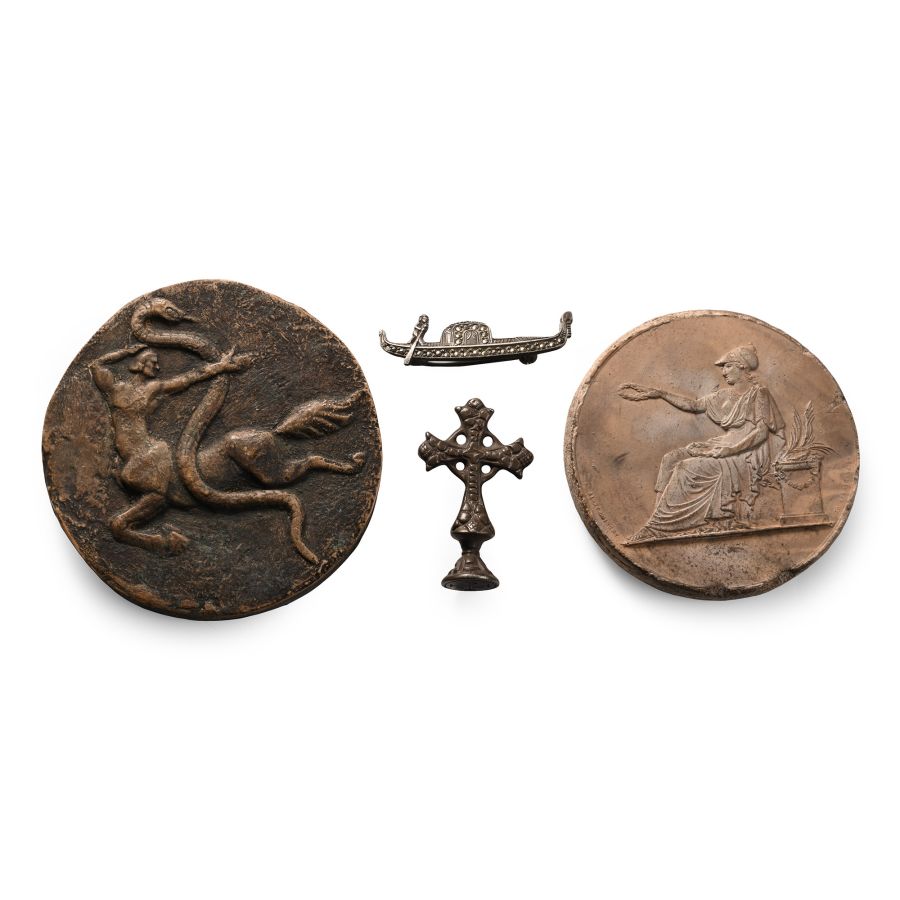
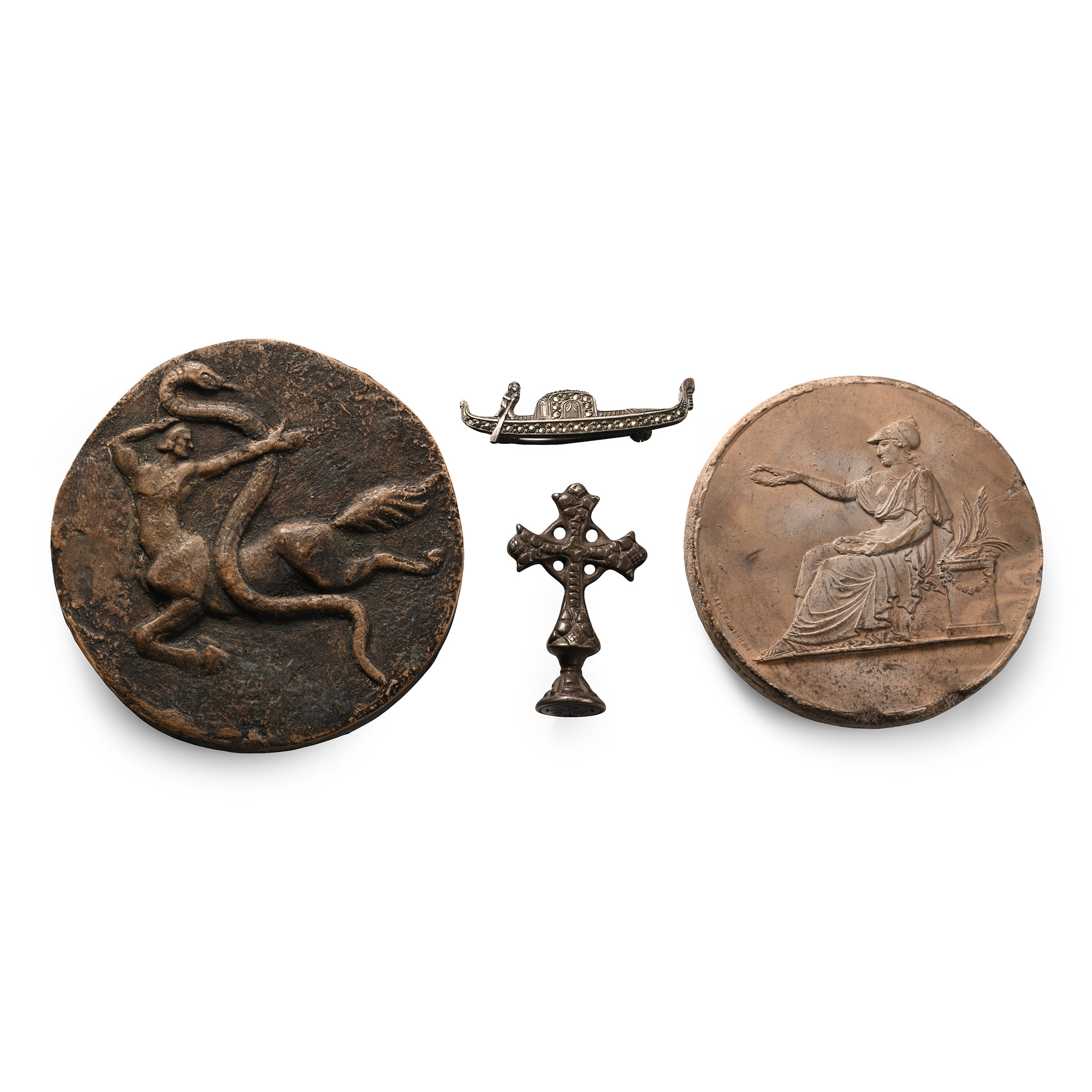
Reproduction Artefact Collection
20TH CENTURY A.D.
1 3/4 - 3 1/8 in. (176 grams total, 46-80 mm).
Comprising: ceramic roundel with low-relief Minerva; similar with centaur and serpent; cruciform stamp-seal with Christogram to underside; brooch in the shape of a gondola. [4, No Reserve]
ProvenanceFrom a private Tyneside collection, formed since the early 2000s.
CONDITIONTimeLine Auctions follows a vetting process to ensure the authenticity and legality of all items, reinforcing our commitment to integrity and responsible trading. Each antiquity, antique, and coin lot undergoes thorough examination by a vetting committee of at least ten external specialists, professional trade association members, scientists, and archaeologists: Our Vetting Process
AUCTIONS:
TimeLine is a leading auction house specialising in antiquities, ancient art, collectables, natural history, coins, medals, and books. Our auctions offer museums, collectors, historians, and enthusiasts the opportunity to acquire unique and historically significant pieces.
-
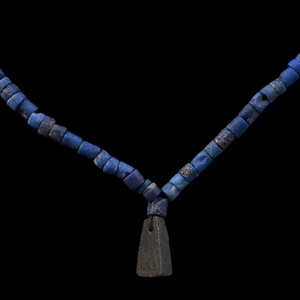
Lapis Lazuli Bead Necklace String
20th century A.D.Sold for (Inc. bp): £46
Restrung group of tubular beads with tabular centrepiece. 10.8 grams, 31 cm
London, UK, collection, 2000s. -
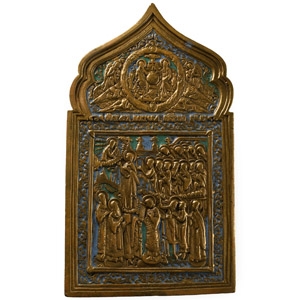
Russian Orthodox Enamelled Bronze Travel Icon with Trinity and the Protection of the Mother of God
19th century A.D.Sold for (Inc. bp): £260
Representing the Protection of the Mother of God; the icon within inside a crested kokoshnik (bochka) with triple border; the crest depicting the Trinity, with God the Father and the Son sitting and facing each other across an orb and crucifix; a dove, symbolising the Holy Spirit, hovering above the crucifix; the Trinity inscribed inside a crown of flying angels, sitting at his feet the four living creatures, the Cherubins symbolising the Evangelists: the Lion, the Angel, the Eagle and the Ox; inscription in Old Slavonic beneath the crest, the Mother of God standing slightly left, looking toward God the Son in the upper corner; clouds at her feet and around the upper left corner; thirteen Saints and four Angels above them standing around her. 281 grams, 17.1 cm
Acquired from Chris Martin-Zakheim, Iconastas, 5 Piccadilly Arcade, London SW1. From the private collection of a West London, UK, gentleman, formed since the early 2000s.
The Icon of the Protection of the Mother of God, or Pokrov (in Old Slavonic), celebrates the Virgin Mary, depicting the Mother of God in prayer, wrapped in her mantle, surrounded by angels and saints. The image is a powerful symbol of protection and a reminder of Marian intercessory prayer, centered on protecting the Christian people from adversity and danger. -
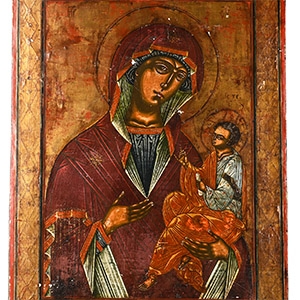
Large Painted Wooden Icon of Mother of God of Tikhvin
Russia, 16th century A.D.Estimate: £5,000 - 7,000 (+bp*)
Opening Bid: £2,500
Oil and tempera, depicting the Virgin Mary and the infant Jesus on a plain gold field; Mary wearing a red maphorion mantle over a blue robe, with golden brocade to the hem, in the style of Hodegetria (She who shows the way); the Virgin pointing at Jesus with her right hand, while looking towards the spectator; the infant facing left, resting on Mary's left arm, dressed in white tunic, wrapped in a red-orange shawl, right hand blessing the mother, left hand extended holding a scroll of the Holy Scriptures, while crossing his legs to reveal the naked sole of one of his feet; very effaced Greek inscriptions in red lettering 'ΜΡ ΘΥ (Μήτηρ (τοῦ) Θεοῦ = Mother of God)' flanking Mary's head; inscription in Greek 'ΙϹ ΧϹ' (ΙΗϹΟΥϹ ΧΡΙϹΤΟϹ = Jesus Christ) above the infant; rectangular wooden board with mounting bars to reverse and old collector's label 'Vierge Hodigitria, type Tikhvin, Icone russe du 16eme siècle, achetée á Constantinople…chez Monsieur Captain…peinture transmise sur nouvelle planche [Virgin Hodigitria, Tikhvin type, Russian icon from the 16th century, purchased in Constantinople...from Monsieur Captain...painting moved on a new board]'; border with pointillé lozenges and other detailing. 4.7 kg, 70.3 x 52.5 cm
Acquired on the UK art market. Private collection, London, UK. Accompanied by an academic report by Dr Raffaele D’Amato. This lot has been checked against the Interpol Database of stolen works of art and is accompanied by search certificate number no. 19929-246334.
According to the legend, this particular icon of the Mother of God appeared in Rus' in 1383 near Veliky Novgorod over Lake Ladoga, and travelled through the air to the Tikhvin River, stopping at several points along the way and performing miracles. On Tikhvin, where the icon came to rest, a stone Dormition Cathedral was built by order of Grand Prince of Moscow Vasil III in 1515, and in 1560, Ivan the Terrible founded the Tikhvin Dormition Monastery near this cathedral. In 1613, the Dormition Monastery withstood the Swedish invasion, and in 1617, the Treaty of Stolbovo was concluded with Sweden. These events were associated with the miraculous intercession of the icon. Until 1936, the icon was kept in the Dormition Cathedral. In 1936, services in the cathedral were discontinued, and the icon was housed in various churches in Tikhvin. In November 1941, Tikhvin was occupied by German troops. The icon was taken abroad and remained in Chicago since the 1950s. In 2004, the icon was again ceremoniously transferred to the Dormition Cathedral of the Tikhvin Monastery.
