
Loading, please wait...
_900x900.jpg "Pseudo-Illyrian Chalcidian Variant Bronze Helmet")
_200x200.jpg "Pseudo-Illyrian Chalcidian Variant Bronze Helmet")
_900x900.jpg "Pseudo-Illyrian Chalcidian Variant Bronze Helmet")
_200x200.jpg "Pseudo-Illyrian Chalcidian Variant Bronze Helmet")
_900x900.jpg "Pseudo-Illyrian Chalcidian Variant Bronze Helmet")
_200x200.jpg "Pseudo-Illyrian Chalcidian Variant Bronze Helmet")
.jpg "Pseudo-Illyrian Chalcidian Variant Bronze Helmet")
.jpg "Pseudo-Illyrian Chalcidian Variant Bronze Helmet")
.jpg "Pseudo-Illyrian Chalcidian Variant Bronze Helmet")
LOT 0249
Pseudo-Illyrian Chalcidian Variant Bronze Helmet
4TH-1ST CENTURY B.C.
19 in. (4.7 kg total, 48 cm high including stand).
Large rounded two-part bowl rivetted beneath the repoussé crest extending across the brow and around the circumference; repoussé arches above the eyes extending to the nasal; lateral D-shaped cheek-pieces with scallop to the forward edge, pierced for a chin-strap; some restoration of the bowl and one cheek-piece; mounted on a custom-made display stand.
ProvenanceAcquired 1971-1972.
From the collection of the vendor's father.
Property of a London, UK, collector.
Accompanied by an academic report by Dr Raffaele D’Amato.
This lot has been checked against the Interpol Database of stolen works of art and is accompanied by search certificate number no.11751-202770.
Cf. Beglova, E.A., Antichnoe nasledie Kubani (Ancient heritage of Kuban) III, Moscow, pp.410-422 (in Russian); Dedjulkin A.V., 'Locally Made Protective Equipment of the Population of North-Western Caucasus in the Hellenistic Period', in Stratum Plus, no. 3, 2014, pp.169-184; Симоненко А.В., 'Шлемы сарматского времени из Восточной Европы' (Sarmatian Age Helmets from Eastern Europe), in Stratum Plus, no.4, 2014, fig.15, no.1.
FootnotesAccording both to Symonenko and Dedjulkin (2014, p.189, fig.9, nn.4-5-6), this category of helmet derives from Chalcidian types (with pseudo-Illyrian elements). As with Chalcidian helmets, our specimen shows vertical decorative lines on the bowl and triangular brow ornament. Distinct from Attic types, it does not have a protruding neck guard introduced on variant III of such helmets (Symonenko, 2014, fig. 15,2-3). According to Dedjulkin, these helmets derive from Greek prototypes, but are simplifications of the original models and made by local artisans. They were widely worn by mercenaries in the Hellenised armies of Pontus and other Hellenistic kingdoms across the Eastern Mediterranean.
CONDITIONTimeLine Auctions follows a vetting process to ensure the authenticity and legality of all items, reinforcing our commitment to integrity and responsible trading. Each antiquity, antique, and coin lot undergoes thorough examination by a vetting committee of at least ten external specialists, professional trade association members, scientists, and archaeologists: Our Vetting Process
AUCTIONS:
TimeLine is a leading auction house specialising in antiquities, ancient art, collectables, natural history, coins, medals, and books. Our auctions offer museums, collectors, historians, and enthusiasts the opportunity to acquire unique and historically significant pieces.
LOT 0249
Pseudo-Illyrian Chalcidian Variant Bronze Helmet
Estimate £5,000 - 7,000€5,800 - 8,120 (for guidance only)$6,750 - 9,450 (for guidance only)
-
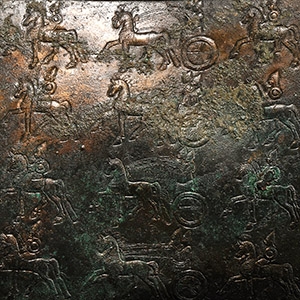
Neo-Assyrian 'Axel Guttmann' Bronze Belt Section Group
9th-7th century B.C.Sold for (Inc. bp): £2,340
Comprising two belt sections, each perforated around the edges for attachment: one with a repoussé display of alternating lions leaping towards warriors on horseback, leaping horned bulls and archers standing in horse-drawn war chariot; one fragment with articulate loop; the other folding over on itself, with repoussé display of helmetted warriors on horseback, alternating with warriors driving horse-drawn chariots; Urartian or Assyrian. 845 grams total, 30.5-35 cm
Ex Axel Guttmann collection, with reference no.AG R 244. Accompanied by an academic report by Dr Raffaele D’Amato. This lot has been checked against the Interpol Database of stolen works of art and is accompanied by search certificate number no.11760-203204. -
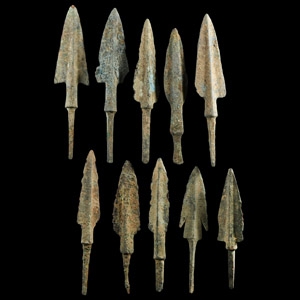
Luristan Bronze Arrowhead
2nd-1st millennium B.C.Estimate: £150 - 200 (+bp*)
Opening Bid: £80
The group comprising various types of tanged arrowheads, including barbed and leaf-shaped examples. 175 grams total, 8.1-10.5 cm
Acquired 1990s. From the collection of a late Japanese weaponry collector. -
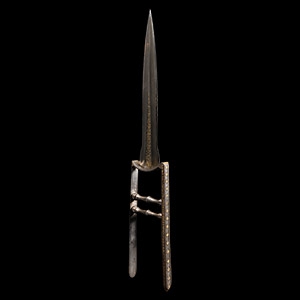
Indian Quatar Iron Dagger
18th-19th century A.D.Estimate: £1,000 - 1,400 (+bp*)
Opening Bid: £500
Comprising a broad blade tapering to an armour-piercing point, the steel side bars and balustered grips decorated with copper Koftgari work flowers and scrolls. 488 grams, 48 cm
General condition very good.
Property of a London gallery.
Unique to South Asia, the quatar or katar was a dagger that held at the crossbars with a clenched fist. The weapon was meant to be thrust into the opponent or prey from a close range. Rajput and Mughal royalty used this weapon to hunt tigers and even crocodiles to demonstrate their bravery and martial skill.
