
Loading, please wait...
LOT 1038
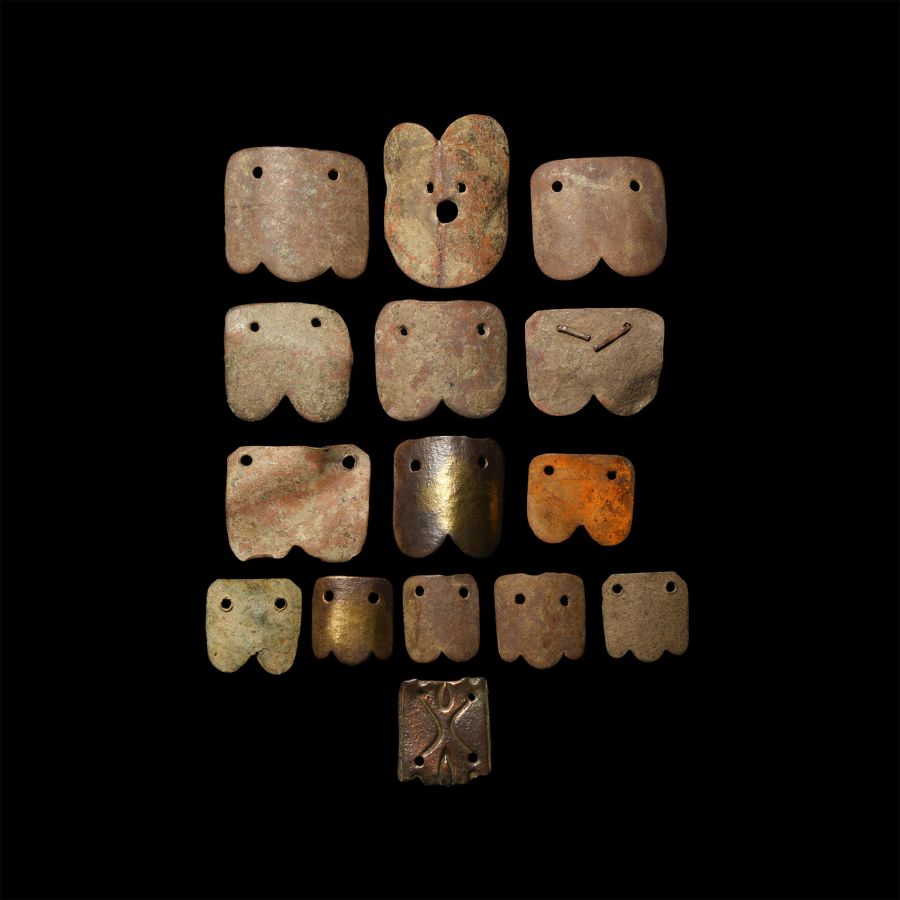
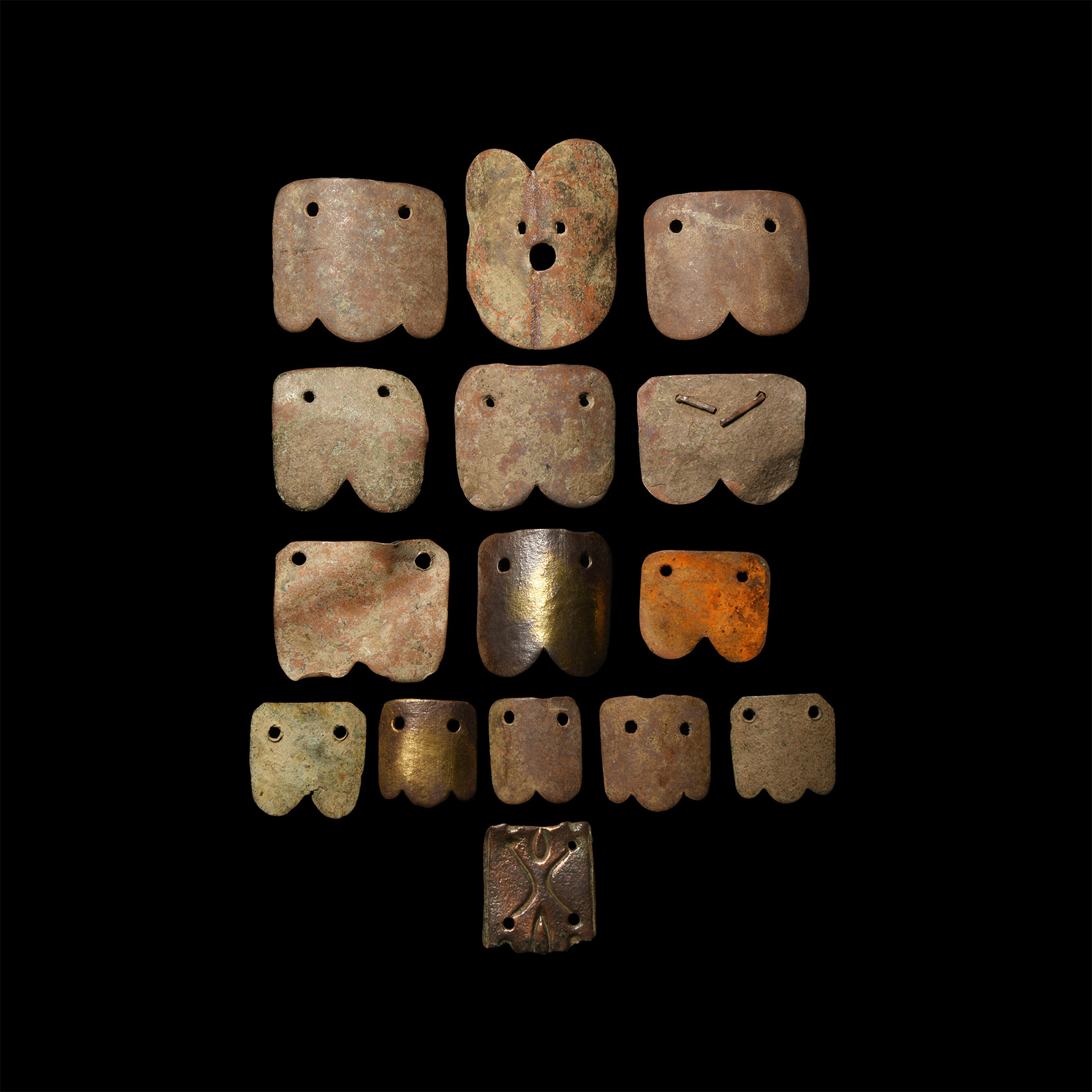
Post Roman Squama Armour
5TH-9TH CENTURY A.D.
3/4 - 1 1/2 in. (55 grams total, 19-38 mm).
Each scale B-shaped, slightly convex sides, two equally spaced circular holes along the straight edge. [5, No Reserve]
ProvenanceThe Kusmirek Collection, UK.
LiteratureCf. D'Amato, R., Salimbeti, A., Post Roman Kingdoms, Dark Ages Gaul and Britain, 450-800, Oxford, 2023, p.37, letters A, D, for similar.
FootnotesThis object is not typical of 'squama' which usually has scales that are rectangular with one rounded end, and numerous attachment holes at the square end in pairs. However, it can be a type widespread in the post Roman age, with various specimens found in Britain (PAS SWYOR-CA6BBB, BM-95F434 and NCL-34BE90.
CONDITIONTimeLine Auctions follows a vetting process to ensure the authenticity and legality of all items, reinforcing our commitment to integrity and responsible trading. Each antiquity, antique, and coin lot undergoes thorough examination by a vetting committee of at least ten external specialists, professional trade association members, scientists, and archaeologists: Our Vetting Process
AUCTIONS:
TimeLine is a leading auction house specialising in antiquities, ancient art, collectables, natural history, coins, medals, and books. Our auctions offer museums, collectors, historians, and enthusiasts the opportunity to acquire unique and historically significant pieces.
-
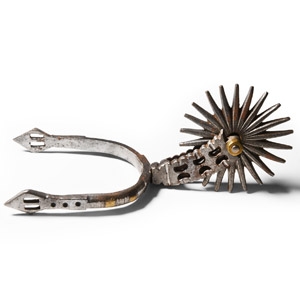
Mexican Iron and Brass Rowel Spur
19th century A.D.Sold for (Inc. bp): £20
With pierced crescent motifs to the shank, free-running star-shaped rowel and geometric engraving to heelband with lozengiform terminals. 349 grams, 22 cm
Acquired from Czerny's Auctions, Italy, 2016, lot 390. The Kusmirek Collection, UK. Accompanied by copy of Czerny's invoice and lot details. -
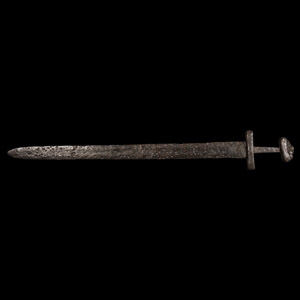
Viking Age Iron Sword with Five-Lobed Pommel
10th-11th century A.D.Sold for (Inc. bp): £4,550
Of Petersen Type S variant with a double-edged blade, shallow fullers and a rounded point; boat-shaped upper and lower guard with some remains of silver inlay, the pommel also showing traces of silver decoration. 1.3 kg, 87.5 cm
The structure of the blade is still homogenous but presents delamination on various part, corrosion damage along the edge and deep corrosion and pitting due to permanence in the water.
Acquired 1971-1972. From the collection of the vendor's father. Property of a London, UK, collector. Accompanied by an academic report by Dr Raffaele D’Amato. This lot has been checked against the Interpol Database of stolen works of art and is accompanied by search certificate number no.11756 - 202774.
Viking swords of Type S are commonly found in Nordic countries and in Eastern Europe, with only a small number found in Western Europe. The type was often characterised by splendid decoration achieved with silver and copper inlays, of which here some traces are still visible. -
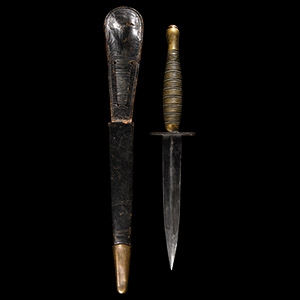
British Fairbairn-Sykes 'Beaded and Ringed' Commando Dagger in Scabbard
Circa 1942 A.D.Sold for (Inc. bp): £715
By Rodgers, with finely shaped 15cm stiletto blade with traces of original black finish tapering to a steel oval guard and fitted with a brass 'beaded and ringed' shaped hilt secured by a copper pommel nut; the hilt bearing the War Department 'broad arrow' and '2' marks near to the guard; with the original leather scabbard fitted with brass rivets and chape, pierced for belt wear and with the side flaps for sewing cut away as commonly seen when belt worn; the dagger showing wear with minor chipping to the blade. 254 grams, 33 cm overall
Property of a Luton, UK gentleman, by inheritance.
In the autumn of 1942, the Rodgers firm produced what many consider to be the best of all the wartime Fairbairn-Sykes knives: the 'Beads and Ridges' model (or 'Beaded and Ringed'); so-called for its distinctive grip pattern to the brass hilt of single rings of tiny beads, interspersed between sections of four to seven plain rings. The blade is delicate and uniform, and the weapon, though light, is well balanced. The blade finish was black (as this example) or nickel. All of this type are considered to be at least scarce. According to both Fredrick Stephens and Leroy Thompson the type was a commercial variant for private purchase; however, there are some rare cases of this type which were officially issued with the War Department broad arrow and number marks, as with this example.
