Loading, please wait...

Post Medieval 'Thames' Lead Cloth Seal Group Post Medieval 'Thames' Lead Cloth Seal Group Post Medieval 'Thames' Lead Cloth Seal Group
Use mousewheel to zoom in and out, click to enlarge
Details

LOT 1938

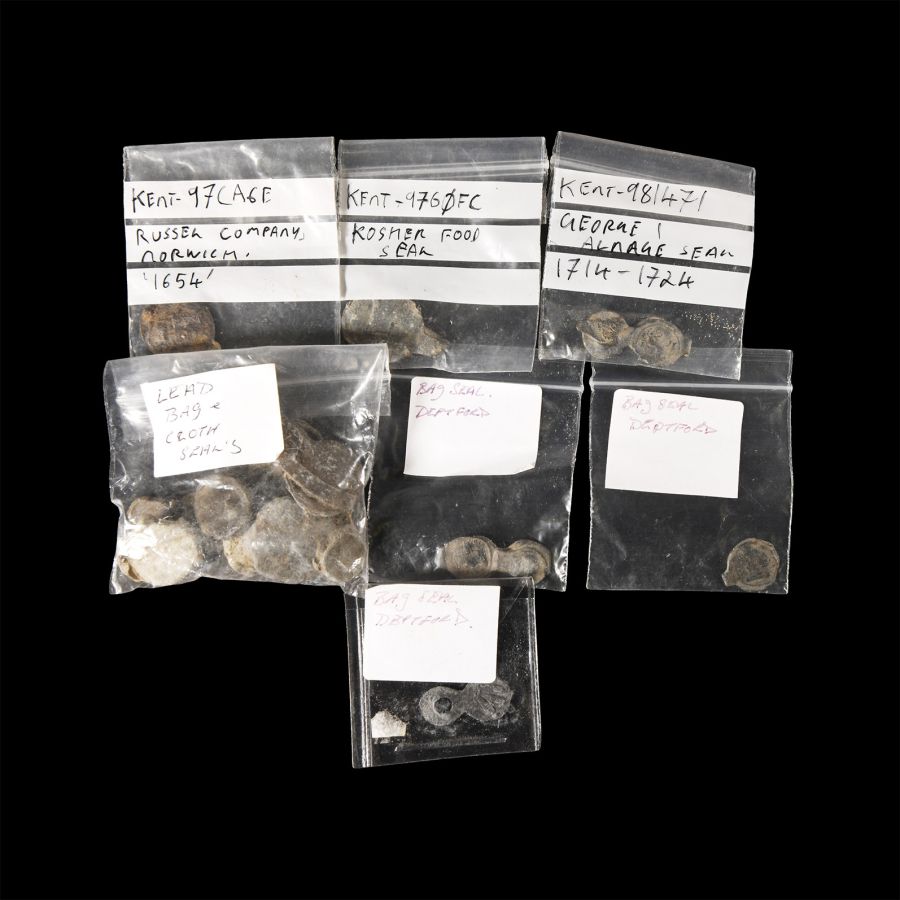
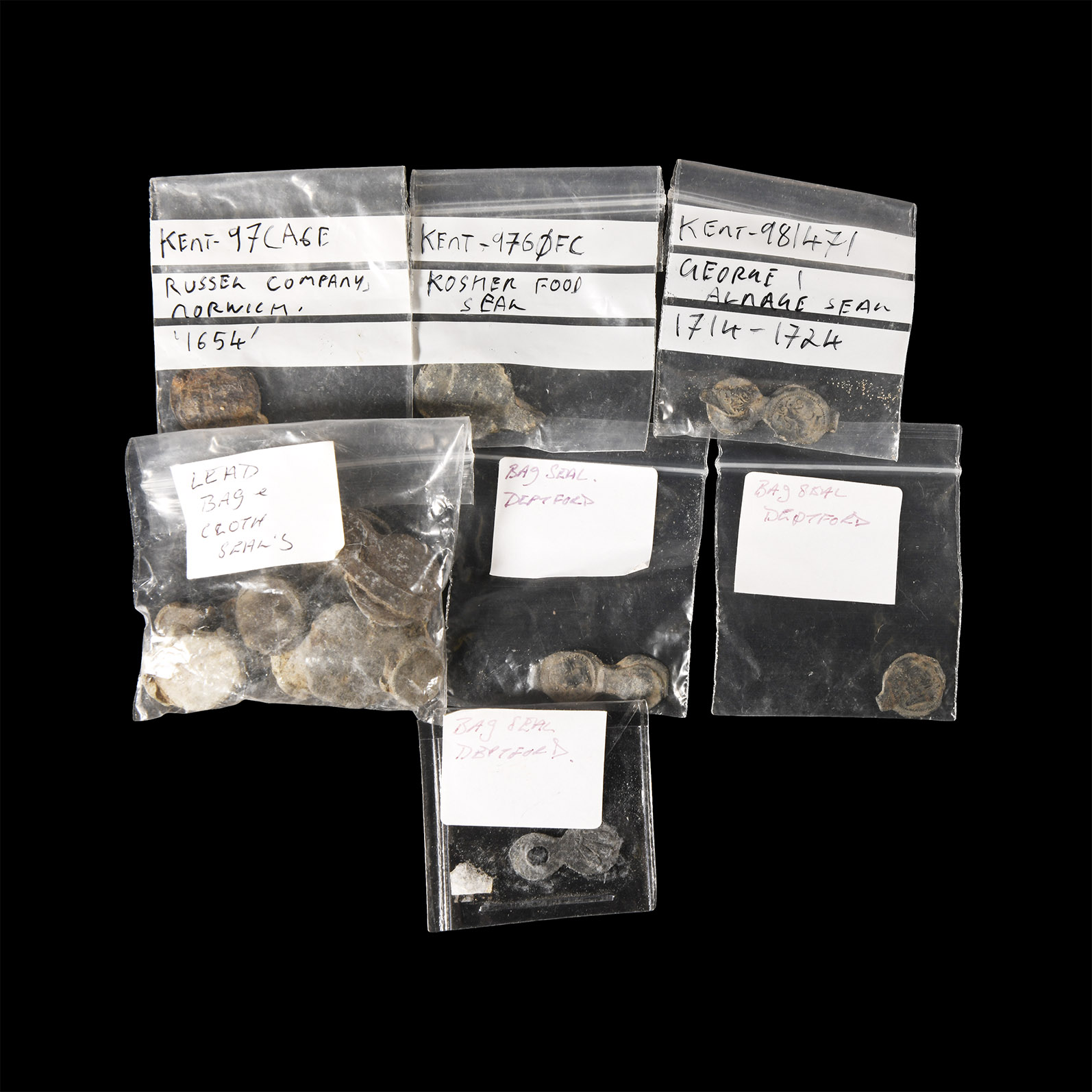
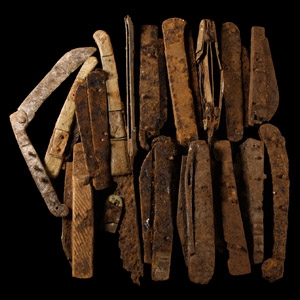
Post Medieval 'Thames' Lead Cloth Seal Group

17TH-19TH CENTURY A.D.

5/8 - 1 1/4 in. (150 grams total, 15-33 mm).

Including bag and cloth seals, a kosher food seal, an alnage seal of King George I and others; some with PAS reference numbers and find spots. [18, No Reserve]

Provenance

Found Thames foreshore spoil, 1980s.

CONDITION
VETTING:

TimeLine Auctions follows a vetting process to ensure the authenticity and legality of all items, reinforcing our commitment to integrity and responsible trading. Each antiquity, antique, and coin lot undergoes thorough examination by a vetting committee of at least ten external specialists, professional trade association members, scientists, and archaeologists: Our Vetting Process


AUCTIONS:

TimeLine is a leading auction house specialising in antiquities, ancient art, collectables, natural history, coins, medals, and books. Our auctions offer museums, collectors, historians, and enthusiasts the opportunity to acquire unique and historically significant pieces.

Live Bidding

LOT 1938

Post Medieval 'Thames' Lead Cloth Seal Group

Sold for (Inc. bp): £20

Print page

RELATED LOTS
  • Post Medieval Bronze Fauno Rosso Satyr
    Post Medieval Bronze 'Fauno Rosso' Satyr
    19th century A.D.

    Sold for (Inc. bp): £1,690

    Standing on a hexagonal base wearing a goatskin mantle tied by the forelegs around his shoulders, with poppy seed-heads and bunches of grapes by the left arm; in his raised right hand, a bunch of grapes and in his left hand a cudgel; stump of a tree by his right leg and barrel beside his left, with a lamb to the rear placing its foreleg on top; modelled after the so-called Fauno Rosso from Hadrian's Villa, now in the Capitoline Museum. 18.5 kg, 67 cm high


    From an important Paris gallery, France.

    Half-man, half-beast, satyrs were believed to be the children of goats and mountain nymphs. Followers of the god Dionysus, they had a reputation for drunkenness and spent their days participating in orgiastic rituals. They represented the crude and boisterous facets of the stereotypical male persona, particularly of rural man.

    Lot Details

  • Post Medieval Thames Glass Poison Bottle Group
    Post Medieval 'Thames' Glass Poison Bottle Group
    16th-17th century A.D.

    Sold for (Inc. bp): £156

    Comprising two glass bottles: one with a rounded cuboid-shaped body, slender neck, everted rim and remains of iridescent surfaces; one cylindrical bottle with short neck and broad everted rim. 58 grams total, 41-58 mm


    Found Thames foreshore spoil, 1980s.

    Lot Details

  • Post Medieval Gold Thy Faith Favls Not Decorated Posy Ring
    Post Medieval Gold 'Thy Faith Favls Not' Decorated Posy Ring
    17th-18th century A.D.

    Sold for (Inc. bp): £780

    Displaying a circumferential band of six-armed stars to the exterior with some remains of enamelling to the fields; the interior inscribed 'THY + FAITH + FAVLS + NOT' (possibly: thy faith fails/false not). 1.20 grams, 16.93 mm overall, 14.95 mm internal diameter (approximate size British I, USA 4 1/4, Europe 7.44, Japan 7)


    Acquired on the UK antiques market between 1974-1985. Albert Ward collection, Essex, UK.

    In the medieval period many rings bore posy inscriptions in Latin or French, the languages frequently spoken by the affluent elites. Later, inscriptions in English became more usual, although the lack of standardisation in spelling might surprise the modern reader. The inscription is generally found on the interior of the ring, hidden to everyone except the wearer and most of the sentimental mottoes were taken from the popular literature of the time. In fact, love inscriptions often repeat each other, which suggests that goldsmiths used stock phrases. In the later 16th century, ‘posy’ specifically meant a short inscription. A posy is described in contemporary literature as a short ‘epigram’ of less than one verse. George Puttenham (1589) explained that these phrases were not only inscribed on finger rings, but also applied to arms and trenchers. The practice of giving rings engraved with mottoes at betrothals or weddings was common in England from the 16th century onwards, and continued until the late 18th century. Sources suggest that rings could be acquired ready- engraved, or alternatively engraved sometime after their initial production, by a hand other than the goldsmith’s. Joan Evans assumed that posy rings were principally used by/between lovers and distinguished four contexts for the giving of posy rings by one lover to another: betrothals, weddings, St Valentine’s Day and occasions of mourning. Samuel Pepys’ diary makes clear that posy rings might also mark the marriage of a family member, when bearers could even commission their own rings and chose their own mottoes from books. The rings could also function as tokens of friendship or loyalty.

    Lot Details

Stay up-to-date with the latest from TimeLine Auctions by joining our mailing list