
Loading, please wait...

LOT 2002
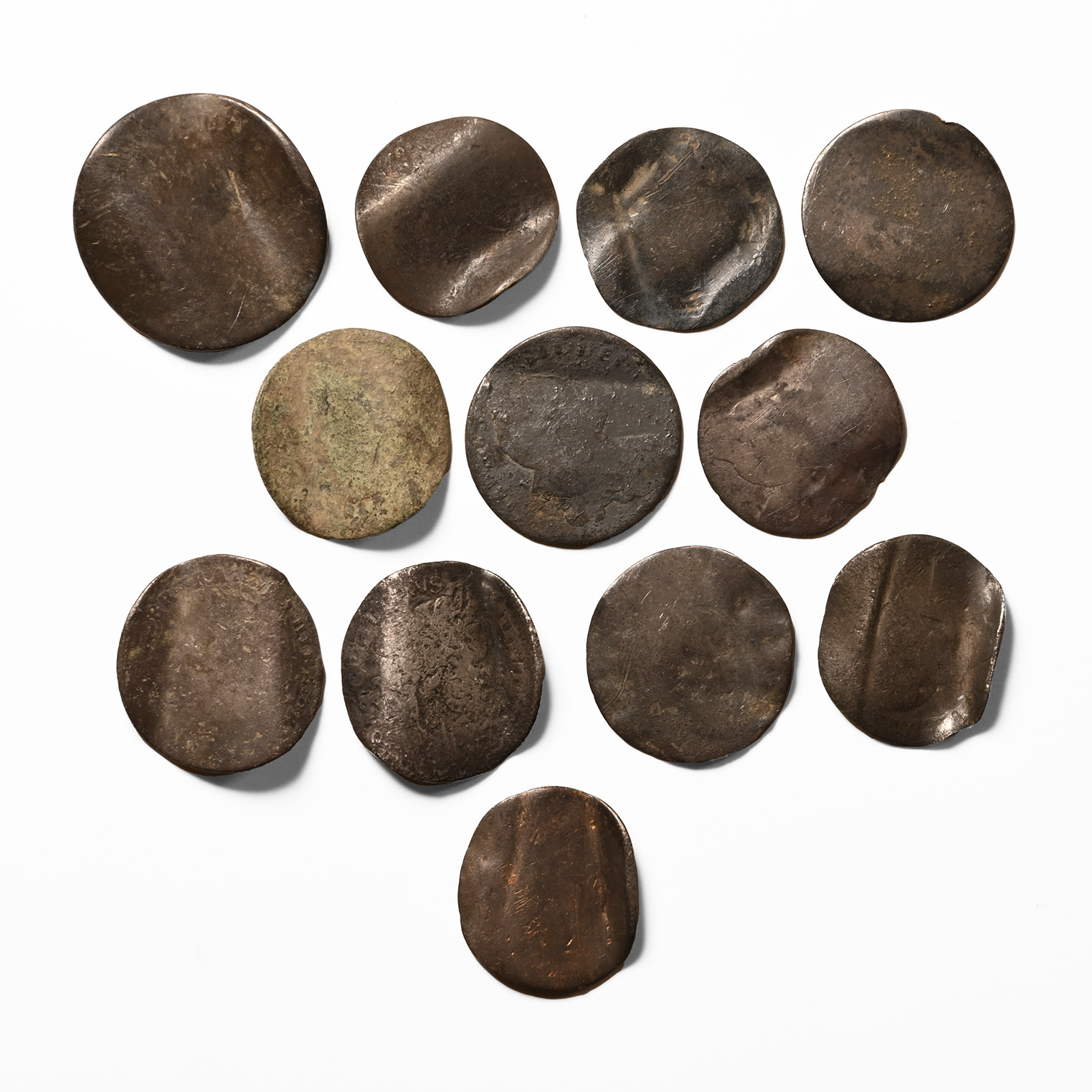
Post Medieval Silver and Bronze Love Token Collection
CIRCA 18TH CENTURY A.D.
(27.65 grams total, 19-25mm.).
Mixed group comprising of mostly silver issue coins, each worn flat and coin bent into a double-curved 's' profile for use as a token of love. [12, No Reserve]
ProvenanceFound on various UK sites since 1974.
Property of an Essex collector.
The custom of giving a bent coin as a love-token is known from the 17th century in England. The coins were usually smoothed to obliterate the monarch’s head and then bent twice; sometimes they were engraved with initials or symbols such as hearts or knots. If the sweetheart accepted the youth's advances, she kept the token; if not, she disposed of the coin. The tradition is referred to in the children's rhyme 'There was a crooked man, and he walked a crooked mile, he found a crooked sixpence on a crooked stile.'
CONDITIONTimeLine Auctions follows a vetting process to ensure the authenticity and legality of all items, reinforcing our commitment to integrity and responsible trading. Each antiquity, antique, and coin lot undergoes thorough examination by a vetting committee of at least ten external specialists, professional trade association members, scientists, and archaeologists: Our Vetting Process
AUCTIONS:
TimeLine is a leading auction house specialising in antiquities, ancient art, collectables, natural history, coins, medals, and books. Our auctions offer museums, collectors, historians, and enthusiasts the opportunity to acquire unique and historically significant pieces.
-
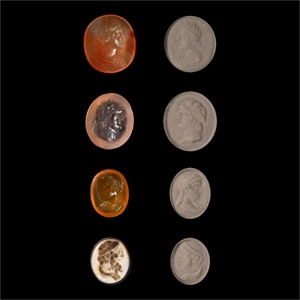
Gemstone Collection
19th-20th century A.D.Sold for (Inc. bp): £176
Comprising: profile male and female busts in carnelian and other stones; each supplied with a museum-quality impression. 4.66 grams total, 14-18 mm
Private collection, England. -
.jpg)
Blue Glass Bead Necklace String
20th century A.D. or earlierSold for (Inc. bp): £13
Restrung; composed of translucent blue glass beads interspersed with umber-coloured spacer beads. 8.01 grams, 76 cm long
UK gallery, early 2000s. -
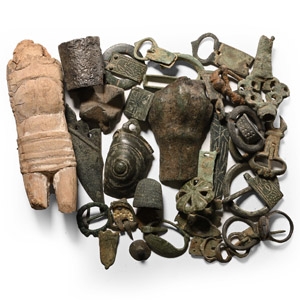
Medieval and Later Bronze Artefact Collection
16th-20th century A.D.Sold for (Inc. bp): £13
Including a ceramic figurine, strap end, belt buckle, key handle, sheath chape and other items. 560 grams total, 1.3-12.3 cm
Found various site in the UK. Ex N. Mills.
