Loading, please wait...

Post Medieval Siena Majolica Armorial Floor Tile from Piccolomini Library Post Medieval Siena Majolica Armorial Floor Tile from Piccolomini Library Post Medieval Siena Majolica Armorial Floor Tile from Piccolomini Library
Use mousewheel to zoom in and out, click to enlarge
Details

LOT 0423

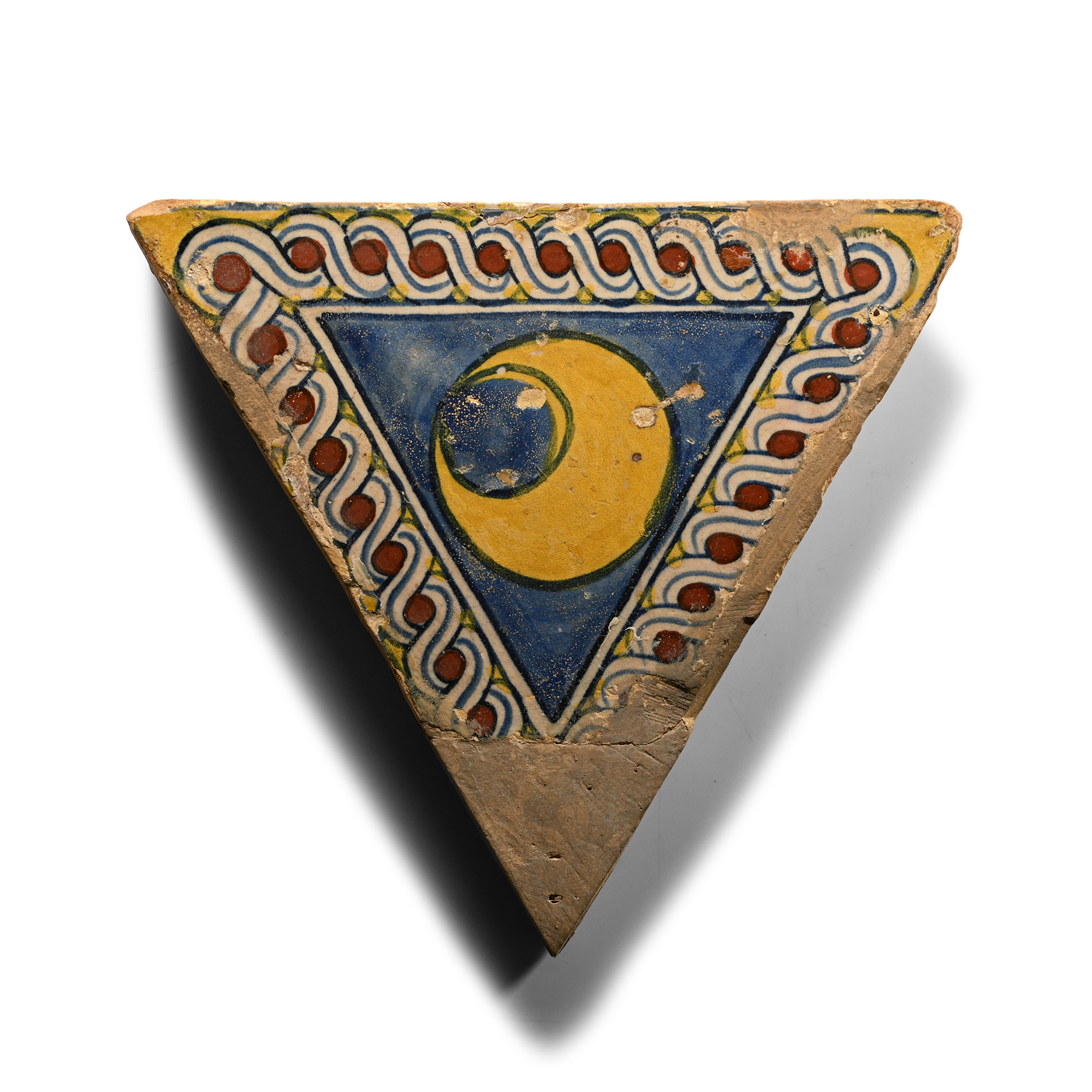
Post Medieval Siena Majolica Armorial Floor Tile from Piccolomini Library

TUSCANY, SIENA, CIRCA 1502 A.D.

5 7/8 in. (340 grams, 15 cm).

A triangular majolica armorial floor tile from the Piccolomini Library, Siena; showing a crescent moon on blue background, scrollwork border. [No Reserve]

Provenance

with Christie's South Kensington, 1 October 2013, no.351 [Part].
Ex central London gallery.

Footnotes

The Piccolomini Library adjoins the Siena Cathedral, a medieval Roman Catholic Marian church consecrated in 1215. It houses illuminated choir books and frescoes painted probably based on designs by Raphael, that tell the life story of Pope Pius II, Siena's favourite son.

CONDITION
VETTING:

TimeLine Auctions follows a vetting process to ensure the authenticity and legality of all items, reinforcing our commitment to integrity and responsible trading. Each antiquity, antique, and coin lot undergoes thorough examination by a vetting committee of at least ten external specialists, professional trade association members, scientists, and archaeologists: Our Vetting Process


AUCTIONS:

TimeLine is a leading auction house specialising in antiquities, ancient art, collectables, natural history, coins, medals, and books. Our auctions offer museums, collectors, historians, and enthusiasts the opportunity to acquire unique and historically significant pieces.

LOT 0423

Post Medieval Siena Majolica Armorial Floor Tile from Piccolomini Library

Sold for (Inc. bp): £2,600

Print page

RELATED LOTS
  • Post Medieval Iron Kidney Dagger with Replacement Handle and Sheath
    Post Medieval Iron Kidney Dagger with Replacement Handle and Sheath
    15th century A.D. and later

    Sold for (Inc. bp): £72

    The tapering blade with a single cutting edge; replica leather scabbard decorated with 'fleur de lys' and wooden handle with bulbous guard and pommel. 229 grams, 36.5 cm long


    From the collection of the famous author, writer and speaker, Gordon Bailey, Essex, UK; formed since 1968.

    The term 'ballock dagger' was used in medieval times to describe a dagger with a grip bearing a considerable resemblance to a phallic symbol. It was also called 'kidney dagger' during the Victorian times. The constant characteristic is the presence of two roundish and symmetrical bulbs at the guard, with the grip itself emerging upward between them and flaring slightly towards the top, sometimes being surmounted by a cap.

    Lot Details

  • Marble Head of a Roman Noblewoman
    Marble Head of a Roman Noblewoman
    Italy, 19th century A.D.

    Sold for (Inc. bp): £5,720

    Female bust modelled in the round with hair centre-parted and dressed in ringlets gathered at the nape of the neck and extending to the shoulders; mounted on a socle base. 22.1 kg, 46 cm


    Private collection, England. This lot has been checked against the Interpol Database of stolen works of art and is accompanied by a search certificate number no.12303-215648.

    This portrait is directly inspired by a Roman model (fig. 1) discovered in 1880, now housed at the Museo Nazionale Romano in Rome and believed to depict Minatia Polla. The young woman depicted showcases the refined features characteristic of Roman feminine nobility, with a rounded oval face, large hemmed eyes, a long nose, and a well-defined, slightly open mouth. Her low forehead is adorned with a sophisticated hairstyle: long, soft locks separated by a middle parting that end in curls, with a few delicate strands falling over her shoulders. She wears a dress with subtle pleats and a round neckline. Upon comparing our portrait with the Roman original of Minatia Polla, it becomes evident that this piece is an exact neoclassical copy of the ancient portrait. The only notable difference is the more pronounced fullness under the chin in our version, which is less evident in the antique model. From the 18th century and throughout the neoclassical era, significant archaeological discoveries sparked immense interest and enthusiasm (as evidenced by Winckelmann), compelling contemporary sculptors to engage with ancient works to showcase their talents. The portrait presented here, given the delicacy of the features and the overall quality of the sculpture, is unmistakably the work of a master sculptor.

    Lot Details

  • Jadeite Pendant Necklace with Rubies and Other Cabochons
    Jadeite Pendant Necklace with 'Rubies' and Other Cabochons
    Late 19th-early 20th century A.D.

    Sold for (Inc. bp): £111

    Plaque with floral design comprising inset glass cabochons, synthetic rubies and gold-coloured wire frond detailing. 65 grams, pendant height: 78 mm


    Property of a South West London gentleman.

    Lot Details

Stay up-to-date with the latest from TimeLine Auctions by joining our mailing list