
Loading, please wait...
LOT 1040
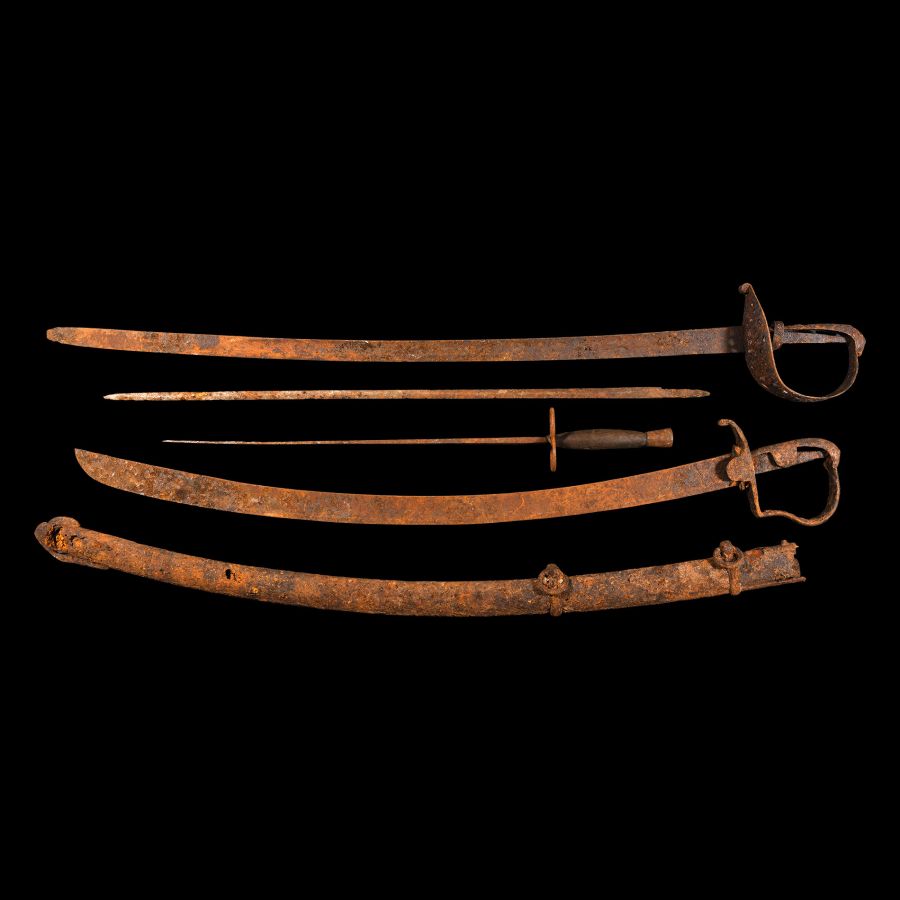
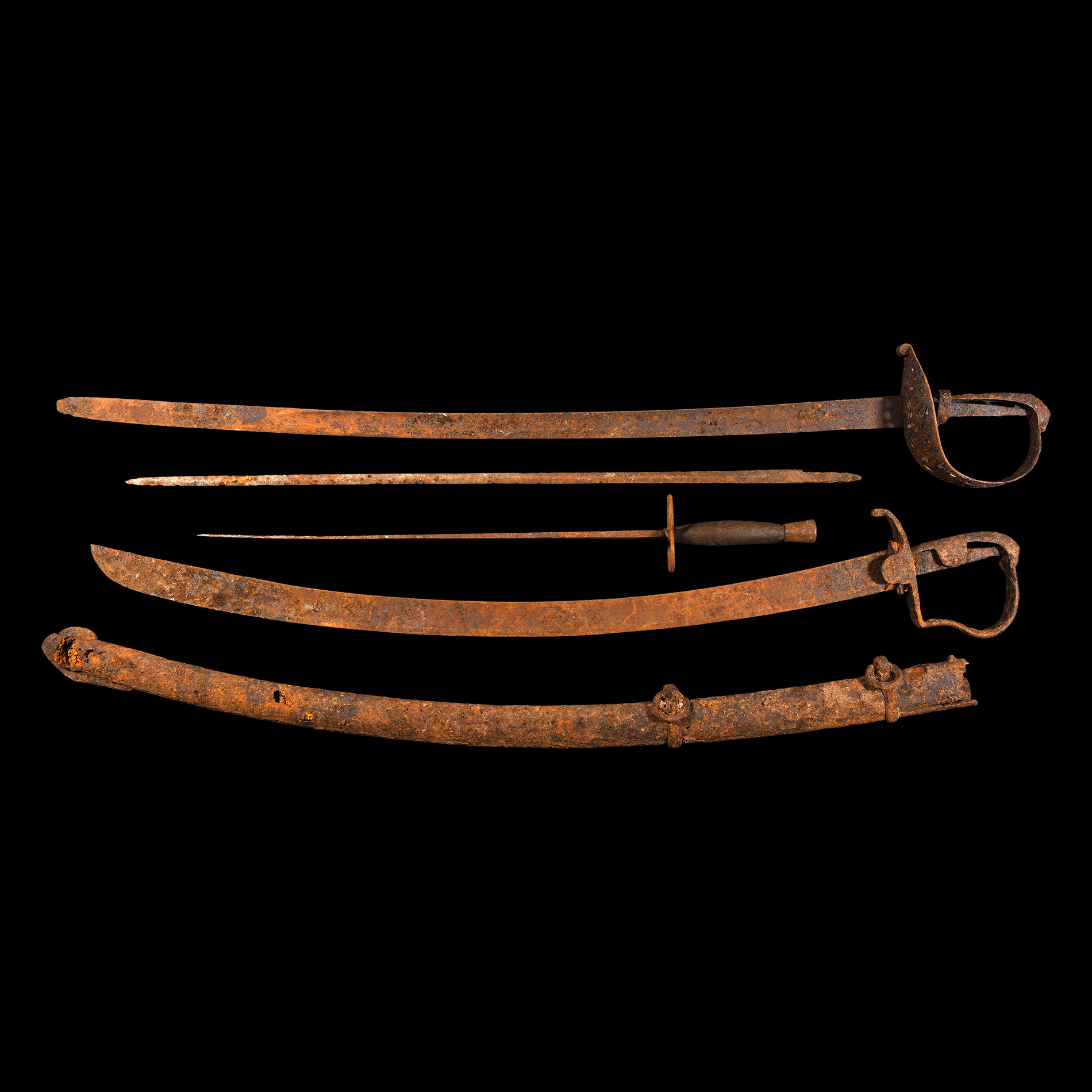
Post Medieval Iron Sword Group
18TH-19TH CENTURY A.D.
24 1/2 - 39 in. (3.45 kg total, 62-100 cm).
Comprising military and civilian weapons: short rapier; basket hilted sword; sabre seemingly with scabbard; rapier blade. [5, No Reserve]
ProvenanceAcquired 1990s-early 2000s.
East Anglian private collection.
Cf. similar swords in Farkas, T., ‘Lovassági szablyák a XVIII-XIX. Században (Cavalry sabers in the XVIII-XIX century,'in Hungarian)’ in Magyar Huszar es Katonai Hagyomanyorzo Szovetseg 2017, pp.1-10, figs.pp.7-9.
FootnotesThe two sabres, with the particular hilt and steel scabbard, seems to have affinities with Hungarian sabres of about 1837-1838, destined to staff and senior officers of the Austro-Hungarian Kingdom Hussars. At the end of the 1830s, the Austrian military leaders introduced a new type of sabre for the Hussar officers, while the 1837 infantry officer sabre was standardised.
CONDITIONTimeLine Auctions follows a vetting process to ensure the authenticity and legality of all items, reinforcing our commitment to integrity and responsible trading. Each antiquity, antique, and coin lot undergoes thorough examination by a vetting committee of at least ten external specialists, professional trade association members, scientists, and archaeologists: Our Vetting Process
AUCTIONS:
TimeLine is a leading auction house specialising in antiquities, ancient art, collectables, natural history, coins, medals, and books. Our auctions offer museums, collectors, historians, and enthusiasts the opportunity to acquire unique and historically significant pieces.
-
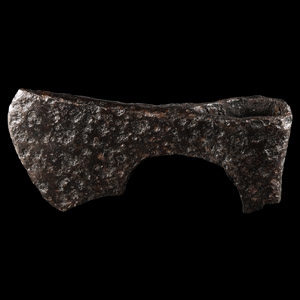
Viking Age Iron Bearded Axehead
9th-13th century A.D.Sold for (Inc. bp): £208
Finno-Ugrian with triangular-section blade widening to a broad bevelled edge with spur to the underside, socket with extended lower sleeve. 779 grams, 17.5 cm
Acquired 1971-1972. From the collection of the vendor's father. Property of a London, UK, collector.
During their struggles against Germans and Teutonic Knights, deceased pagans were often cremated along with damaged or ceremonially sacrificed weaponry. If swords were generally reserved for the military elite, the side axe was one of the most commonly used weapons. -
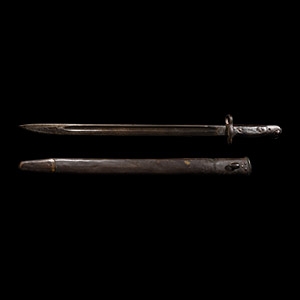
Siamese 'Wild Tigers Corps' Type 62 Pattern 1907 Bayonet and Scabbard
Dated 1919 A.D.Sold for (Inc. bp): £78
Stamped 2642 in Thai numerals at top of blade with 'tiger mask' mark for Siam, together with original British marks, fitted with wood grip scales and spring release button; the scabbard with original throat and chape, modified in Thailand to replace the original leather main section. 726 grams, 58.5 cm
Property of a Luton, UK gentleman, by inheritance.
The Type 62 is a re-badged British Pattern 1907 bayonet. Siam purchased 10,000 SMLE rifles and Pattern 1907 bayonets from Britain in 1919 to equip the 'Wild Tiger Corps', royal bodyguard of Vajiravudh, King Rama VI (reigned 1910–1925). The tiger figural on the ricasso is representative of the Wild Tiger Corps. Year 2462 on the Buddhist Calendar corresponds to 1919. SMLE rifles and Pattern 1907 bayonets were taken from British stocks, refurbished by Birmingham Small Arms (BSA), and remarked with Siamese markings. The bayonets were shipped with standard steel-mounted leather scabbards. However, the leather rapidly deteriorated in the tropical climate, so the Siamese made a replacement steel scabbard body to which the original steel mounts were brazed. -
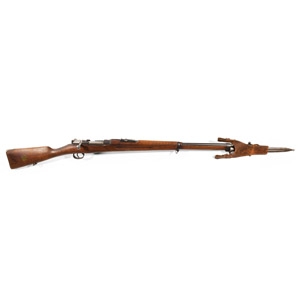
Deactivated M96 Mauser Rifle and Bayonet
Dated 1917 A.D.Sold for (Inc. bp): £374
Swedish made bolt action model M96 with matching serial No.890, full wood stock with steel butt plate, trigger guard, sling swivels and fore-end, hinged backsight with slide; fitted with correct bayonet dated 1916 with steel scabbard and leather frog. 4.05 kg, 148 cm
Acquired from Arundel Militaria Ltd, UK, 2016. The Kusmirek Collection, UK. Accompanied by copies of invoice and listing and original Birmingham Gun Barrel Proof House Deactivation Certificate No.96730.
Sold as an exempt item under Section 58 (2) of the Firearms Act, 1968, to be held as a curiosity or ornament. No license required but buyer must be over 18 years of age. Overseas bidders should note that, due to UK regulations governing export of all firearms, overseas buyers will need to make arrangements for shipping this lot out of the UK directly, by air freight, with a specialist company or agent.
