
Loading, please wait...
LOT 1091
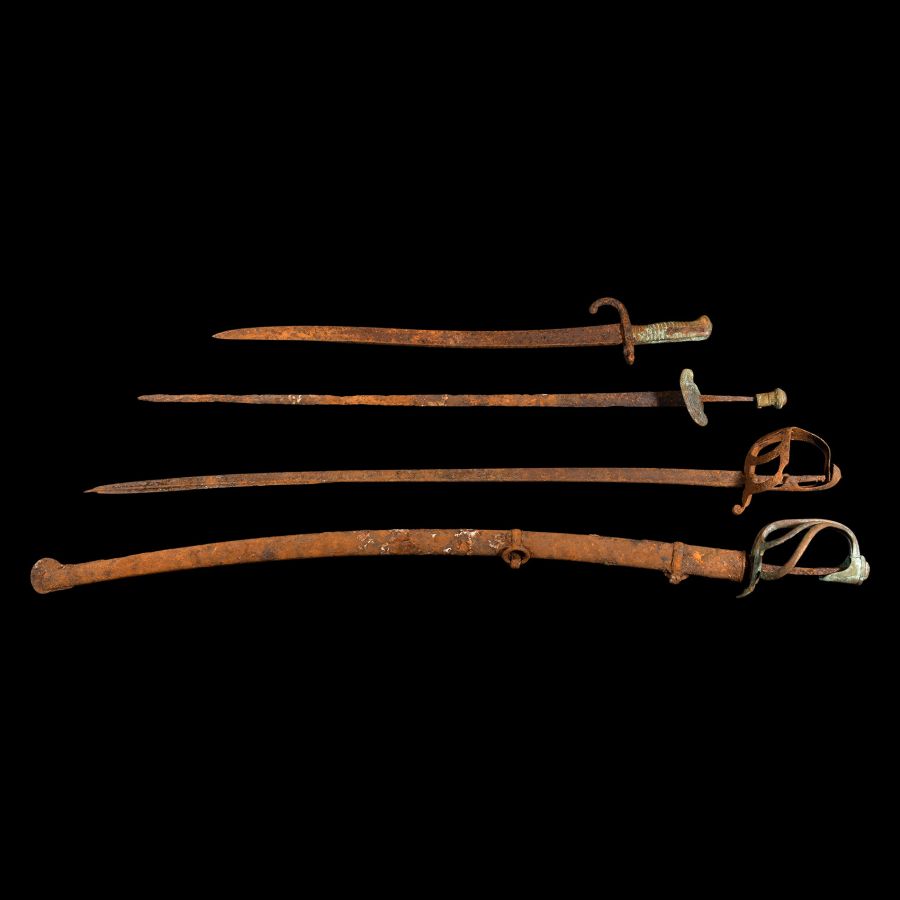
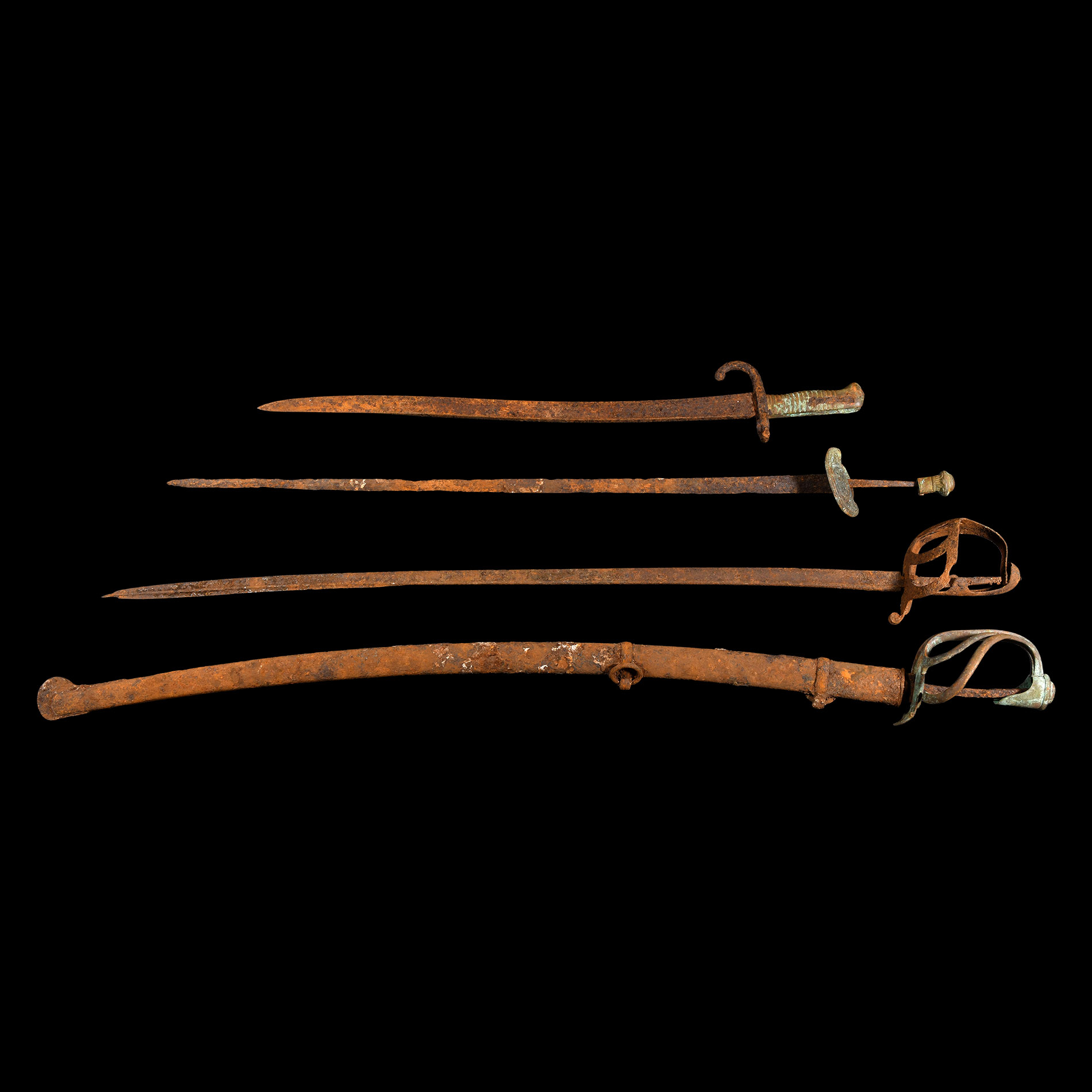
Post Medieval Iron Sword Group
18TH-19TH CENTURY A.D.
35 - 43 1/4 in (3.5 kg total, 89-110 cm).
Comprising mostly military weapons: a bayonet; sabre; two swords. [4, No Reserve]
ProvenanceAcquired 1990s-early 2000s.
East Anglian private collection.
One of the swords shows analogies with post-1846 Wilkinson types, regulation steel hilt and steel scabbard with two loose rings. The Wilkinson style officers' blade was a compromise cut and thrust sabre blade with a fuller (groove), found on huge numbers of antique British military officers' swords. It replaced the pipeback blade previously used on officers' swords.
CONDITIONTimeLine Auctions follows a vetting process to ensure the authenticity and legality of all items, reinforcing our commitment to integrity and responsible trading. Each antiquity, antique, and coin lot undergoes thorough examination by a vetting committee of at least ten external specialists, professional trade association members, scientists, and archaeologists: Our Vetting Process
AUCTIONS:
TimeLine is a leading auction house specialising in antiquities, ancient art, collectables, natural history, coins, medals, and books. Our auctions offer museums, collectors, historians, and enthusiasts the opportunity to acquire unique and historically significant pieces.
-
.jpg)
Roman Bronze Military Mask Helmet Section
3rd century A.D.Sold for (Inc. bp): £975
From the upper part of the right side of the face mask, the upper edge with a band of embossed curved lines, probably representing stylised hairs, intertwined with laurel crown; embossed image of advancing Mars, the god of war, to the centre, depicted nude with military sagum, a pseudo-Corinthian helmet to the head and carrying a circular shield. 55 grams, 17 cm wide
Acquired 1960s-1990s. Late Alison Barker collection, a retired London barrister.
In the decorative patterns of Roman helmets, Mars was among the most revered deities in the Imperial army. After Jupiter, he was the most aristocratic god of the old Italic religion, master of armament, who governed military service (militiae potens) and oversaw the training ground, for which he was named Campester. The emperor Augustus named him Ultor (‘Avenger’) and dedicated to him a luxurious temple in the centre of the forum in gratitude for his victory over the murderers of Caesar and, in addition, granted to him the privileges of the Capitoline Jupiter. -
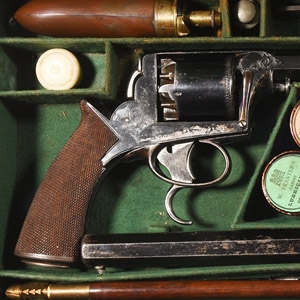
Cased 1st Model Tranter 36 Bore Revolver Pair
1853-1854 A.D.Sold for (Inc. bp): £6,500
With 19.5cm (8¾") octagonal rifled barrels of 36 bore (marked to front of frame), solid Adams patent frames with foliate engraving marked 'ADAMS PATENT ' and serial numbers 20,368Y and 20,832Y with plain loading lever pins to left side, Tranter double trigger (providing single and double action), London proof marks to 5-shot cylinders and barrels, blued finish; in wood case with two hook latches and lock (no key) with accessories including loading lever (stamped 'TRANTERS PATENT 36), wood cleaning rod with extractor screw and two brass cleaning tips), wood handled turnscrew and nipple key, pewter oil bottle, steel wad cutter (marked CAST STEEL), brass-handled double bullet mould (stamped 'TRANTERS PATENT 36); Dixon powder flask, tin of Eley's Superior caps, tin of Tranter's Lubricating Composition, turned bone container with four spare nipples and three pre-made bullets with felt wads. 5.10 kg total, case 43 x 24 cm
Acquired Brighton dealer, 2020. Property of a Kent collector. This lot has been checked against the Interpol Database of stolen works of art and is accompanied by search certificate no.204131.
The Tranter revolvers based on the Adams solid frame were numbered from 20,000 and have the Y suffix. Sold as an exempt item under Section 58 (2) of the Firearms Act, 1968, to be held as a curiosity or ornament. No license required but buyer must be over 18 years of age. Overseas bidders should note that, due to UK regulations governing export of all firearms, overseas buyers will need to make arrangements for shipping this lot out of the UK directly, by air freight, with a specialist company or agent. -
.jpg)
Post Medieval Iron Socketted Spearhead
18th-19th century A.D.Sold for (Inc. bp): £33
Composed of a tapering tubular socket and short triangular blade. 158 grams, 28.5 cm
Fair condition.
Acquired on the UK art market before 1980. Private British collection 1980. Private collection of a Devonshire, UK, collector.
