
Loading, please wait...
_900x900.jpg "Post Medieval Iron Socketted Spearhead")
_200x200.jpg "Post Medieval Iron Socketted Spearhead")
.jpg "Post Medieval Iron Socketted Spearhead")
LOT 1128
Post Medieval Iron Socketted Spearhead
18TH-19TH CENTURY A.D.
11 1/4 in. (158 grams, 28.5 cm).
Composed of a tapering tubular socket and short triangular blade. [No Reserve]
ProvenanceAcquired on the UK art market before 1980.
Private British collection 1980.
Private collection of a Devonshire, UK, collector.
TimeLine Auctions follows a vetting process to ensure the authenticity and legality of all items, reinforcing our commitment to integrity and responsible trading. Each antiquity, antique, and coin lot undergoes thorough examination by a vetting committee of at least ten external specialists, professional trade association members, scientists, and archaeologists: Our Vetting Process
AUCTIONS:
TimeLine is a leading auction house specialising in antiquities, ancient art, collectables, natural history, coins, medals, and books. Our auctions offer museums, collectors, historians, and enthusiasts the opportunity to acquire unique and historically significant pieces.
-
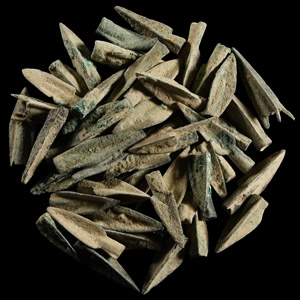
Greek Bronze Arrowhead Group
5th-3rd century B.C.Sold for (Inc. bp): £111
Primarily composed of socketted types with triangular cross-sections. 198 grams total, 26-43 mm
Ex private collection, 1980s. Acquired on the UK art market in the 1990s. -
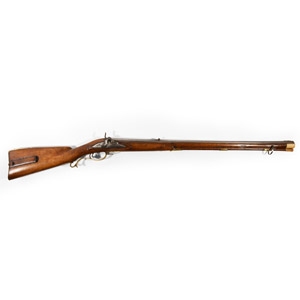
German Jager Set Trigger Percussion Rifle
1730-1830 A.D.Sold for (Inc. bp): £780
Converted from a flintlock of about 3/4" bore with lock modified having 77cm (30¾") rifled barrel swamped to muzzle with set and hair triggers, with full wood stock and shaped butt with patch compartment and sliding top and fitted with brass butt plate, trigger guard, ferrules and engraved side plates and a bone fore-end; the wood ramrod with bone tip; fitted with hinged sling loops; action working well to half cock, full cock and set. 3.70 kg, 116 cm
Acquired from M J Noble, UK, 2015. The Kusmirek Collection, UK. Accompanied by copy of an invoice and information.
Sold as an exempt item under Section 58 (2) of the Firearms Act, 1968, to be held as a curiosity or ornament. No license required but buyer must be over 18 years of age. Overseas bidders should note that, due to UK regulations governing export of all firearms, overseas buyers will need to make arrangements for shipping this lot out of the UK directly, by air freight, with a specialist company or agent. -
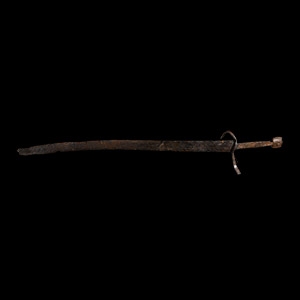
Medieval Iron Schiavonesca Type Sword with Latten Inlaid Crosses
Circa 15th century A.D.Estimate: £800 - 1,000 (+bp*)
Opening Bid: £300
Comprising a broad double-edged parallel-sided blade, flat-section at the upper third with a very shallow central fuller, elliptical-section at the lower end; flat guard with scooped lower edge, D-section arms horizontally S-curved; 'cat's head' type pommel, rectangular with scrolled upper edge and integral central boss to both faces; on the upper part of the blade an engraved three-armed workshop mark and two possibly later added brass inlaid marks including a cross fourchee inside and the image of a sword to one side; mounted on a wall display mount. 1.7 kg total, 1.11 m
In general good condition, point missing, blade structure with little delamination along the upper part, corrosion damages along the edges and on the surface, some material loss on the original surface.
Private collection, Munich, Germany, 1970s. Private collection, London, UK, 2014, acquired from the above.
The Schiavonesca sword was used by Dalmatian mercenaries serving in the Venetian state armies, and produced by the workshops of the Serenissima to which the marks probably belong. Many of these swords were produced in Dubrovnik, a Croatian city under the Venetian rule. Oakeshott classified all the pommels of square shape in his Type Z. Certain morphological differences between them were individuated by Dr Aleksić as a criteria for distinguishing the distinct subtypes, in this case the type Z3 for the upper crenelleted edge. The cross-guards of type 12b, like in this case, have symmetrically and horizontally sharply bent arms in the opposite directions. The 'cat's head' pommel is also found on surviving examples of cross-hilted swords of the 14th century which can be traced into the hands of Slavonic soldiers stationed in southern Europe, employed in the European armies of this period. The independent representation of the cross fourchee usually inscribed in a circle is rather frequent on the swords with type 12 cross guards and type Z pommel from Hungary, Northern Balkans and the neighbouring regions (Aleksić, 2007, p.122).
