
Loading, please wait...
LOT 1056
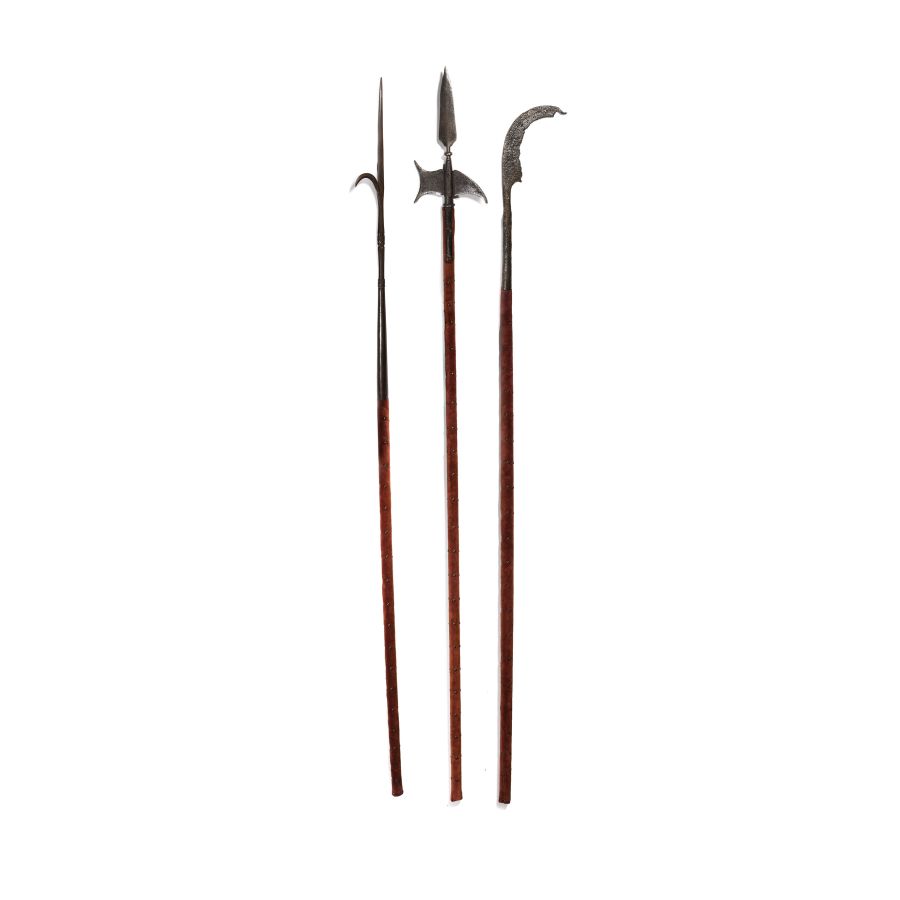
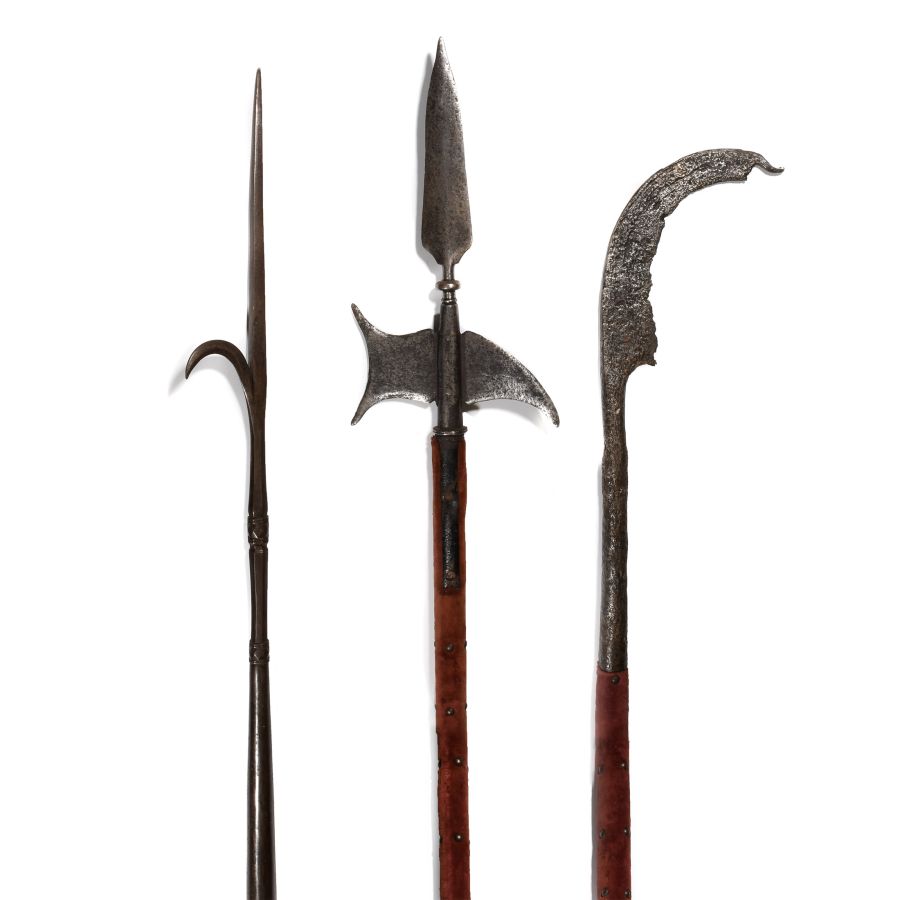
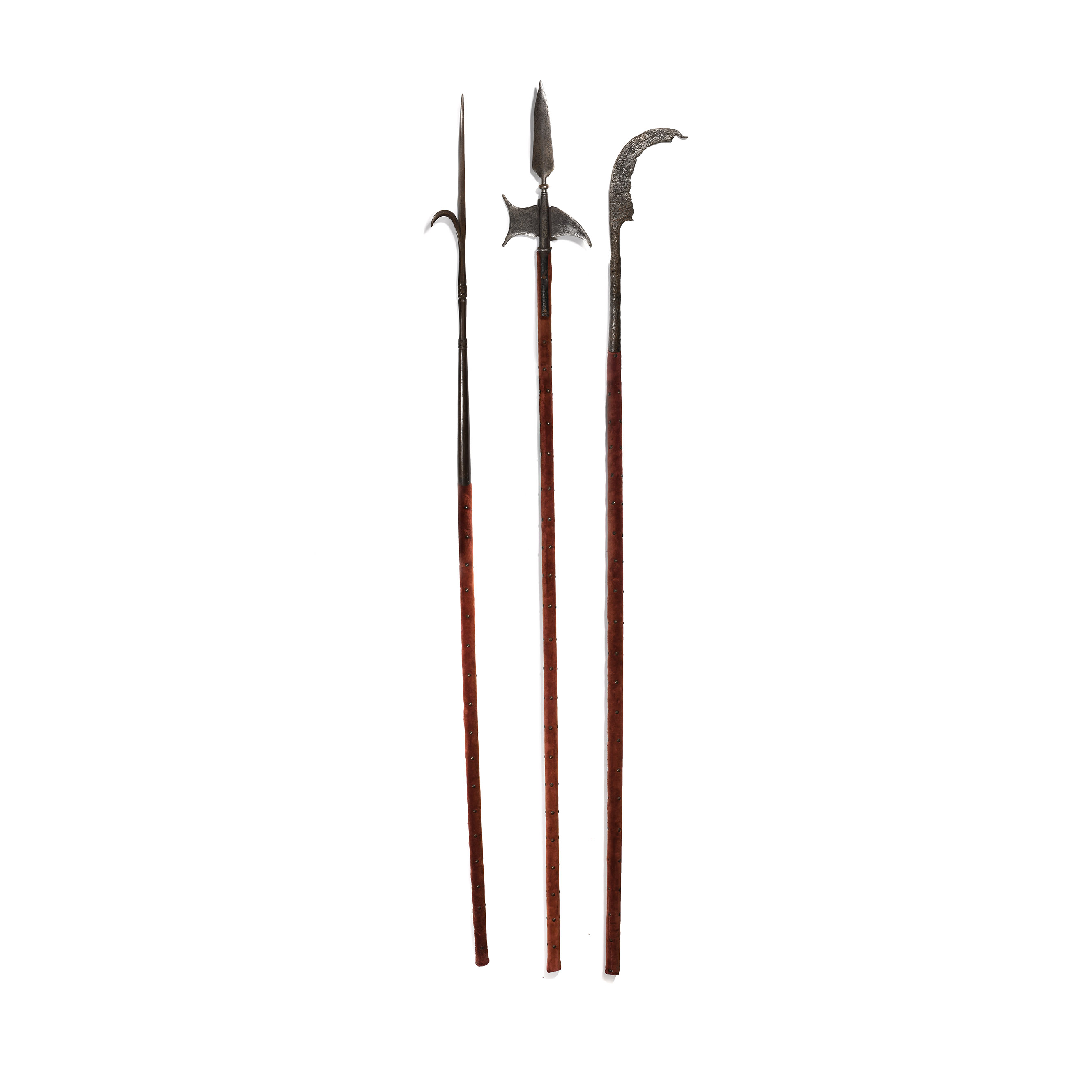
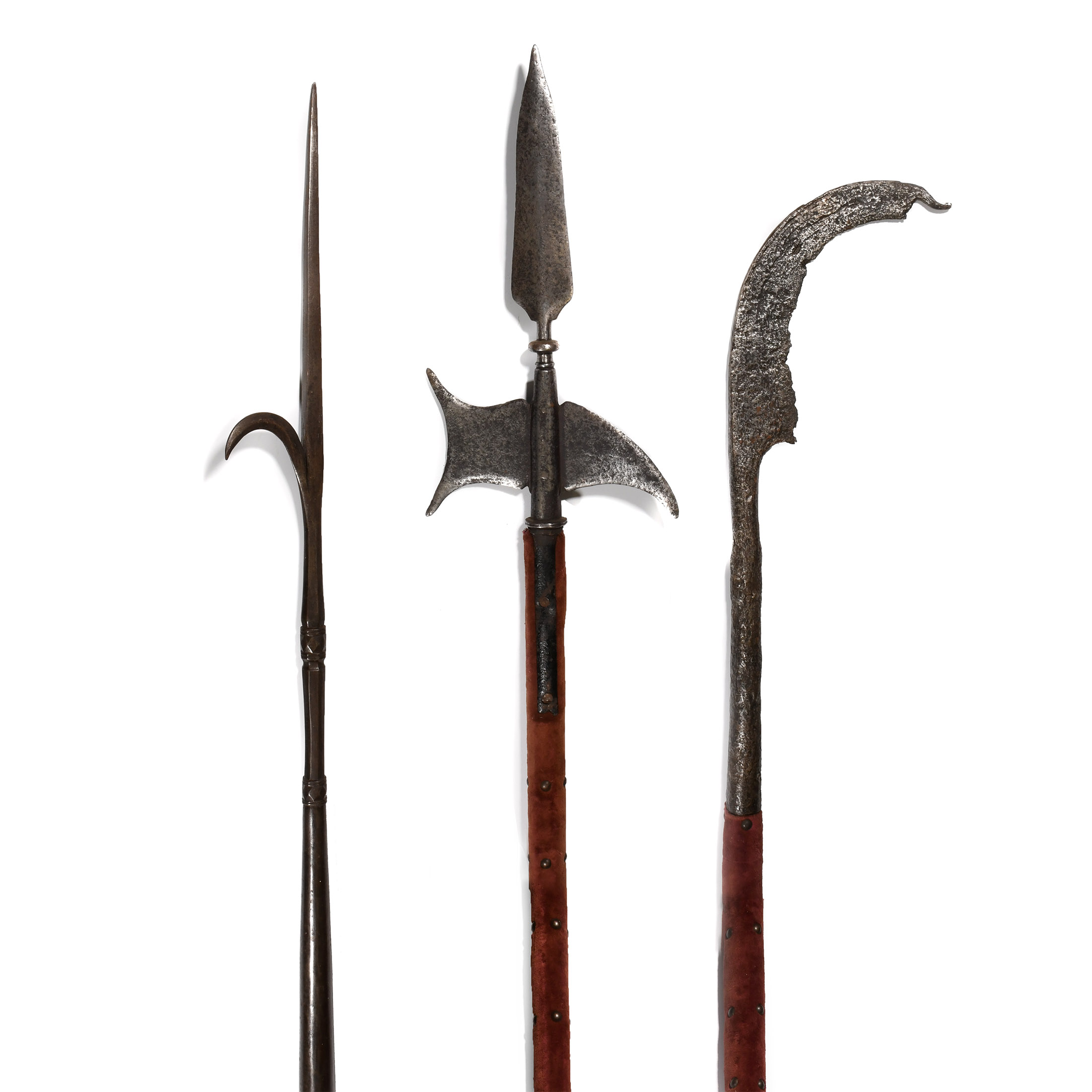
Post Medieval Iron Pike Collection
16TH-18TH CENTURY A.D.
89 - 92 1/8 in. (6.3 kg total, 2.26-2.34 m).
Comprising three weapons: a 'ronca contadina' (peasant scythed staff weapon, known as forest bill) made of trunco-conical tubular gorbia with tapering iron shaft, inclined to the right with respect to the axis of the weapon, ending in a bill; an alabarda-sergentina, iron blade halberd with central rib, two axe-heads, one convex one concave; an alghiero, guisarme with tapering pointed iron shaft of rectangular section, furnished with a side-bill; all three mounted upon wooden velvet-covered shafts. [3]
ProvenanceEx Christie's, Holland, circa 2010.
East Anglian private collection.
Cf. Mauro, M., Armeria della Rocca, mostra di armi antiche, Ancona, 1989, no.124; Pinti, P., Armi e Arte, un viaggio per musei, chiese e castelli alla ricerca di armi antiche, alla ricerca di cose belle (Weapons and Art, a journey through museums, churches and castles in search of ancient weapons, in search of beautiful things, in Italian,) Ascoli Piceno, 1997, p.96; Troso, M., Le Armi in Asta delle Fanterie Europee 1000-1500 (Pole Weapons of European Infantry 1000-1500, in Italian), Novara, 1988, p.58, fig.2.
FootnotesCertainly the most interesting of the three weapons is the peasant roncone. The hooked part of the weapon could be used to hook or cut things, but also for severing a horse's hocks causing both horse and rider to fall.
CONDITIONTimeLine Auctions follows a vetting process to ensure the authenticity and legality of all items, reinforcing our commitment to integrity and responsible trading. Each antiquity, antique, and coin lot undergoes thorough examination by a vetting committee of at least ten external specialists, professional trade association members, scientists, and archaeologists: Our Vetting Process
AUCTIONS:
TimeLine is a leading auction house specialising in antiquities, ancient art, collectables, natural history, coins, medals, and books. Our auctions offer museums, collectors, historians, and enthusiasts the opportunity to acquire unique and historically significant pieces.
-
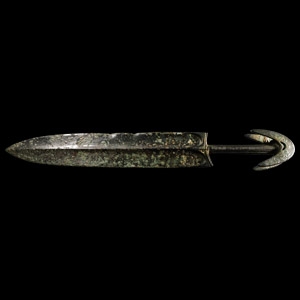
Amarlu Type Bronze Short Sword
Late 2nd millennium B.C.Sold for (Inc. bp): £1,755
Composed of a massive triangular blade with a slightly raised mid-rib flanked by three parallel rows on each side, the guard formed with a pronounced trident shape, ornamented with small geometric square recesses, the hilt with square-section grip incised with four vertical rows of similar square recesses, double broad crescentic open pommel surmounted by a broad raised median rib which links the double crescentic halves; repaired. 911 grams, 53 cm
One horn cracked and repaired
Acquired 1970s-1980s. From the collection of a Surrey, UK, gentleman.
Moorey, analysing similar swords found in Amarlu, stated that the blade and tang were made first, forged to shape by hammering at a high temperature. The next step was to cover the tang with a clayed material. Once dry, this material formed the core for the casting. Then a hollow mould of the exact shape of the shoulder, grooved hilt and pommel was made around the clay core covering the tang. Finally, liquid metal was poured into the mould. The weapon was then finished by hammering the pommel and shoulder to the hilt. -
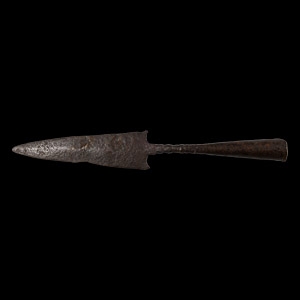
Ummayad Bronze Spearhead
7th-8th century A.D.Estimate: £300 - 400 (+bp*)
Opening Bid: £133
Formed with a broadly triangular blade, narrow neck and tapering round-section socket. 245 grams, 34 cm
Ex old English collection. The Kusmirek Collection, UK.
The basic Arabic term for a spear or lance, whether used by cavalry or infantry, was rumh. In the 7th century it normally would have been ten or twelve cubits long, i.e. four and a half metres. -
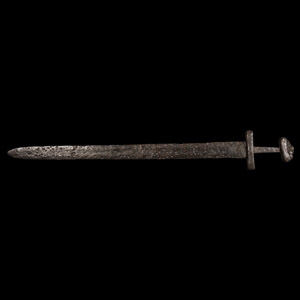
Viking Age Iron Sword with Five-Lobed Pommel
10th-11th century A.D.Sold for (Inc. bp): £4,550
Of Petersen Type S variant with a double-edged blade, shallow fullers and a rounded point; boat-shaped upper and lower guard with some remains of silver inlay, the pommel also showing traces of silver decoration. 1.3 kg, 87.5 cm
The structure of the blade is still homogenous but presents delamination on various part, corrosion damage along the edge and deep corrosion and pitting due to permanence in the water.
Acquired 1971-1972. From the collection of the vendor's father. Property of a London, UK, collector. Accompanied by an academic report by Dr Raffaele D’Amato. This lot has been checked against the Interpol Database of stolen works of art and is accompanied by search certificate number no.11756 - 202774.
Viking swords of Type S are commonly found in Nordic countries and in Eastern Europe, with only a small number found in Western Europe. The type was often characterised by splendid decoration achieved with silver and copper inlays, of which here some traces are still visible.
