
Loading, please wait...
_900x900.jpg "Post Medieval Glazed Ceramic Tile Group")
_200x200.jpg "Post Medieval Glazed Ceramic Tile Group")
.jpg "Post Medieval Glazed Ceramic Tile Group")
LOT 1965
Post Medieval Glazed Ceramic Tile Group
17TH-18TH CENTURY A.D.
4 x 3 1/2 - 4 1/8 x 3 3/4 in. (1.3 kg total, 10 x 9 - 10.5 x 9.5 cm).
Comprising two designs in relief including three horses in an enclosure and two animals, likely cats, fighting; coloured glazes. [8, No Reserve]
ProvenanceAcquired 1990s-early 2000s.
East Anglian private collection.
Cf. similar example in style, with double border, in the British Museum, inventory no.OA.7394.
FootnotesThe tile production increases in the second half of the sixteenth century and during the following centuries. The fragments discovered from various localities (pot-tiles, rectangular, triangular and trapezoidal panels, open-work crest tiles) were all produced in regional workshops, from the end of the 15th century or at the beginning of the 16th century. They all had diverse decorative motifs, mainly animals and geometrical or vegetal combinations, almost all of them singular finds for this study area.
CONDITIONTimeLine Auctions follows a vetting process to ensure the authenticity and legality of all items, reinforcing our commitment to integrity and responsible trading. Each antiquity, antique, and coin lot undergoes thorough examination by a vetting committee of at least ten external specialists, professional trade association members, scientists, and archaeologists: Our Vetting Process
AUCTIONS:
TimeLine is a leading auction house specialising in antiquities, ancient art, collectables, natural history, coins, medals, and books. Our auctions offer museums, collectors, historians, and enthusiasts the opportunity to acquire unique and historically significant pieces.
-
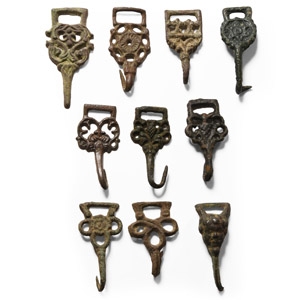
Tudor 'Published' Bronze Clothes Fastener Collection
16th century A.D.Sold for (Inc. bp): £52
Group of hooked tags of various forms including rosette and openwork types; many of these objects are published in the Detector Finds book series and Buttons & Fasteners 500 BC-AD 1840. 25.3 grams total, 30-40 mm
From the collection of the famous author, writer and speaker, Gordon Bailey, Essex, UK; formed since 1968. -
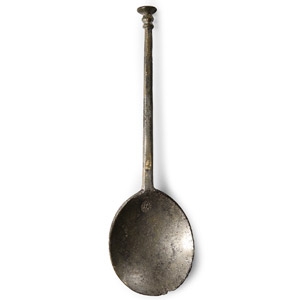
Tudor Tinned Bronze Spoon with Spoons Maker's Mark
16th century A.D.Sold for (Inc. bp): £78
With flat oval cross-section stem, tapering very slightly from the bowl and ending in a simple ball seal knop; a maker's mark within a circular border has been stamped within the bowl, adjacent to the stem. 37 grams, 16.2 cm
From the collection of the famous author, writer and speaker, Gordon Bailey, Essex, UK; formed since 1968.
Spoons with this type of knop date from the 16th century A.D. The knop, when bearing an owner's initial, could be used as a seal. The bronze spoons of the Tudor era were inexpensive and not mentioned in wills, but if silvered or in silver they were often listed among their owner’s property. -
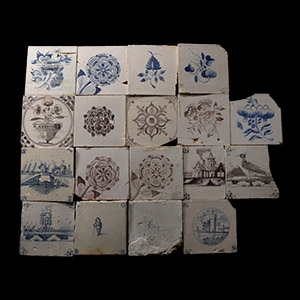
Post Medieval Dutch Glazed Ceramic Tile Group
Circa 17th-18th century A.D.Sold for (Inc. bp): £52
Comprising a variety of glaze colours, with designs featuring animals, figural vignettes floral and vegetal motifs and architectural and landscape scenes. 4.1 kg total, 13 x 13 cm each
Acquired 1990s-early 2000s. East Anglian private collection.
