
Loading, please wait...
LOT 1113
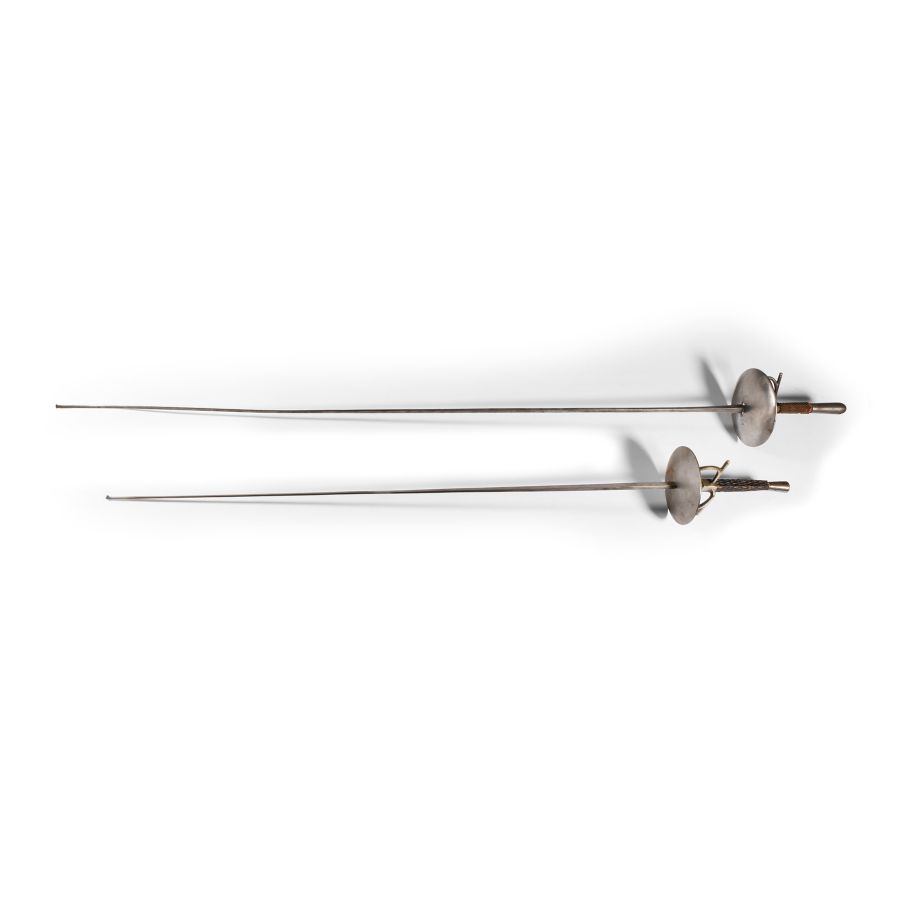
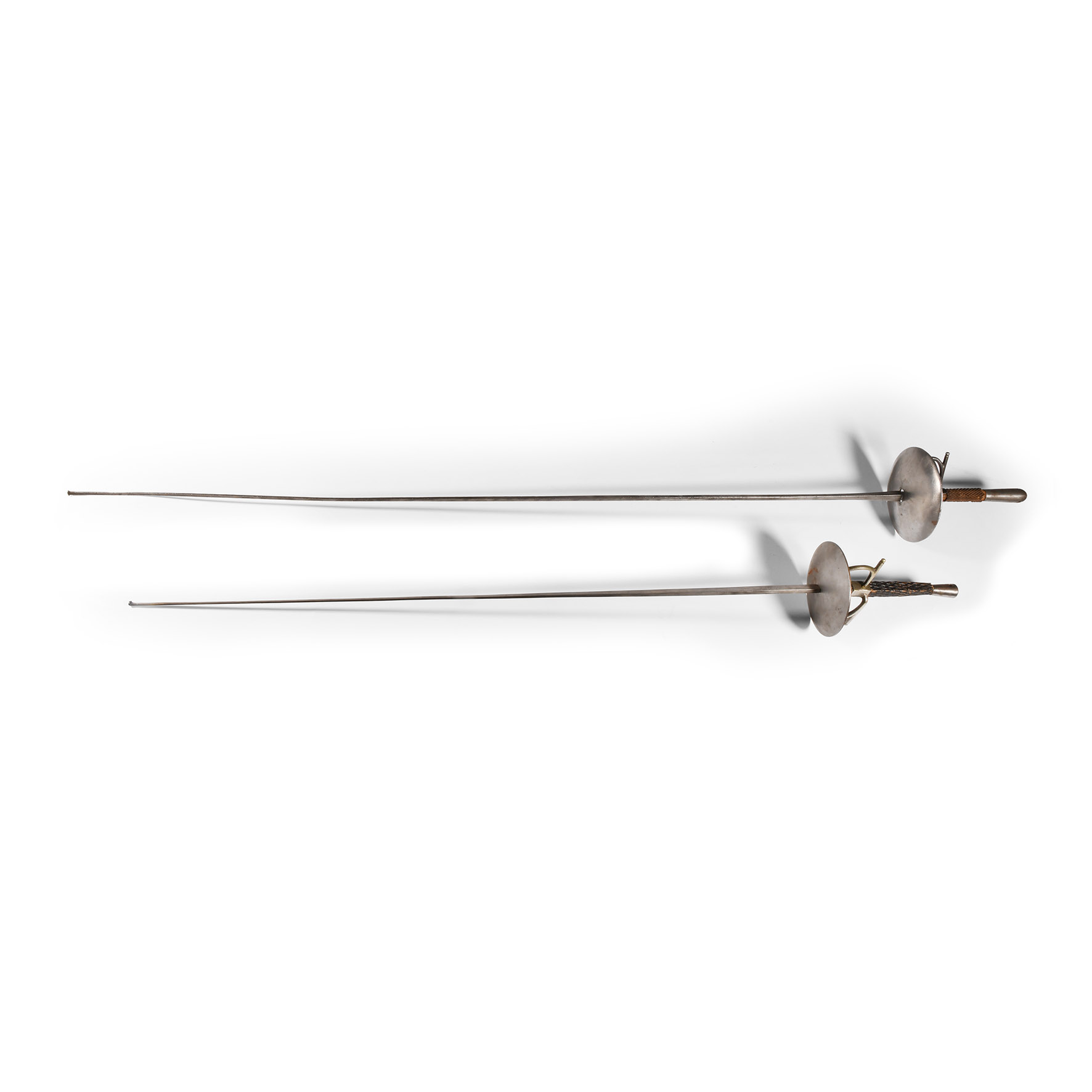
Post Medieval Fencing Foil Pair
CIRCA 1900 A.D.
33 1/2 - 41 3/4 in. (657 grams total, 85-106 cm).
Each with a long and narrow blade, the longer of square section, the shorter rectangular, each fitted with traditional slender, straight hilt, guard and finger-ring. [2, No Reserve]
ProvenanceAcquired from Czerny's Auctions, Italy, 2016, lot 280.
The Kusmirek Collection, UK.
Accompanied by a copy of Czerny's invoice and listing.
TimeLine Auctions follows a vetting process to ensure the authenticity and legality of all items, reinforcing our commitment to integrity and responsible trading. Each antiquity, antique, and coin lot undergoes thorough examination by a vetting committee of at least ten external specialists, professional trade association members, scientists, and archaeologists: Our Vetting Process
AUCTIONS:
TimeLine is a leading auction house specialising in antiquities, ancient art, collectables, natural history, coins, medals, and books. Our auctions offer museums, collectors, historians, and enthusiasts the opportunity to acquire unique and historically significant pieces.
-
.jpg)
Roman Julius Caesar Lead Sling Shot from the Battle of Munda
45 B.C.Sold for (Inc. bp): £520
Bearing a monogram: a combination of the letters 'C', 'A' and 'E', for 'C A E S' referring to Julius Caesar. 65.04 grams, 37 mm
Fine condition.
Found near to a village close to Seville, 1960-1970. From an old Spanish collection. Swiss private collection. Accompanied by a copy of the Spanish export licence. Accompanied by an academic paper by military specialist Dr Raffaele D'Amato, dated 4th May 2022 and titled Roman Res Publica - Lead Slingshots (glandes) of Caesarian Age - 45 B.C circa.
The shot (type IIb of the Völling classification) is marked with the abbreviated name of Julius Caesar; it was used in quantity at the Battle of Monda (or Munda) against the last fellows of Pompey, the leaders of the Optimates, on the 17th March 45 B.C. Similar shots were used in the civil war among Pompey and Caesar, and in all Caesar's wars. The funditores of Caesar's age were part of the light infantry. Caesar speaks of his Balearic slingers during the conquest of Gaul, who were usually covered by a short tunic, leather or rope sandals, a coat to cover them, but which could also have been used to store projectiles. Rather, they used a satchel to carry very deadly lead-like stones or bullets. The men employed several slings: one was tied around the head for quick employment should the other break during the battle. -
.jpg)
Western Asiatic Bronze Dagger with Stone Pommel
3rd millenium B.C.Sold for (Inc. bp): £910
Comprising a leaf-shaped blade with broad midrib to both faces, square-section tang and pommel with discoid bronze top displaying a stylised floral or geometric motif with parallel pairs of lines radiating from the centre and a pellet in each segment. 693 grams, 42 cm
Ex old English collection. Acquired from Timeline Originals, UK, 2015. The Kusmirek Collection, UK.
This type of daggers include lanceolate blades with a pronounced piercing and cutting function, often reinforced with a convex stiffening rib or fullers that follow the contour of the blade (Gorelik, 2003, pls. IV, 15-21, 23-25). It is commonly believed that the fullers were designed to drain blood, but this is a misconception; their purpose is to increase the strength of the blade and reduce its weight. -
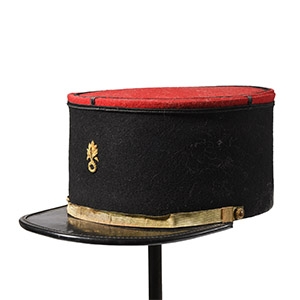
French Foreign Legion Kepi
Circa 1930-1940s A.D.Sold for (Inc. bp): £104
Black and red cloth with gold-coloured banding and 'button'; red lining and typed label reading 'Sergent BUYUKISPIR Haluk 1o R.E. Quartier Viénot C.S.L.E./S.I.H.L.E....'. 197 grams, 24.5 cm wide
Acquired from Czerny's Auctions, Italy, lot 104, 2016. The Kusmirek Collection, UK. Accompanied by copy of Czerny's invoice and information.
