
Loading, please wait...
LOT 2046
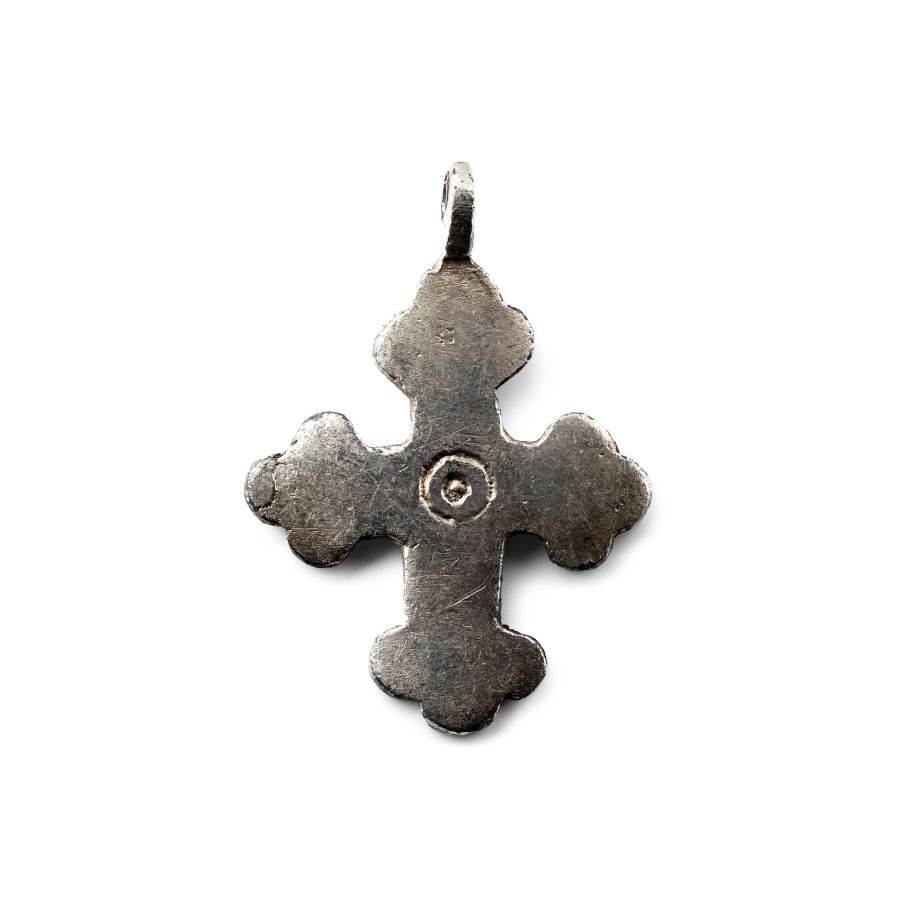
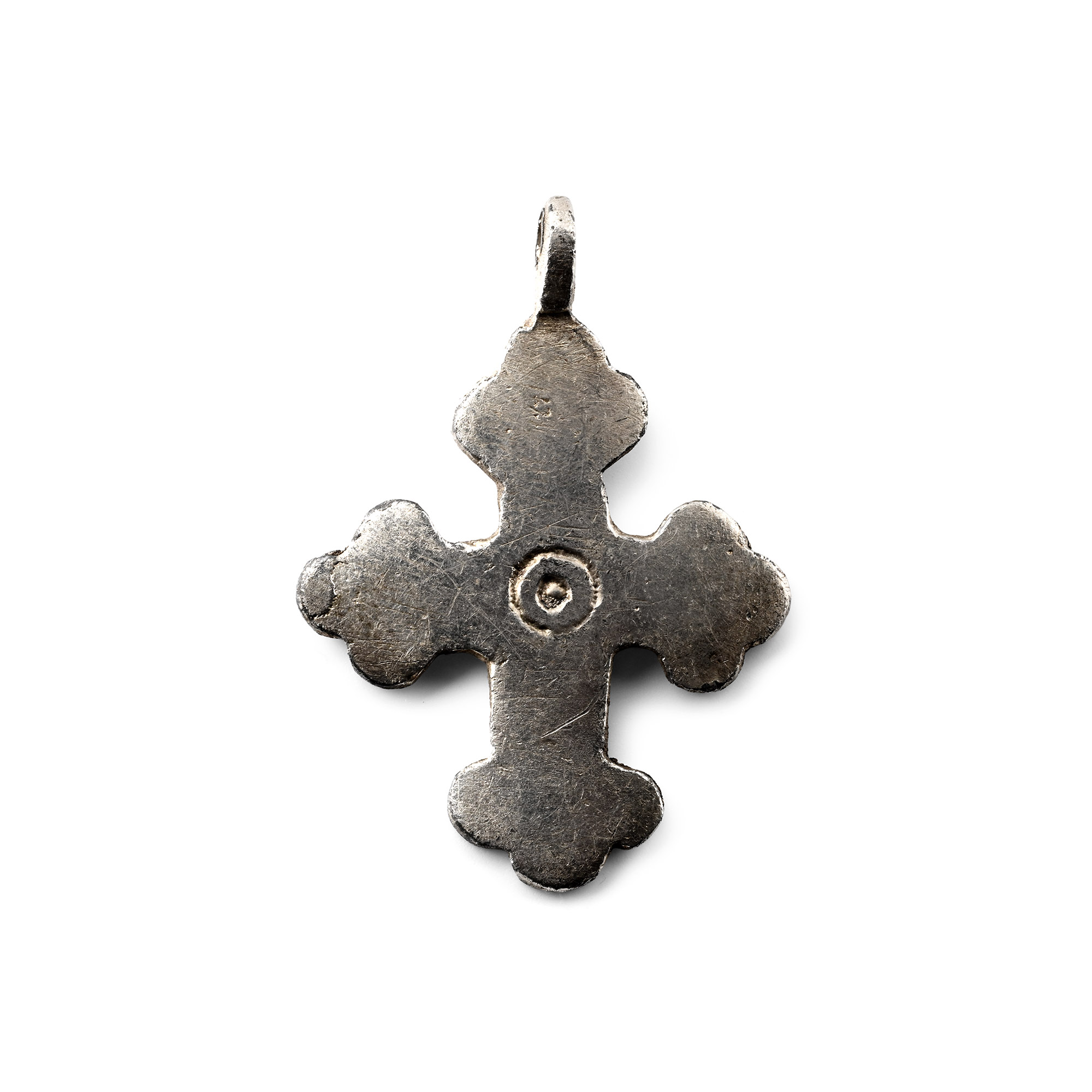
Post Medieval Coptic Silvered Cross Pendant
ETHIOPIA, 20TH CENTURY A.D.
2 in. (18.3 grams, 50 mm).
Cross botonny with suspension loop, ring-and-dot to centre of obverse. [No Reserve]
ProvenanceFrom an old Lincoln, UK, collection, 1950s-1970s.
From the property of a late Lincolnshire, UK, gentleman.
See Wlodzimierz Grzegorz Winkler, W.G., Piekarska-Winkler, D., ‘Krzyże Etiopii: orientalna ewolucja na obrzeżach Kościola’ in Saeculum Christianum, 15 (2008), nr.1, pp.101-108.
FootnotesThe pectoral cross, also called the neck cross, is much smaller in the Orthodox Ethiopian world (and in general in all Orthodox world) than both the processional and the priests' cross. These crosses, secured by a blue string or cord, adorn the necks of the faithful. Many people receive their pectoral cross at baptism. They are made from a range of materials: bronze, silver, iron, horn, and occasionally gold. The richness of ornaments and the complex structure of Ethiopian crosses give a picture of an extraordinary culture, that of one of the world’s oldest Christian societies. The ornaments and forms of the crosses of Ethiopia are unique and instantly recognisable.
CONDITIONTimeLine Auctions follows a vetting process to ensure the authenticity and legality of all items, reinforcing our commitment to integrity and responsible trading. Each antiquity, antique, and coin lot undergoes thorough examination by a vetting committee of at least ten external specialists, professional trade association members, scientists, and archaeologists: Our Vetting Process
AUCTIONS:
TimeLine is a leading auction house specialising in antiquities, ancient art, collectables, natural history, coins, medals, and books. Our auctions offer museums, collectors, historians, and enthusiasts the opportunity to acquire unique and historically significant pieces.
-
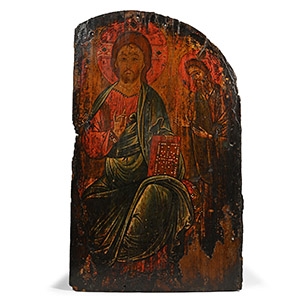
Large Cretan Wooden Icon Fragment of Deesis with Christ Pantocrator and Saint John the Prodromos
Circa 1670 A.D.Sold for (Inc. bp): £1,300
Depicting Christ Pantocrator and Saint John on his side, hand of Mary visible on the left; the Lord of the Universe represented seated upon a cushioned throne, the right hand in blessing gesture, the left hand holding a Gospel decorated with precious stones; wearing a blue chlamys and red sticharion; Saint John in proskynesis in front of Christ, dressed in a brown vestis talaris; the head of both surrounded by a red halo; later wire for hanging to the reverse with an information sheet in German. 1.8 kg, 57 cm
Ex Hargesheimen Auction House, Dusseldorf, Germany. Property of a London, UK, gentleman collector.
The icon represents a middle section from a Deesis of a church iconostasis. Although preserved as a fragment, it is designed in the high style of the late 16th century. -
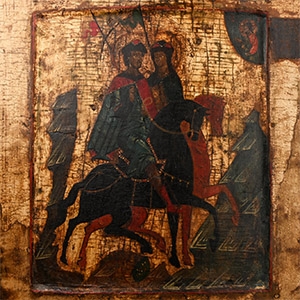
Painted Wooden Icon with Saints Boris and Gleb
Russia, 16th-17th century A.D.Estimate: £2,000 - 3,000 (+bp*)
Opening Bid: £1,000
Painted on a wooden board with gessoed surface, tempera on wood panel with kovcheg (recessed central panel on the obverse) executed on a pale yellow ground; Boris and Gleb depicted on horseback wearing Russian 16th century Boyar costume, both with nimbus, each with a lance and pennant; on the right upper corner, God is represented as a half figure making a blessing gesture, inscription in Greek letters 'ΙϹ ΧϹ' (ΙΗϹΟΥϹ ΧΡΙϹΤΟϹ = Jesus Christ); rectangular wooden board with mounting slots to reverse. 1 kg, 32 x 26.5 cm
; good condition, losses to the borders, areas of retouching.
Acquired on the UK art market. Private collection, London, UK. Accompanied by an academic report by Dr Raffaele D'Amato. This lot has been checked against the Interpol Database of stolen works of art and is accompanied by search certificate number no.12927-246338.
Boris and Gleb, Princes of old Rus Nation, were the sons of Vladimir of Kiev, the first Christian Prince of Rus; according the history they were killed in 1015 and 1019 in the civil struggles for the succession to the Kiev’s throne, and sanctified for their faith. Standards with their image were worn by the medieval Russian army. -
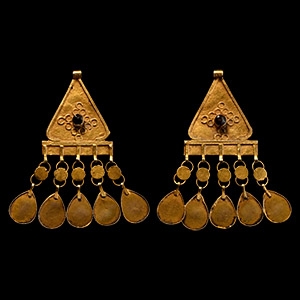
Roman Style Gold Earring Pair with Garnets
20th century A.D.Estimate: £300 - 400 (+bp*)
Opening Bid: £150
Each a triangular plaque with filigree border, central cell with inset garnet cabochon surrounded by applied filigree annulets, transverse bar below with discoid dangles. 4.04 grams total, 49 mm
with Archaeologia, Switzerland, before 1983. Ex private North American collection. London private collection, 2016.
