
Loading, please wait...
_900x900.jpg "Post Medieval Bronze Statuette of a Roman Banqueteer")
_200x200.jpg "Post Medieval Bronze Statuette of a Roman Banqueteer")
.jpg "Post Medieval Bronze Statuette of a Roman Banqueteer")
LOT 2134
Post Medieval Bronze Statuette of a Roman Banqueteer
18TH-20TH CENTURY A.D.
4 3/8 in. (741 grams, 11.3 cm high).
Seated on a footed plinth, wearing a robe which exposes his left breast, right leg crossed over the left, holding a goblet in his left hand and a bunch of grapes in his right, naturalistic facial features. [No Reserve]
ProvenanceAcquired in the 1980s-1990s.
Previously with Mansour Gallery, London W1.
Property of a North West London gentleman.
TimeLine Auctions follows a vetting process to ensure the authenticity and legality of all items, reinforcing our commitment to integrity and responsible trading. Each antiquity, antique, and coin lot undergoes thorough examination by a vetting committee of at least ten external specialists, professional trade association members, scientists, and archaeologists: Our Vetting Process
AUCTIONS:
TimeLine is a leading auction house specialising in antiquities, ancient art, collectables, natural history, coins, medals, and books. Our auctions offer museums, collectors, historians, and enthusiasts the opportunity to acquire unique and historically significant pieces.
-
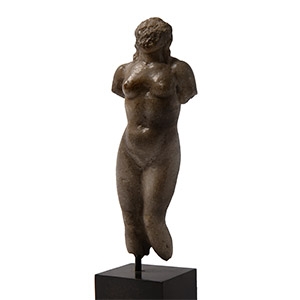
Mounted Marble Torso
20th century A.D.Estimate: £100 - 140 (+bp*)
Opening Bid: £50
Carved in the round as a standing nude female; mounted on a custom-made display stand. 165 grams total, 14.5 cm high including stand
Acquired 1980-2015. Ex Abelita family collection. -
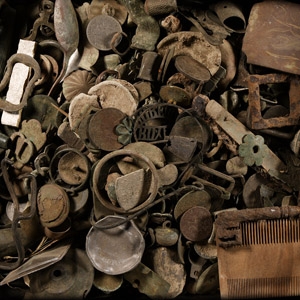
Mixed Copper-alloy Artefact Collection
20th century A.D. and earlierSold for (Inc. bp): £13
Comprising a large quantity of buttons, coins, furniture and other fittings, weights, buckles, crotal bells, thimbles, knives and other miscellaneous items. 4.5 kg total, 1-10.5 cm
Acquired 1990s-early 2000s. East Anglian private collection. -
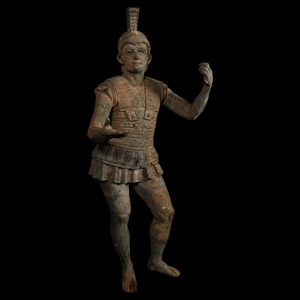
Post Medieval Bronze Statue of an Etruscan Warrior
20th century A.D.Estimate: £2,600 - 3,600 (+bp*)
Opening Bid: £1,444
Hollow-formed copy of the Mars of Todi, a figure of an Etruscan warrior wearing segmented armour to the chest and shoulders, crested helmet, short tunic; the hands in animated pose with left hand open to accept a weapon; holes beneath feet for mounting. 7.6 kg, 61.5 cm high
French collection, 1960s-early 2000s. From an important Paris gallery, France. with Galerie Athena, Brussels, 9 May 2019, lot 393. This lot has been checked against the Interpol Database of stolen works of art and is accompanied by search certificate number no.11691-199344.
The "Mars of Todi" figure is a large, almost life-sized bronze statue of a warrior in armour. It dates from the late 5th - early 4th century B.C., and is believed to have been produced by an Etruscan workman for an Umbrian patron. The figure was probably a votive offering for a religious sanctuary, perhaps sacred to Laran, the Etruscan god of war. It had been buried ritually and left undisturbed until its modern discovery in 1835. It lacks a helmet, and the hands are empty; possibly a patera plate was originally in the open right hand, and a spear gripped in the clenched left hand. The sculptor of the figure followed the Greek contrapposto posture accentuating the carefully modelled lamellar plate armour. The statue bears a short inscription in Umbrian "Ahal Trutitis dunum dede" (Ahal Trutitis gave this gift).
