
Loading, please wait...
_900x900.jpg "Pocket Qur'an Manuscript Page Group")
_200x200.jpg "Pocket Qur'an Manuscript Page Group")
.jpg "Pocket Qur'an Manuscript Page Group")
LOT 1263
Pocket Qur'an Manuscript Page Group
18TH-19TH CENTURY A.D.
3 3/8 x 3 3/8 in. (55 grams, 86 x 86 mm).
Miniature paper Qur'an, each page with dense Nasta'liq text in black ink with a red double-border and green outer border; decorative title page with floral ornament and liquid gold; several pages of handwritten notes at the end; probably from North Africa. [No Reserve]
ProvenanceAcquired 1970s-1996.
Property of a North American collector.
London collection, 2016.
TimeLine Auctions follows a vetting process to ensure the authenticity and legality of all items, reinforcing our commitment to integrity and responsible trading. Each antiquity, antique, and coin lot undergoes thorough examination by a vetting committee of at least ten external specialists, professional trade association members, scientists, and archaeologists: Our Vetting Process
AUCTIONS:
TimeLine is a leading auction house specialising in antiquities, ancient art, collectables, natural history, coins, medals, and books. Our auctions offer museums, collectors, historians, and enthusiasts the opportunity to acquire unique and historically significant pieces.
-
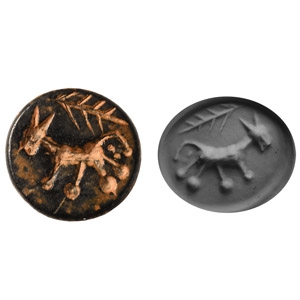
Western Asiatic Bronze Seal Matrix with Lion
1st millennium B.C.Estimate: £100 - 140 (+bp*)
Opening Bid: £50
With stepped, pierced handle, intaglio motif of a stylised standing lion with a branch above. 11.18 grams, 18 mm
From an important collection formed before 1988, London and Geneva. -
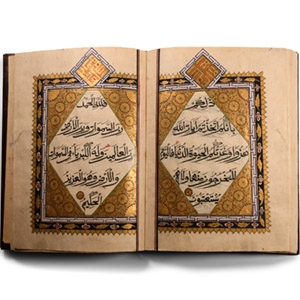
Islamic Leather Bound Chinese Qur'an, Juz' 25, Part 25
18th century A.D.Sold for (Inc. bp): £1,170
Rebound as a hardback with full leather binding, central arabesque foliage panel and foliage frame to front and back covers; title and end pages with liquid gold frame enclosing a pattern of geometric and floral blocks with Kufic script lozenge above calligraphic text; text pages with red-outlined rectangular panel and typically five lines of bold black-ink text with red diacritics and headers. 310 grams, 16.5 x 22.5 cm
From an important family collection started in the late 1950s. Property of a West London, UK, gentleman.
The text is a Chinese version of the Qur'an, Juz' 25, Part 25. -
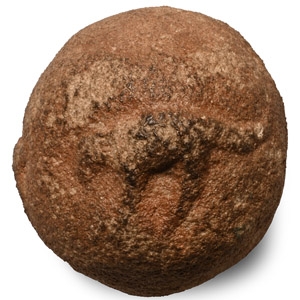
Western Asiatic Stone Ball with High-Relief Animals
1st millennium B.C.Sold for (Inc. bp): £65
Reserved animal shapes - hare, fox and hound, on an irregular ball, perhaps part of a game. 178 grams, 53 mm
From a collection acquired on the UK art market from various auction houses and collections mostly before 2000. From an important Cambridgeshire estate; thence by descent.
