
Loading, please wait...
LOT 0472
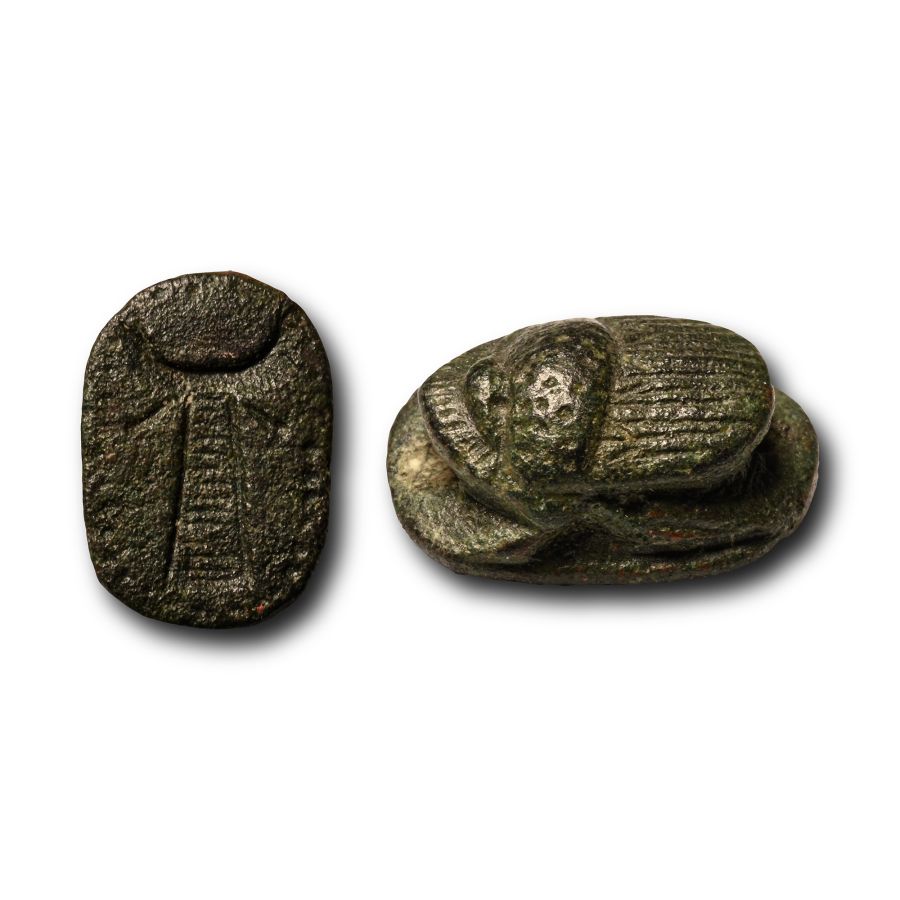
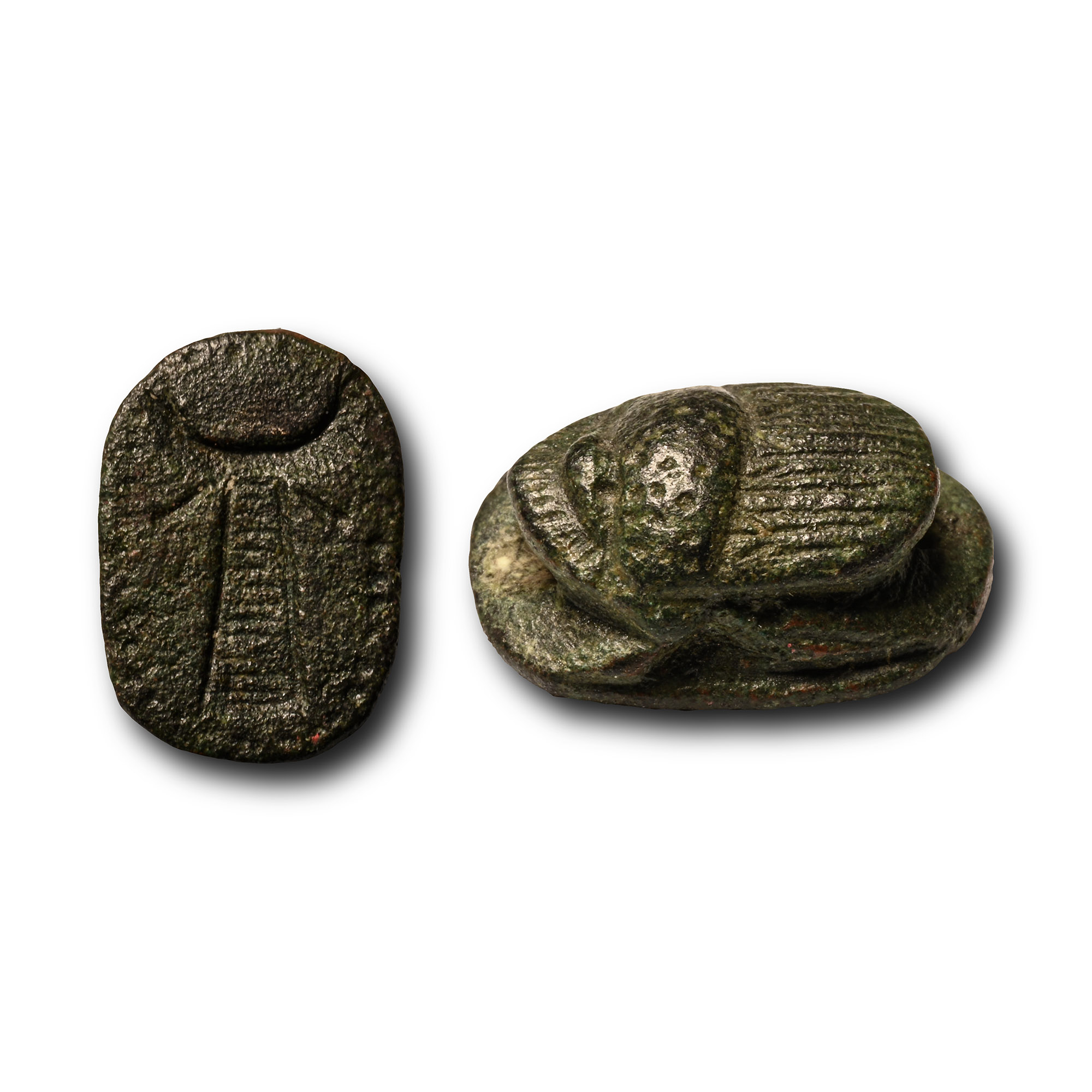
Phoenicio-Egyptian Dark Green Stone Scarab
CIRCA 9TH-8TH CENTURY B.C.
5/8 in. (3.94 grams, 15 mm).
With textured carapace, bull-horned column to the reverse, possibly a symbol of Tanit.
ProvenanceFrom the property of the late Mr SM, London, UK, 1969-1999.
This lot is accompanied by an illustrated lot declaration signed by the Head of the Antiquities Department, Dr Raffaele D'Amato.
Cf. Moscati, S., I Fenici (The Phoenicians), Milano, 1988, p.395, for examples of Phoenician scarabs; Boschloos, V., 'Tyre, Achziv and Kition. Evidence for a Phoenician Iron Age II Scarab Seal Workshop,' in Lohwasser, A. (ed.), Skarabäen des 1. Jahrtausends: Ein Workshop in Münster am 27. Oktober 2012, Orbis Biblicus et Orientalis 269, Ruprecht, 2014, p. 16, pl. 3.1, for a more stylised Tanit-like symbol.
FootnotesThe widespread adoption of the scarab, both as a symbol linked to the concept of rebirth, and in its function as a seal, exemplifies the extent of Egyptian influence on Phoenician culture, from its origins in the Levant to its spread across the Mediterranean.
CONDITIONTimeLine Auctions follows a vetting process to ensure the authenticity and legality of all items, reinforcing our commitment to integrity and responsible trading. Each antiquity, antique, and coin lot undergoes thorough examination by a vetting committee of at least ten external specialists, professional trade association members, scientists, and archaeologists: Our Vetting Process
AUCTIONS:
TimeLine is a leading auction house specialising in antiquities, ancient art, collectables, natural history, coins, medals, and books. Our auctions offer museums, collectors, historians, and enthusiasts the opportunity to acquire unique and historically significant pieces.
-
.jpg)
Egyptian Faience Fish Plaque Amulet
New Kingdom, 1550-1070 B.C.Sold for (Inc. bp): £416
Rectangular plaque with raised Tilapia fish motif on the top and six ring-and-dot motifs on the underside. 2.12 grams, 17 mm
Mrs Allinson to Mrs Foster, 1867 and thence by descent to the current owner, Stanley Crescent, London, UK.
Amulets depicting the Tilapia fish served as symbols of regeneration. -
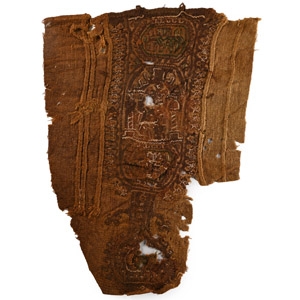
Large Egyptian Coptic Textile Fragment
Circa 4th-8th century A.D.Sold for (Inc. bp): £169
Very large tunic fragment with a clavus connected by a thin band to the orbiculus, in red purple, brown and red granate wool over linen, S torsion, embroidered with three tondos decorated with stylised images of dancers with raised heads and curly hair; crenellated borders. 108 grams total including package, 30 cm
Acquired 1970s-1996. Property of a North American collector. London collection, 2016.
This type of embroidery was typical of tunics and garments characterised by full-length clavi, decorated with either intricate geometric patterns or with a multitude of small figures and animals, often edged with geometric borders and finished with thick, weft-loop fringes or cords. -
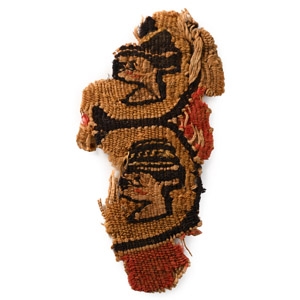
Egyptian Coptic Textile Fragment
Circa 5th-6th century A.D.Sold for (Inc. bp): £78
Small fragment of a garment in yellow, green and red wool, S torsion, embroidered with female heads wearing high propoloma. 10 grams total including package, 76 mm
Acquired 1970s-1996. Property of a North American collector. London collection, 2016.
This fragment was most likely part of a tapestry medallion with symbolic figures, likely linked to the Christian cult or, perhaps, to the Dionysian iconography. These figures could surround Tyche (a city's patron deity) or a figure of Christ or Saints.
