
Loading, please wait...
LOT 0443
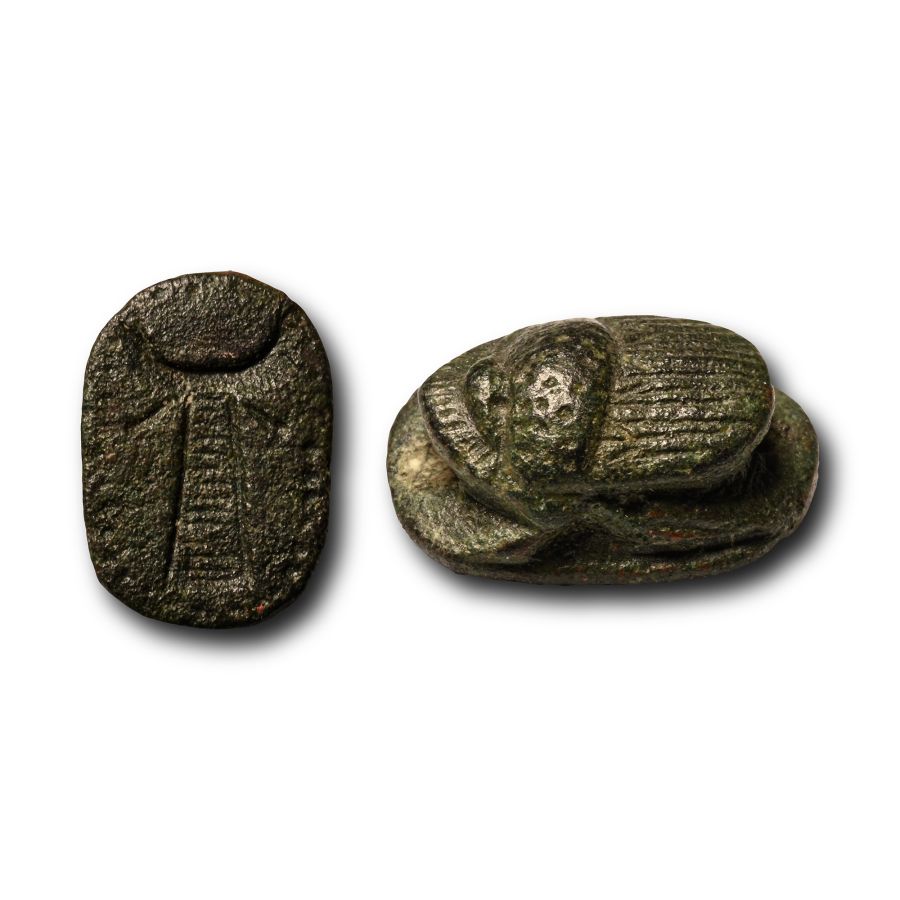
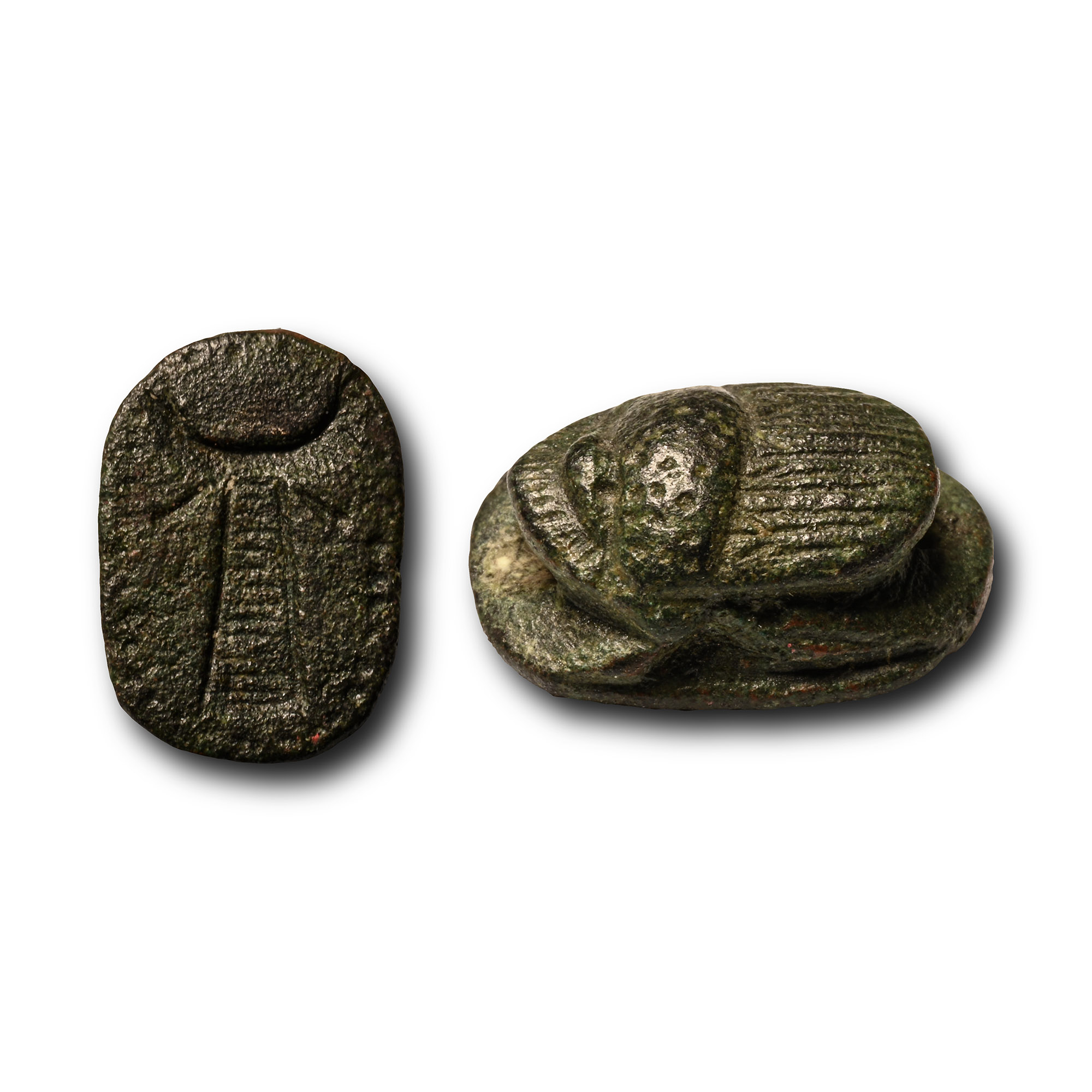
Phoenicio-Egyptian Dark Green Stone Scarab
CIRCA 9TH-8TH CENTURY B.C.
5/8 in. (3.94 grams, 15 mm).
With textured carapace, bull-horned column to the reverse, possibly a symbol of Tanit.
ProvenanceFrom the property of the late Mr SM, London, UK, 1969-1999.
This lot is accompanied by an illustrated lot declaration signed by the Head of the Antiquities Department, Dr Raffaele D'Amato.
Cf. Moscati, S., I Fenici (The Phoenicians), Milano, 1988, p.395, for examples of Phoenician scarabs; Boschloos, V., 'Tyre, Achziv and Kition. Evidence for a Phoenician Iron Age II Scarab Seal Workshop,' in Lohwasser, A. (ed.), Skarabäen des 1. Jahrtausends: Ein Workshop in Münster am 27. Oktober 2012, Orbis Biblicus et Orientalis 269, Ruprecht, 2014, p. 16, pl. 3.1, for a more stylised Tanit-like symbol.
FootnotesThe widespread adoption of the scarab, both as a symbol linked to the concept of rebirth, and in its function as a seal, exemplifies the extent of Egyptian influence on Phoenician culture, from its origins in the Levant to its spread across the Mediterranean.
CONDITIONTimeLine Auctions follows a vetting process to ensure the authenticity and legality of all items, reinforcing our commitment to integrity and responsible trading. Each antiquity, antique, and coin lot undergoes thorough examination by a vetting committee of at least ten external specialists, professional trade association members, scientists, and archaeologists: Our Vetting Process
AUCTIONS:
TimeLine is a leading auction house specialising in antiquities, ancient art, collectables, natural history, coins, medals, and books. Our auctions offer museums, collectors, historians, and enthusiasts the opportunity to acquire unique and historically significant pieces.
LOT 0443
Phoenicio-Egyptian Dark Green Stone Scarab
Estimate £200 - 280€230 - 320 (for guidance only)$270 - 380 (for guidance only)
-
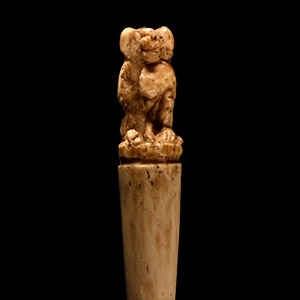
Egyptian Bone Hairpin with Thoth as a Baboon
New Kingdom, 1569-1081 B.C.Sold for (Inc. bp): £624
Tapering round-section hairpin, with a finial fashioned as a seated baboon with its tail resting along the body. 5.4 grams, 89 mm
Ex Thomas collection, UK, 1980s-1990s. This lot is accompanied by an illustrated lot declaration signed by the Head of the Antiquities Department, Dr Raffaele D'Amato.
Decorative hairpins often feature animals such as monkeys and cats, and inanimate objects such as olives. -
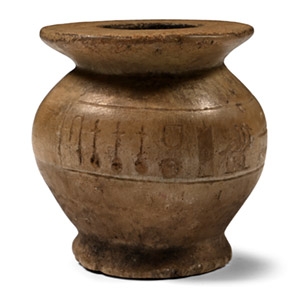
Egyptian Alabaster Kohl Pot with Later Hieroglyphs
Second Intermediate Period, 1650-1550 B.C.Sold for (Inc. bp): £195
Comprising a squat piriform body with a wide everted rim, a band of later hieroglyphs beneath the shoulder: ḳmꜢ.t n bꜢw ı͗wnw nfrw.s (You have gathered the souls (i.e. divine powers) of Heliopolis—her beauties). 208 grams, 55 mm high
Ex late London, UK, gentleman, 1970s. This lot is accompanied by an illustrated lot declaration signed by the Head of the Antiquities Department, Dr Raffaele D'Amato.
The inscription on what is a cosmetic vessel could be interpreted as “You acquire the powers of Heliopolis, source of her beauty”; “her beauties” likely references either the woman using the vessel or perhaps the divine beauty imparted by the contents. -
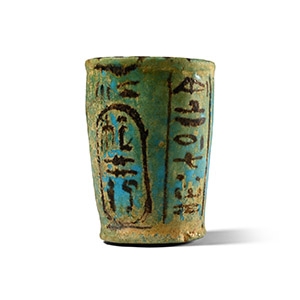
Egyptian Blue Glazed Libation Cup of Ramesses III
New Kingdom, 20th Dynasty, circa 1183-1152 B.C.Sold for (Inc. bp): £1,235
Ritual cup with sides tapering towards the base; the black glazed rectangular panel containing two columns of text: 'Lord of Appearances, Ramesses ruler of Heliopolis (Ramses heqa Iwnw) given life, beloved of Osiris, Lord of Rosetau'. 50 grams, 53 mm
with Hoshigaoka Gallery Co. Ltd, Japan. Private collection, London, acquired from the above on the 26th September 1981. This lot has been checked against the Interpol Database of stolen works of art and is accompanied by a search certificate number no.12637-235085. This lot is accompanied by an illustrated lot declaration signed by the Head of the Antiquities Department, Dr Raffaele D'Amato.
