
Loading, please wait...

LOT 0042
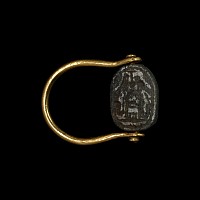
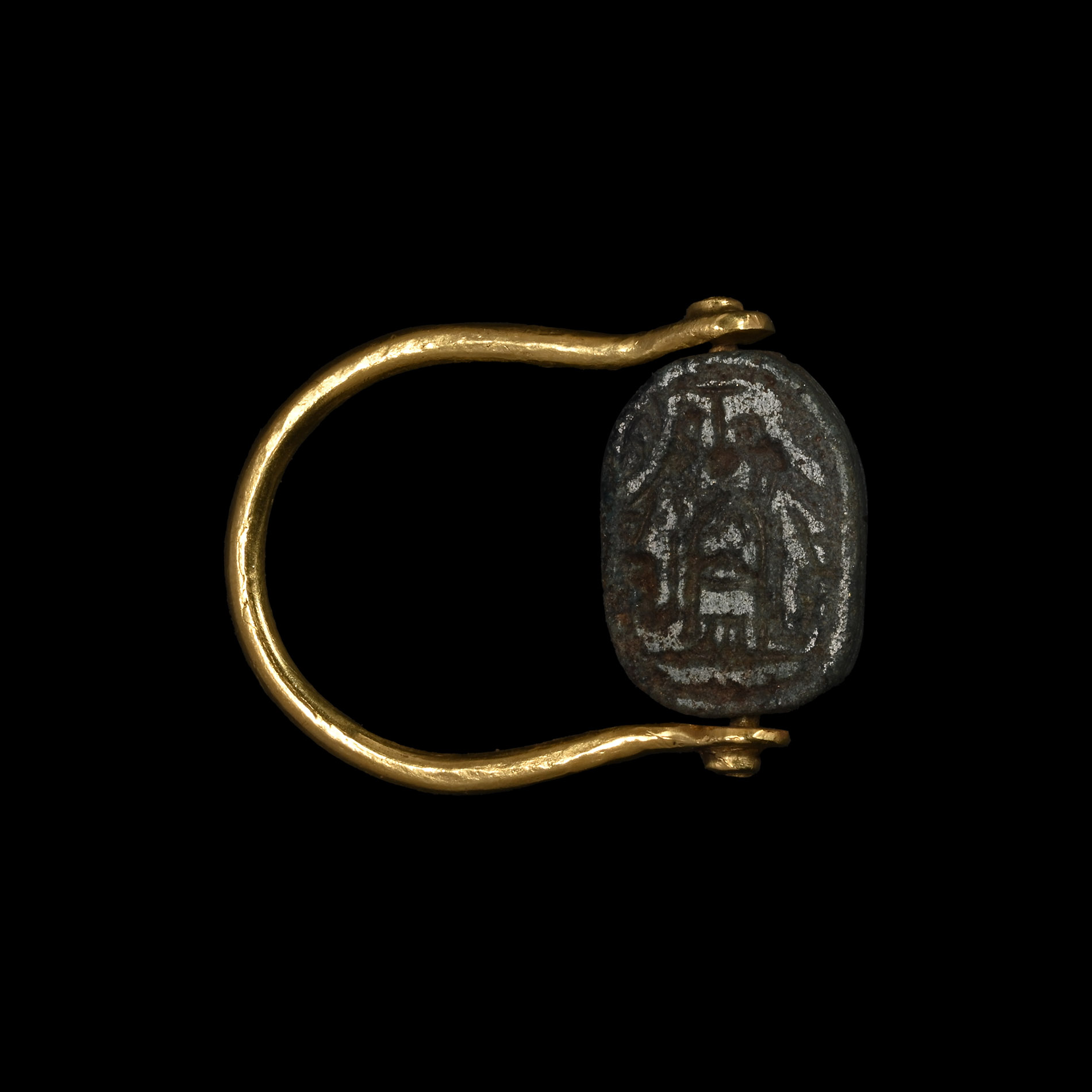
Phoenician Scarab in Gold Swivel Ring
6TH-4TH CENTURY B.C. AND LATER
1 in. (4.34 grams, 26.44 mm overall, 15.68 mm internal diameter (approximate size British J 1/2, USA 5, Europe 9.32, Japan 9)).
The scarab with lightly incised anatomical detailing, the underside with a central cartouche flanked by two rearing crowned uraei, a pair of falcons standing above the cartouche facing a smꜣ hieroglyph symbolising union (of the two lands, Upper and Lower Egypt); set into a later gold swivel ring.
Provenancewith Bonhams, London, UK, 21 October 1999, no.36.
Private collection, Europe.
This lot has been checked against the Interpol Database of stolen works of art and is accompanied by a search certificate number no.12370-226696.
This lot has been cleared against the Art Loss Register database, and is accompanied by an illustrated lot declaration signed by the Head of the Antiquities Department, Dr Raffaele D'Amato.
Cf. Chadour, A.B., Rings. The Alice and Louis Koch Collection, volume I, Leeds, 1994, items 1,2, for earlier examples of the type.
CONDITIONTimeLine Auctions follows a vetting process to ensure the authenticity and legality of all items, reinforcing our commitment to integrity and responsible trading. Each antiquity, antique, and coin lot undergoes thorough examination by a vetting committee of at least ten external specialists, professional trade association members, scientists, and archaeologists: Our Vetting Process
AUCTIONS:
TimeLine is a leading auction house specialising in antiquities, ancient art, collectables, natural history, coins, medals, and books. Our auctions offer museums, collectors, historians, and enthusiasts the opportunity to acquire unique and historically significant pieces.
LOT 0042
Phoenician Scarab in Gold Swivel Ring
Estimate £1,500 - 2,000€1,740 - 2,320 (for guidance only)$2,030 - 2,700 (for guidance only)
-
Egyptian Silver Bastet as Seated Cat Amulet
Late-Ptolemaic Period, 664-30 B.C.Sold for (Inc. bp): £715
Seated figure of a cat with pointed ears mounted on a rectangular base with a rounded end; suspension loop on the back. 0.34 grams, 8 mm
From an early 20th century collection. This lot is accompanied by an illustrated lot declaration signed by the Head of the Antiquities Department, Dr Raffaele D'Amato.
The cat was sacred to Bastet, a protective mother goddess and the daughter of the sun god Re. Amulets offered the wearer the goddess's protection. Her name means ‘she of the bast [ointment jar],’ which may have contained a substance favoured by or exclusive to royalty. Originally, Bastet was depicted as a woman with the head of a lioness, but by the late New Kingdom, she was usually shown with a cat's head. She is sometimes portrayed with kittens, emphasising her maternal role as a fierce protector of offspring. -
Egyptian Schist Plate
Ptolemaic Period, 323-30 B.C.Estimate: £800 - 1,000 (‡+bp*)
Opening Bid: £360
Discoid palette with rounded underside and flat base, dished central field, flat rim with four radiating trapezoidal projections. 450 grams, 16.4 cm
Acquired in the mid 1980s-1990s. Private collection, Switzerland, thence by descent. Private collection, since the late 1990s. Accompanied by a copy of an Art Loss Register certificate no.S00038135. This lot is accompanied by an illustrated lot declaration signed by the Head of the Antiquities Department, Dr Raffaele D'Amato. -
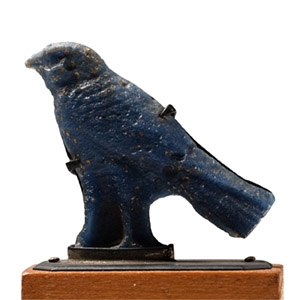
Egyptian Blue Glass Bird Inlay
Ptolemaic Period, circa 332-30 B.C.Sold for (Inc. bp): £624
Modelled in the half-round with low-relief hatched detailing; perching on a D-section base; mounted on a silver support and a wooden display stand. 18 grams total, 55 mm including stand
with Jean-Phillipe Mariaud de Serres, Paris, France. Private collection, London, UK, acquired from the above in 1992. This lot is accompanied by an illustrated lot declaration signed by the Head of the Antiquities Department, Dr Raffaele D'Amato.
The falcon inlay possibly symbolises Horus, the god of the sky, war, and protection. Horus was one of the most significant and widely worshipped gods in ancient Egyptian mythology. His importance spans multiple facets of Egyptian religion, including kingship, protection, the sky, and the sun. Depicted in various human and animal forms, Horus played a vital role in Egyptian cosmology, especially as the protector of the Pharaoh and as a representation of divine authority.
