
Loading, please wait...
LOT 0486
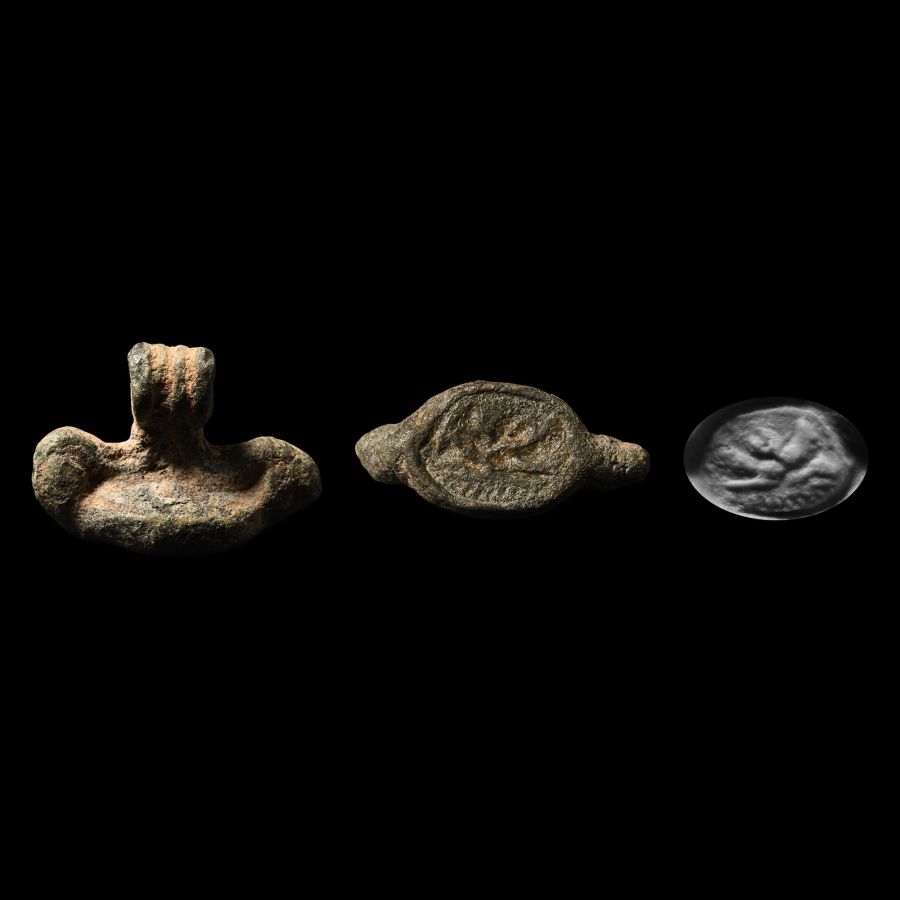
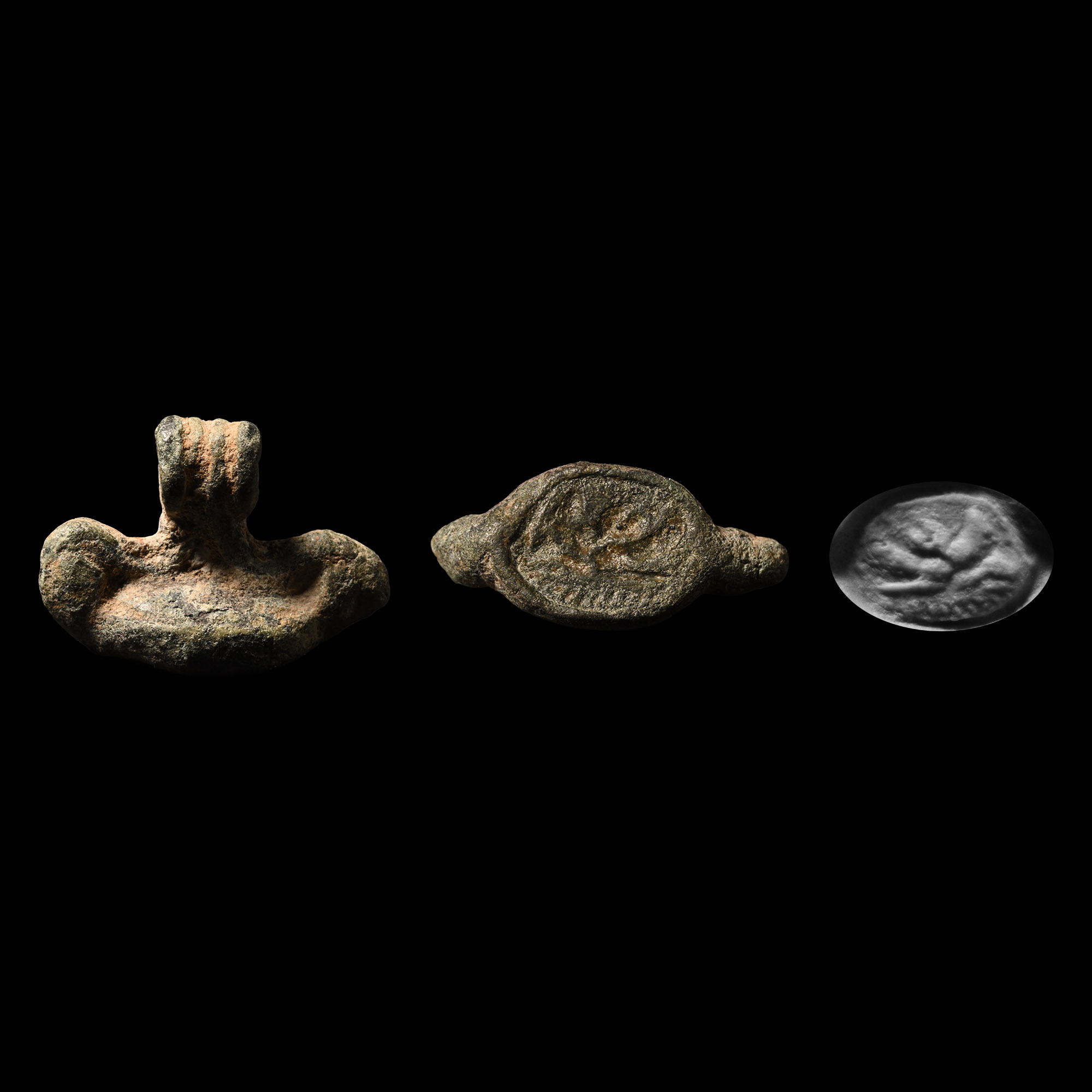
Phoenician Inscribed Bronze Scaraboid Seal
LATE 1ST MILLENNIUM B.C.
1 in. (10.9 grams, 26 mm wide).
With ribbed loop and ellipsoid face, gryphon motif.
ProvenanceEx London, UK, gentleman, 1990.
This lot is accompanied by an illustrated lot declaration signed by the Head of the Antiquities Department, Dr Raffaele D'Amato.
TimeLine Auctions follows a vetting process to ensure the authenticity and legality of all items, reinforcing our commitment to integrity and responsible trading. Each antiquity, antique, and coin lot undergoes thorough examination by a vetting committee of at least ten external specialists, professional trade association members, scientists, and archaeologists: Our Vetting Process
AUCTIONS:
TimeLine is a leading auction house specialising in antiquities, ancient art, collectables, natural history, coins, medals, and books. Our auctions offer museums, collectors, historians, and enthusiasts the opportunity to acquire unique and historically significant pieces.
LOT 0486
Phoenician Inscribed Bronze Scaraboid Seal
Estimate £100 - 140€120 - 160 (for guidance only)$140 - 190 (for guidance only)
-
.jpg)
Egyptian Bronze Khonsu Statuette with Silver Eyes
Late Period, 664-332 B.C.Estimate: £4,000 - 6,000 (+bp*)
Opening Bid: £2,000
Modelled in the round figure of Khonsu standing, holding the crook, flail, and long was-sceptre, with false beard and sidelock, wearing a crown consisting of a lunar crescent and disc with uraeus, and a broad collar; the eyes with sheet-silver inlays; mounted on a custom-made stand. 378 grams total, 19 cm including stand
Ex Geneva collection, Switzerland, acquired before 1980. Ex Galerie Günter Puhze GmbH, Germany, 2008. Ex Keane collection, Kent, UK. Accompanied by an original invoice from Galerie Günter Puhze GmbH. This lot has been checked against the Interpol Database of stolen works of art and is accompanied by a search certificate number no.12628-235137. This lot has been cleared against the Art Loss Register database, and is accompanied by an illustrated lot declaration signed by the Head of the Antiquities Department, Dr Raffaele D'Amato.
Khonsu is an ancient Egyptian god of the moon, often depicted as a young man with a sidelock, a uraeus, and headgear featuring a lunar crescent and disc. He is associated with Thoth, another moon god. Together with his father Amun and mother Mut, Khonsu forms the Theban Triad. -
.jpg)
Egyptian Steatite Harpocrates Statuette
Late Period, 664-332 B.C.Estimate: £1,500 - 2,000 (+bp*)
Opening Bid: £750
Carved in the round, the nude standing figure of the god sporting a solar disc and uraeus headdress, wearing a sidelock, and holding a lotus flower, accompanied by an integral dorsal pillar and base; one arm missing. 15.26 grams, 78 mm
Ex Thomas collection, UK, 1980s-1990s. This lot has been cleared against the Art Loss Register database, and is accompanied by an illustrated lot declaration signed by the Head of the Antiquities Department, Dr Raffaele D'Amato.
Harpocrates is the Greek rendering of the Egyptian Hor-pa-khered, which translates as ‘Horus the Child’. This designation refers to Horus as the divine infant of Isis and Osiris. His nudity represents youth and purity. The sun disc and lotus flower symbolises divine rebirth and solar renewal. The sun disc connects him to Ra and the daily cycle of rebirth, while the lotus—opening with the sunrise—emphasises creation and emergence from chaos. Together, these elements express triumph over death and the promise of eternal life. -
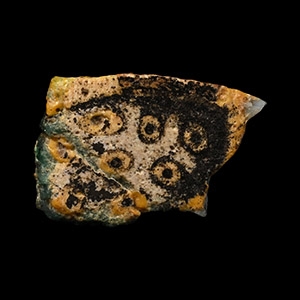
Egyptian Glass Panel with Eyes
Late Period, 664-332 B.C.Estimate: £300 - 400 (+bp*)
Opening Bid: £150
Irregular glass panel fragment with mosaic eye motifs inlaid; repaired. 1.57 grams, 18 mm
From the collection of a gentleman, acquired on the London art market in the 1990s. This lot is accompanied by an illustrated lot declaration signed by the Head of the Antiquities Department, Dr Raffaele D'Amato.
