
Loading, please wait...
LOT 0414
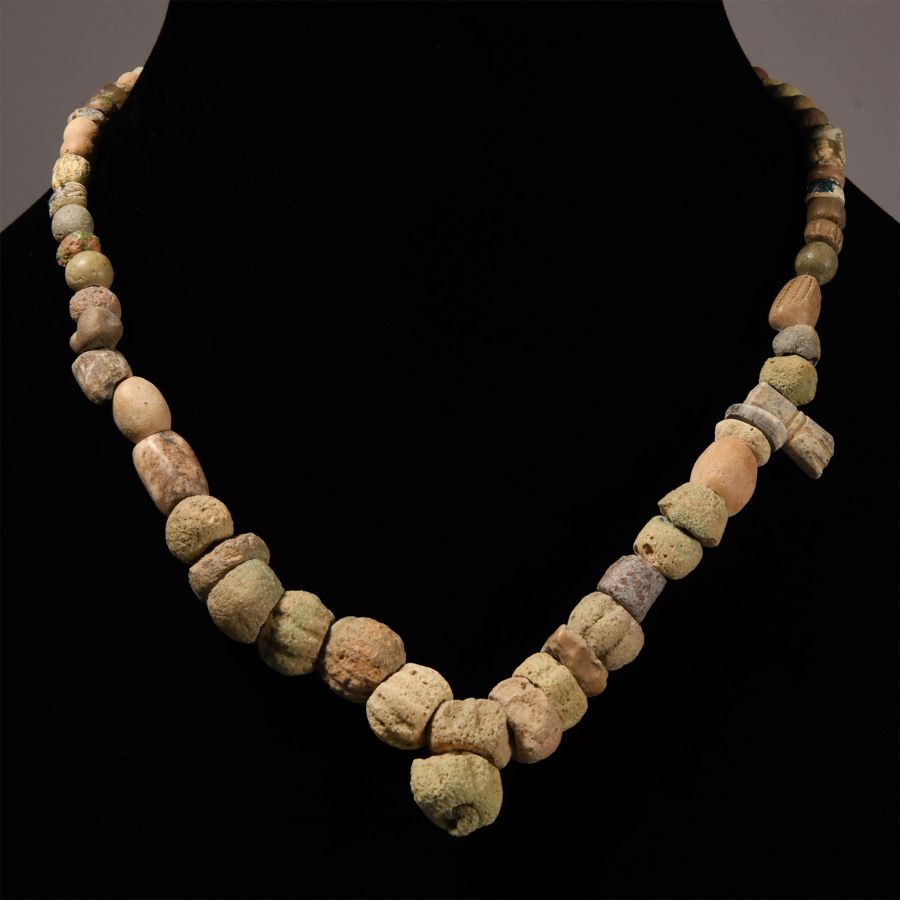
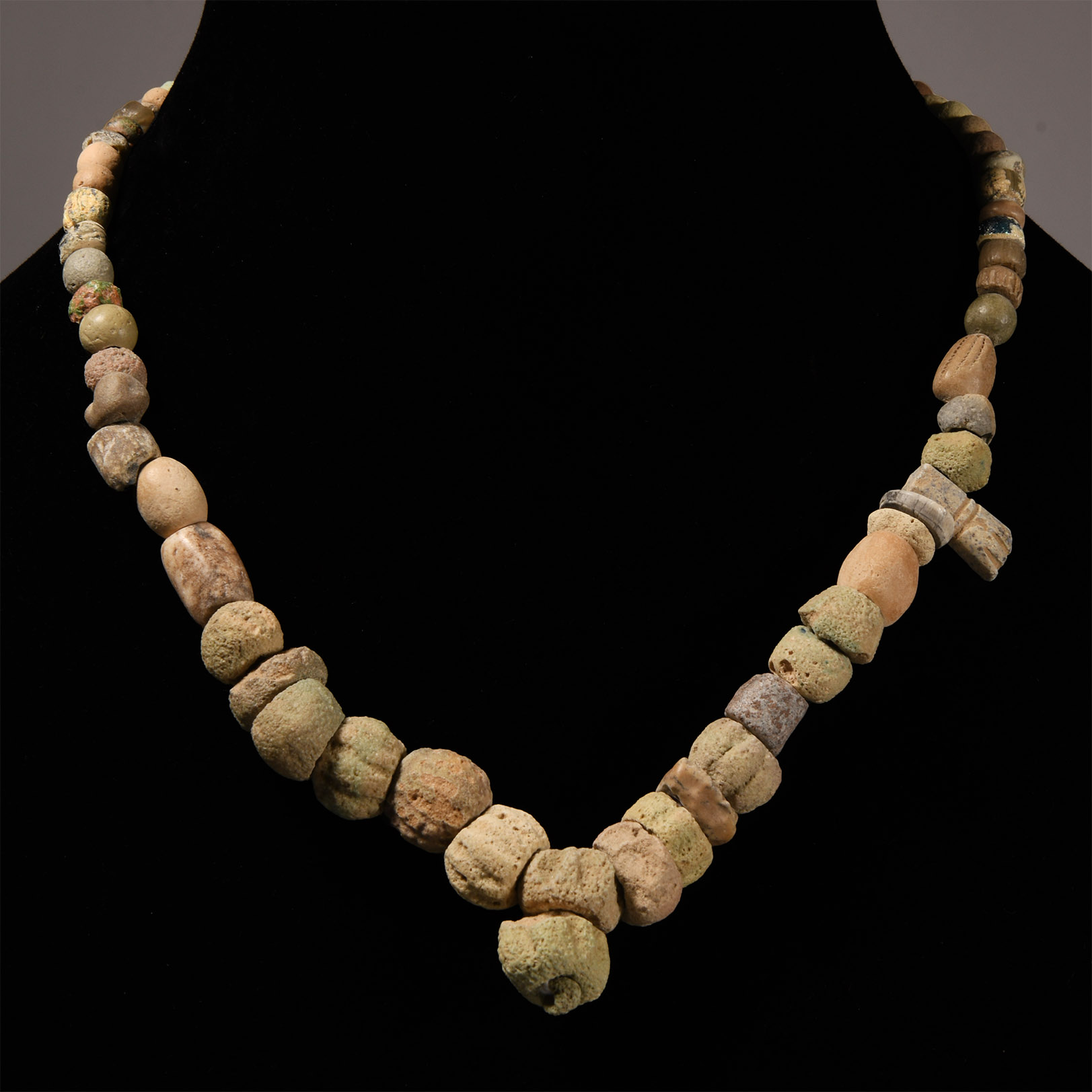
Phoenician Faience and Stone Bead Necklace String
LATE 1ST MILLENNIUM B.C.
17 1/4 in. (39 grams, 44 cm long).
Restrung designer group of melon, spherical and other beads. [No Reserve]
ProvenanceFrom the H.N. collection, Milton Keynes, Berkshire, UK, 1990s.
CONDITIONTimeLine Auctions follows a vetting process to ensure the authenticity and legality of all items, reinforcing our commitment to integrity and responsible trading. Each antiquity, antique, and coin lot undergoes thorough examination by a vetting committee of at least ten external specialists, professional trade association members, scientists, and archaeologists: Our Vetting Process
AUCTIONS:
TimeLine is a leading auction house specialising in antiquities, ancient art, collectables, natural history, coins, medals, and books. Our auctions offer museums, collectors, historians, and enthusiasts the opportunity to acquire unique and historically significant pieces.
-
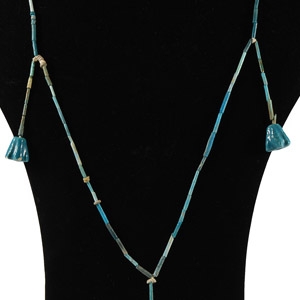
Egyptian Faience Mummy Bead Necklace with Papyrus Flower Amulets
Late Period, 664-332 B.C.Sold for (Inc. bp): £208
Restrung group of mainly tubular beads with five faience papyrus-flower pendants. 25 grams, 102 cm long
From an old English deceased estate. Acquired on the London art market in the early 1990s. Property of a London, UK, collector. -
.jpg)
Egyptian Limestone Female Bust
Coptic, 3rd-6th century A.DEstimate: £8,000 - 10,000 (‡+bp*)
Opening Bid: £4,000
Modelled in the half-round on a flat background as a bust of a woman with stern expression, dressed in a tunic emphasising the rounded shape of the bosom, and a mantle worn on the shoulders descending to the arms; beaded collar to the chest and detailed head-covering; significant remains of polychrome (red, black, and traces of blue) on the face, clothing and hair; mounted on a custom-made display stand. 6.77 kg, 27 x 19.5 cm
From the collection of Nicolas Koutoulakis, Paris-Geneva, 1967. Ex Barbier-Mueller, Geneva, Switzerland. with Boisgirad, Arts D'Orient, 16 November 2007, no.88. Acquired on the French art market in 2007. European private collection. Accompanied by an academic report by Dr Raffaele D’Amato. Accompanied by copies of the relevant Boisgirad, Arts D'Orient catalogue pages. This lot has been checked against the Interpol Database of stolen works of art and is accompanied by a search certificate number no.12065-218189.
The base, back and sides are flat and rough-hewn: it is possible that it served as a funerary stele, perhaps placed as a “lid” of a niche or a loculus. The Egyptian stelae and statues found at the site of Oxyrhynchos (present-day Benhasa) provide the best parallels for the style that characterises this image. These are most often funerary works showing men, women or children (stelae in very high-relief and statues) which are still little known - and even the chronology of which is subject of discussion: current opinion one inclines towards an earlier dating, between the 3rd and 4th centuries A.D., rather than the Coptic period which was previously favoured. In fact these figures, which are devoid of the attributes linked to Christian iconography, generally hold or carry objects which relate to "classical" cults (ie. Isis). Despite a certain naivety of the work, typical of Egyptian sculptures from this region, the woman depicted on this stele certainly belonged to the high contemporary nobility as is evidenced by the richness of her well-pleated clothing and the abundance of adornment, comprising a large necklace with two rows of pearls and some brooches; likewise, the hairstyle, organised in small curls and spiral locks, is worthy of a high-ranking personage. -
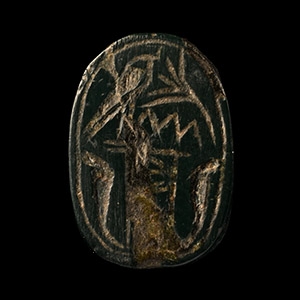
Phoenicio-Egyptian Hardstone Scarab with Hieroglyphs
Circa 6th-4th century B.C.Estimate: £400 - 600 (+bp*)
Opening Bid: £200
Haematite scarab with underside incised Horus falcon and lotus flower atop a fire-altar(?) flanked by uraei. 2.21 grams, 16 mm
Collected from 1969-1999. From the collection of the late Mr S.M., London, UK.
