
Loading, please wait...


LOT 0509
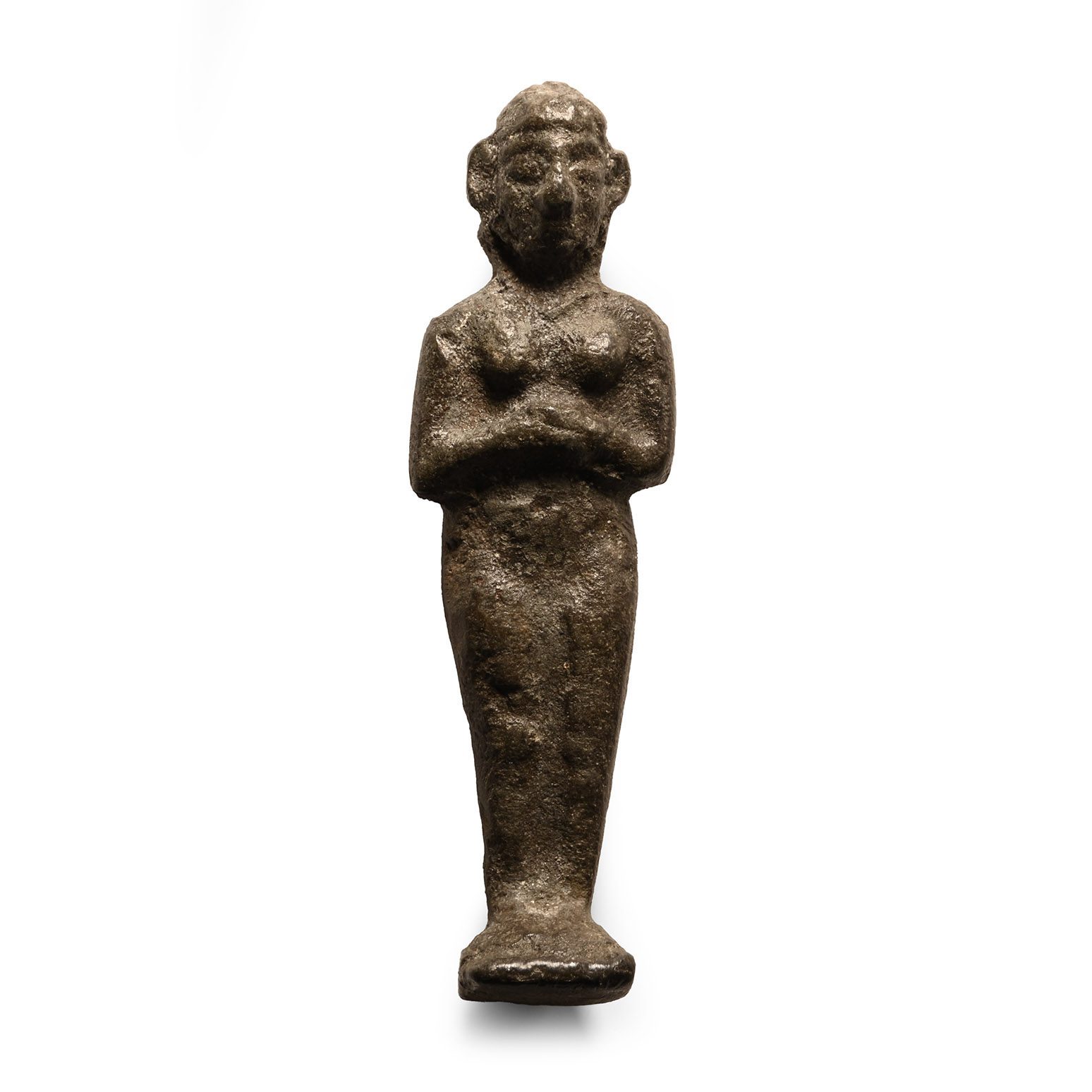
Phoenician Bronze Statuette of a Naked Female
6TH-4TH CENTURY B.C.
3 3/4 in. (107 grams, 94 mm).
Modeled in the round with arms folded across the abdomen, standing nude on a square base. [No Reserve]
ProvenanceAcquired in Egypt by Lieutenant James Alexander Goodman in the 1920s.
Thence by descent to his grandson.
Lieutenant Goodman served in the 4th Battalion Welsh Regiment during World War I and saw action in Palestine during the capture of Bethlehem, (for which he won an MC). After the war, he setup a business selling Fordson trucks and tractors in Alexandria, Egypt. A keen antiquarian, he collected ancient objects during his time in Alexandria and when he visited the pyramids at Giza. After his first marriage failed, he returned to the UK in the early 1930s. On his death in 1959, he passed his small collection of Egyptian objects on to his second wife, Ruby Goodman. On Ruby’s death in 1994, they were left to their second daughter, Rosemary Johnson, (née Goodman), and are currently in the possession of her son.
CONDITIONTimeLine Auctions follows a vetting process to ensure the authenticity and legality of all items, reinforcing our commitment to integrity and responsible trading. Each antiquity, antique, and coin lot undergoes thorough examination by a vetting committee of at least ten external specialists, professional trade association members, scientists, and archaeologists: Our Vetting Process
AUCTIONS:
TimeLine is a leading auction house specialising in antiquities, ancient art, collectables, natural history, coins, medals, and books. Our auctions offer museums, collectors, historians, and enthusiasts the opportunity to acquire unique and historically significant pieces.
-
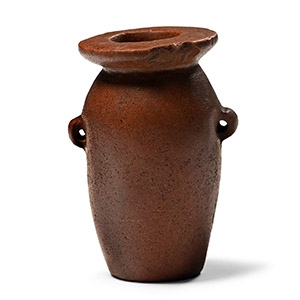
Egyptian Red Limestone Jar
New Kingdom, 1550-1069 B.C.Estimate: £800 - 1,000 (+bp*)
Opening Bid: £400
With everted disc rim and flat base, twin lug handles at the shoulder. 57 grams, 51 mm
Pino Donati collection, Lugano-Breganzona, formed in the 1960s-early 1970s. with Arte Classica, Stefano Donati, Lugano. Private collection, Europe, acquired November 2011 from the above. with Bonhams, New Bond Street, 28 November 2019, no.163.
Red limestone vessels have a limited chronological range and are particularly characteristic of the Predynastic Period. See Aston, B.G., Ancient Egyptian Stone Vessels: Materials and Forms, SAGA 5, Heidelberg, 1994, p.170, fig. 21, for the chronological range of the stone used for vessels. -
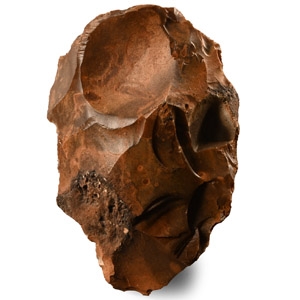
Stone Age Egyptian Flint Axehead
Lower Palaeolithic Period, circa 450,000-280,000 B.P.Sold for (Inc. bp): £46
Biconvex in section with irregular curved edge. 389 grams, 12.3 cm
Found Egypt, North Africa. From the British art market in the 1970s-1980s. Acquired via inheritance, 1988. From the collection of a South West London, UK, specialist Stone Age collector. -
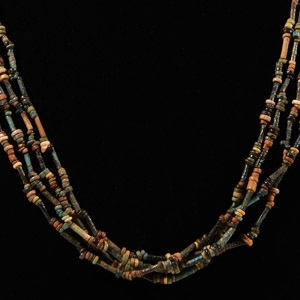
Egyptian Multi-Stranded Mummy Bead Necklace
Late Period, 664-332 B.C.Sold for (Inc. bp): £98
Multi-stranded designer necklace composed of beads of mainly annular and tubular types. 21 grams, 74 cm
Acquired before 1979. From the private collection of Mr F. A., South Kensington, London, UK; thence by descent 2014.
For thousands of years, artisans in Egypt created vibrant ceramics to echo the beauty of rare jewels. These ornaments were created with almost every material, colour, and texture imaginable and they come from across Egypt and beyond: vibrant blue lapis lazuli from Afghanistan, glossy black obsidian from Turkey, and aqua-green turquoise from the Sinai. They were worn in life and, after death, they served as precious ornamentation for mummies.
