
Loading, please wait...
LOT 0010
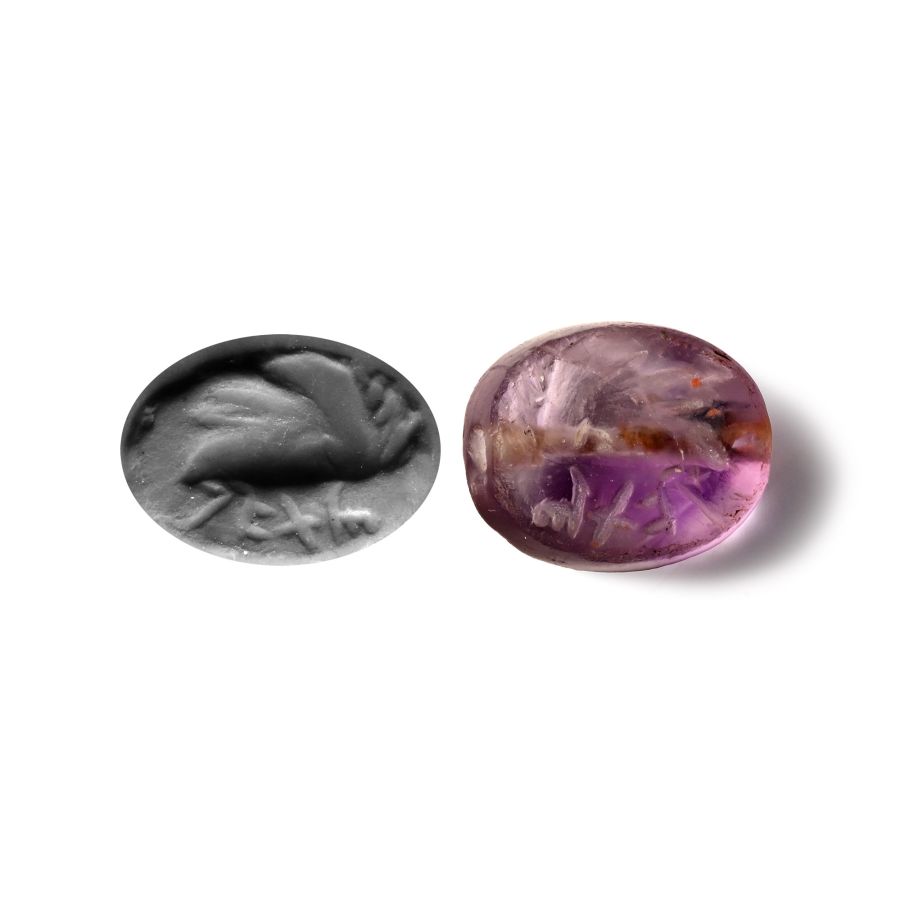
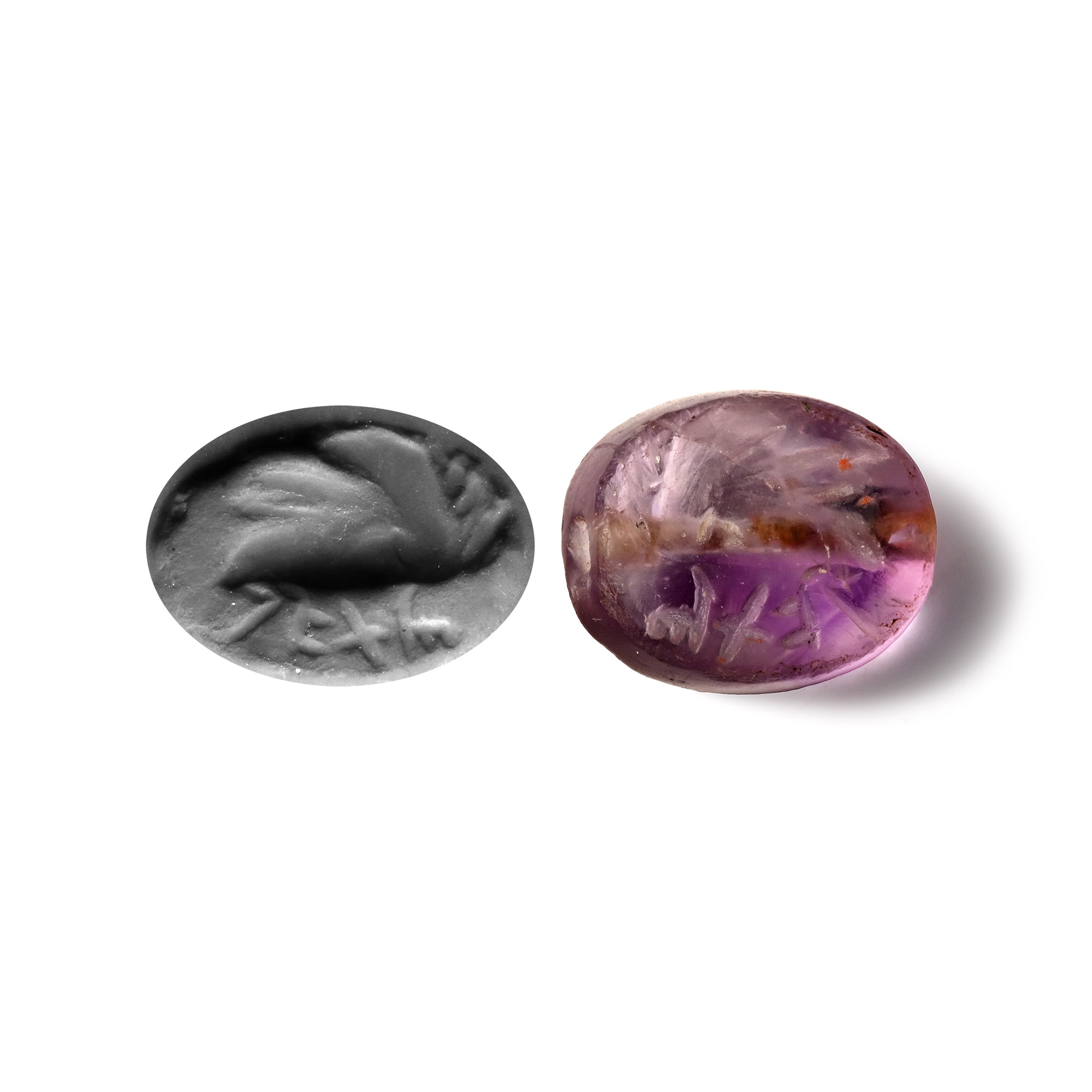
Phoenician Amethyst Scarab with Horse’s Head and Later Aramaic Inscription
LATE 1ST MILLENNIUM B.C.
1/2 in. (1.59 grams, 13 mm).
Scaraboid in form with transverse piercing, four later engraved Aramaic characters engraved to the flat face above a horse-head motif; supplied with a museum-quality impression.
ProvenanceFrom the private collection of the late Mr S.M., London, UK, 1969-1999; thence by descent.
Accompanied by a copy of a previous cataloguing slip.
TimeLine Auctions follows a vetting process to ensure the authenticity and legality of all items, reinforcing our commitment to integrity and responsible trading. Each antiquity, antique, and coin lot undergoes thorough examination by a vetting committee of at least ten external specialists, professional trade association members, scientists, and archaeologists: Our Vetting Process
AUCTIONS:
TimeLine is a leading auction house specialising in antiquities, ancient art, collectables, natural history, coins, medals, and books. Our auctions offer museums, collectors, historians, and enthusiasts the opportunity to acquire unique and historically significant pieces.
LOT 0010
Phoenician Amethyst Scarab with Horse’s Head and Later Aramaic Inscription
Sold for (Inc. bp): £572
-
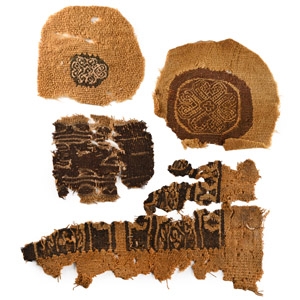
Egyptian Coptic Textile Fragment Group
Circa 5th-6th century A.D.Sold for (Inc. bp): £130
Comprising a fragment of a clavus in white and purple linen and wool, S torsion, the central scene representing a dancer; a small fragment of a double segmenta, ornamented with vegetal embroidery; two orbiculi, one embroidered with a flower inside a rondo and with a cross in the centre, the other with a simple vegetal ornament. 40 grams total including package, 7.2-15.7 cm
Acquired 1970s-1996. Property of a North American collector. London collection, 2016.
The segmentum with the dancer was probably part of the vertical clavus of a tunic; it is highly probable that the embroidery refers to the Dionysian cycle, with dancers, animals and probably, in the missing parts, hunters. -
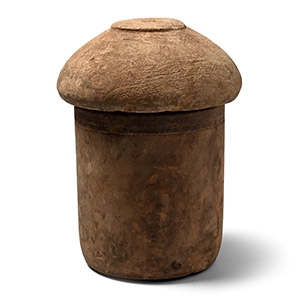
Coptic Wooden Jar with Lid
4th-6th century A.D.Sold for (Inc. bp): £98
Columnar in profile, turned wooden vessel with stepped rim and dark-red painted band below the lip; domed lid with inner locating ring to underside; flat panel to the apex. 147 grams total, 11.5 cm high
London, UK, art market, 1990s. From the collection of G.M.R.H., London, UK. -
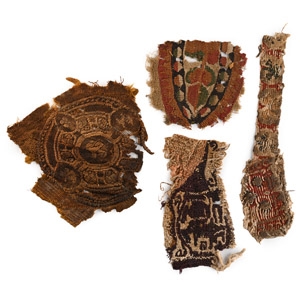
Egyptian Coptic Textile Fragment Group
Circa 4th-5th century A.D.Sold for (Inc. bp): £104
Comprising: a fragment of a clavus in coarse linen and dark brown wool, tapestry, with remains of a medallion embroidered with a lion running right; fragment of an orbiculus in linen and yellow and blue wool, S torsion, embroidered with vegetal and geometric patterns; two terminal fragments of a clavi, in red, green, dark blue and white wool. 58 grams total including package, 8.6-19.5 cm
Acquired 1970s-1996. Property of a North American collector. London collection, 2016.
These are decorative parts of tunics. The lion orbiculus in particular stands out for its delicate design and hunting theme. Dionysus and his entourage were often depicted on these tunics, despite the fact that these fabrics were produced in a by then heavily Christianised empire.
