Loading, please wait...

Parthian Style Marble Female Dignitary Parthian Style Marble Female Dignitary Parthian Style Marble Female Dignitary
Use mousewheel to zoom in and out, click to enlarge
Details

LOT 1950

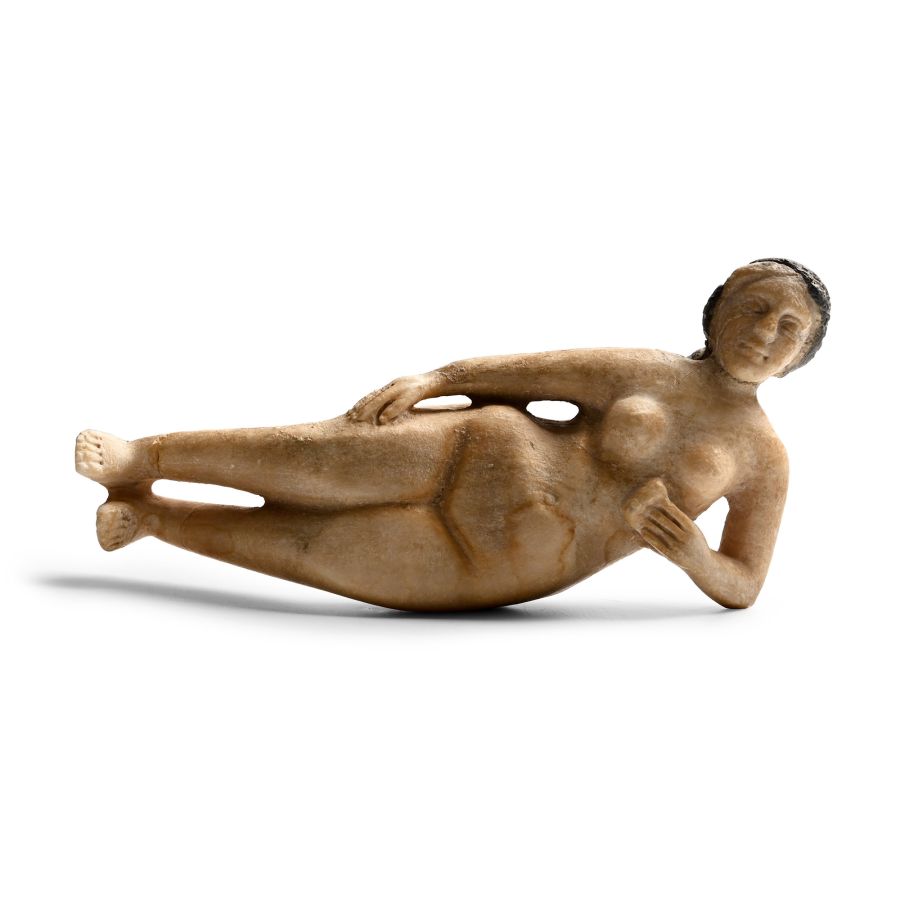
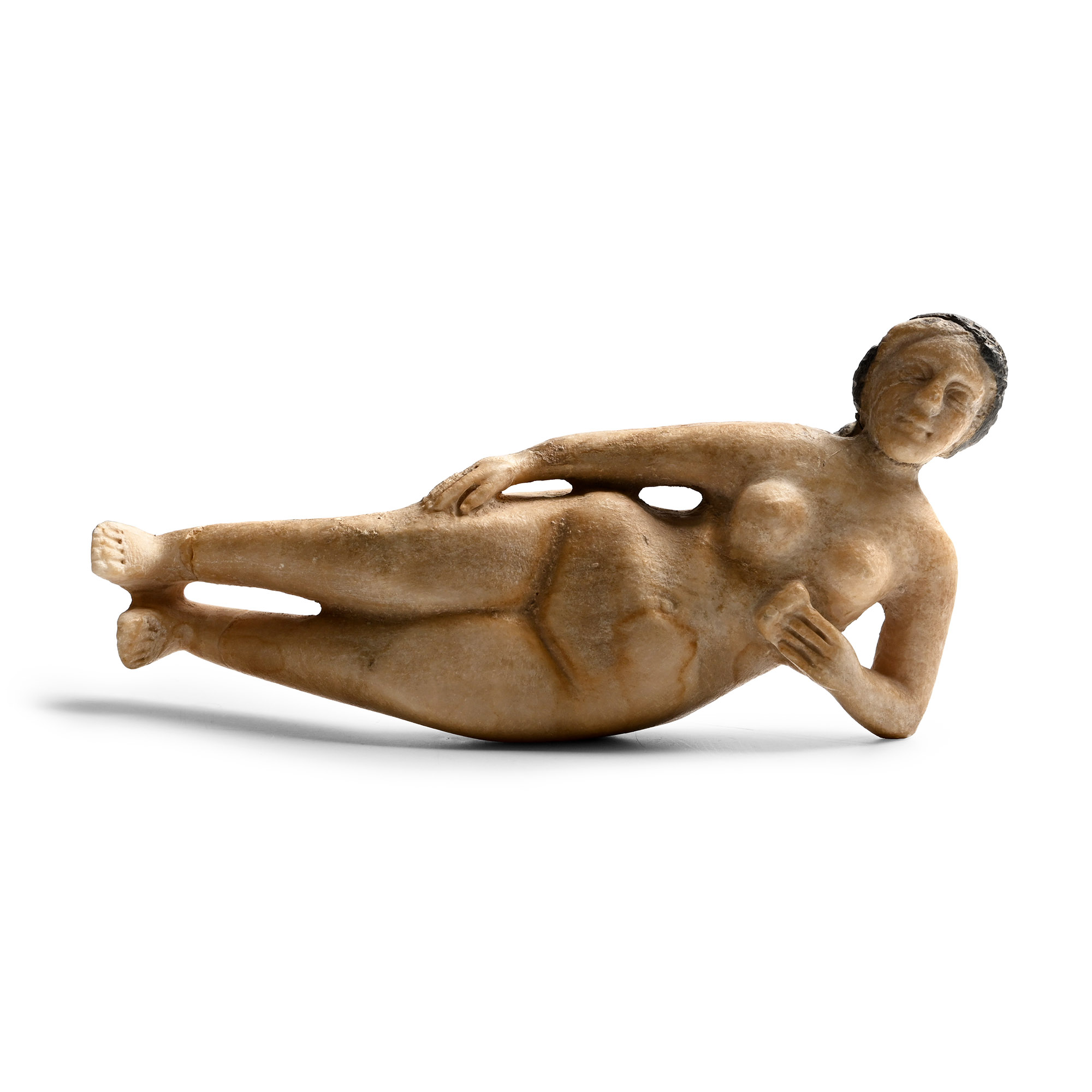
Parthian Style Marble Female Dignitary

20TH CENTURY A.D OR EARLIER

9 3/4 in. (720 grams, 25 cm).

Carved in the round nude female supporting her weight on her left arm and thigh, holding a rectangular block to her side beneath her breast. [No Reserve]

Provenance

Acquired 1970s-1996.
Property of a North American collector.
London collection, 2016.

CONDITION
VETTING:

TimeLine Auctions follows a vetting process to ensure the authenticity and legality of all items, reinforcing our commitment to integrity and responsible trading. Each antiquity, antique, and coin lot undergoes thorough examination by a vetting committee of at least ten external specialists, professional trade association members, scientists, and archaeologists: Our Vetting Process


AUCTIONS:

TimeLine is a leading auction house specialising in antiquities, ancient art, collectables, natural history, coins, medals, and books. Our auctions offer museums, collectors, historians, and enthusiasts the opportunity to acquire unique and historically significant pieces.

LOT 1950

Parthian Style Marble Female Dignitary

Sold for (Inc. bp): £494

Print page

RELATED LOTS
  • Spanish Gold Ring with a Table-Cut Red Spinel
    Spanish Gold Ring with a Table-Cut Red Spinel
    16th-17th century A.D.

    Sold for (Inc. bp): £11,700

    A substantial ring with a box-shaped bezel set with a table-cut red spinel of deep purplish-red hue, the reverse of the bezel convex with chamfered ends. 6.93 grams, 24.30 mm overall, 17.05 mm internal diameter (approximate size British M 1/2 , USA 6 1/4, Europe 13.09, Japan 12)


    Private English collection, formed between the late 1970s and early 1990s. Private collection, UK. This lot has been checked against the Interpol Database of stolen works of art and is accompanied by search certificate number no.12996-245986.

    The box bezel is typical of both Spanish and Islamic goldsmithing traditions. The small pointed projection at the rear of the hoop, however, is not a common feature in Spanish rings but is a distinctive hallmark of Islamic goldwork — a form ultimately rooted in Middle Eastern traditions of the Sasanian, Fatimid, and Mamluk periods. This detail likely reached Spain through the transmission of techniques from the Middle East into Islamic North Africa, and subsequently into the goldsmithing repertoire of al-Andalus. These forms were adapted by Spanish goldsmiths to accommodate the tastes of a Christian clientele, reflecting the deep and enduring influence of Islamic craftsmanship in post-Reconquista Spain.

    Lot Details

  • Russian Orthodox Enamelled Bronze Travel Icon with Anastasis
    Russian Orthodox Enamelled Bronze Travel Icon with Anastasis
    19th century A.D.

    Estimate: £200 - 300 (+bp*)

    Opening Bid: £100

    With blue, yellow, white and green enamel, representing the Anastasis (Resurrection of Christ); the Saviour represented on two registers, in the upper one (Resurrection) emerging from the grave, surrounded by the hesychastic light, with the Roman soldiers falling asleep, and the apostles and a cherubin beside him; in the lower register (Descent into Hades) Christ surrounded by the same divine light, leading the people from the Limbo, Adam and Eve, King David and Salomon and other souls to heaven; the frame decorated with gilt arabesques on blue enamel, inscriptions in Old Slavonic at the top. 200 grams, 11 cm


    Acquired from Chris Martin-Zakheim, Iconastas, 5 Piccadilly Arcade, London SW1. From the private collection of a West London, UK, gentleman, formed since the early 2000s.

    The iconography is typical of the Anastasis or Resurrection of Christ, with the gates of Hades broken under the feet of the Christ, echoing the phrase: 'Christ is Risen From the Dead, Trampling Down Death by Death, and Upon Those in the Tombs Bestowing Life!'

    Lot Details

  • Russian Orthodox Enamelled Bronze Travel Icon with Saint Julitta, Cyricus and Deesis
    Russian Orthodox Enamelled Bronze Travel Icon with Saint Julitta, Cyricus and Deesis
    19th century A.D.

    Estimate: £300 - 400 (+bp*)

    Opening Bid: £150

    With blue enamel and framed by a raised border; Saint Julitta and her son, Cyricus, Saint Gregory the Theologian and Saint John the Chrysostom standing beside them at the centre; three half-length figures above: St. Paraskeva (right), Eudokia, and Barbara (left); OCS inscriptions identifying the saints framing the scene; on the top a deesis, with Christ Pantokrator at the centre, flanked by Saint Mary and Saint John the Precursor; at the top left corner Archangel Michael, on the top right corner the Archangel Gabriel; beneath Saint Gabriel, in vertical order, Saint Paul, Saint Gregory the Theologian, Saint Nicholas of Myra, Saint Demetrios; beneath Saint Michael, in vertical order, Saint Peter, Saint Basil the Great, Saint John Chrysostomos and Saint George; in the last row, nearby Saint Andrew, at the centre, the Archangel Raphael, with sword and cross. 360 grams, 14 cm


    Acquired from Chris Martin-Zakheim, Iconastas, 5 Piccadilly Arcade, London SW1. From the private collection of a West London, UK, gentleman, formed since the early 2000s.

    This icon was intended for private devotion, often carried by pilgrims and Orthodox believers for spiritual protection. St. Julyttas and her son Cyricus (Ки́рик и Иули́тта), among the most venerated figures in Russian tradition, are depicted in the centre, surrounded by other saints, a symbol of the communion of the righteous in front of the Divine Deesis.

    Lot Details

Stay up-to-date with the latest from TimeLine Auctions by joining our mailing list