
Loading, please wait...
LOT 0049
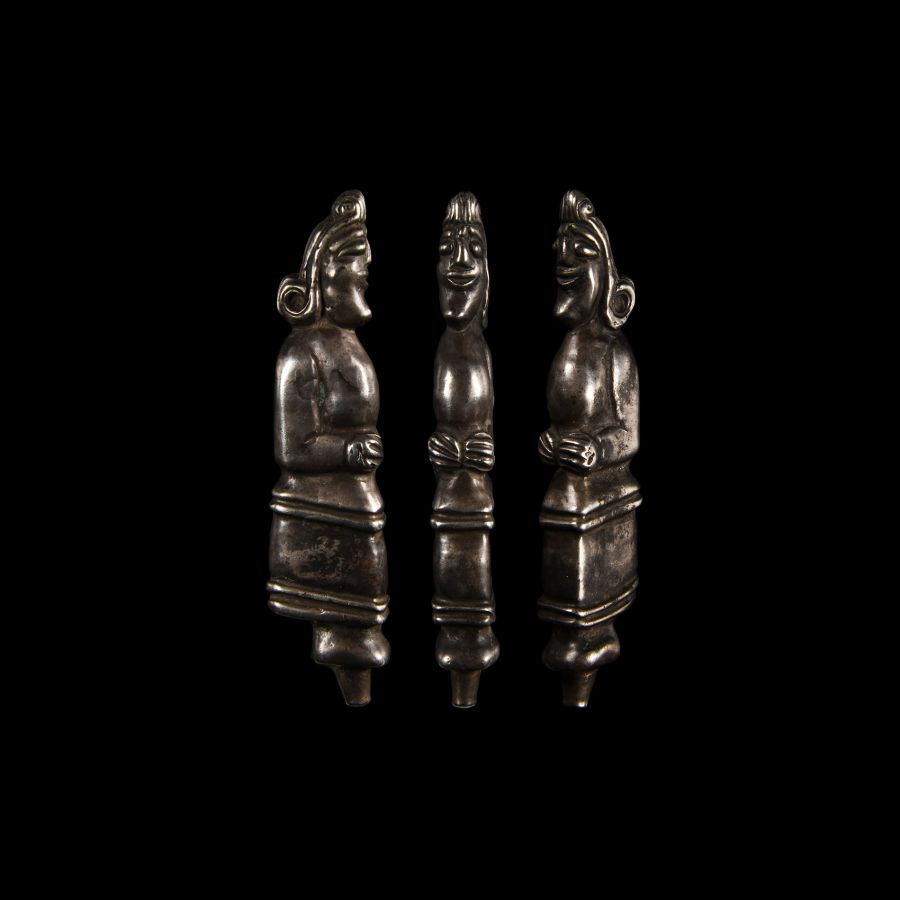
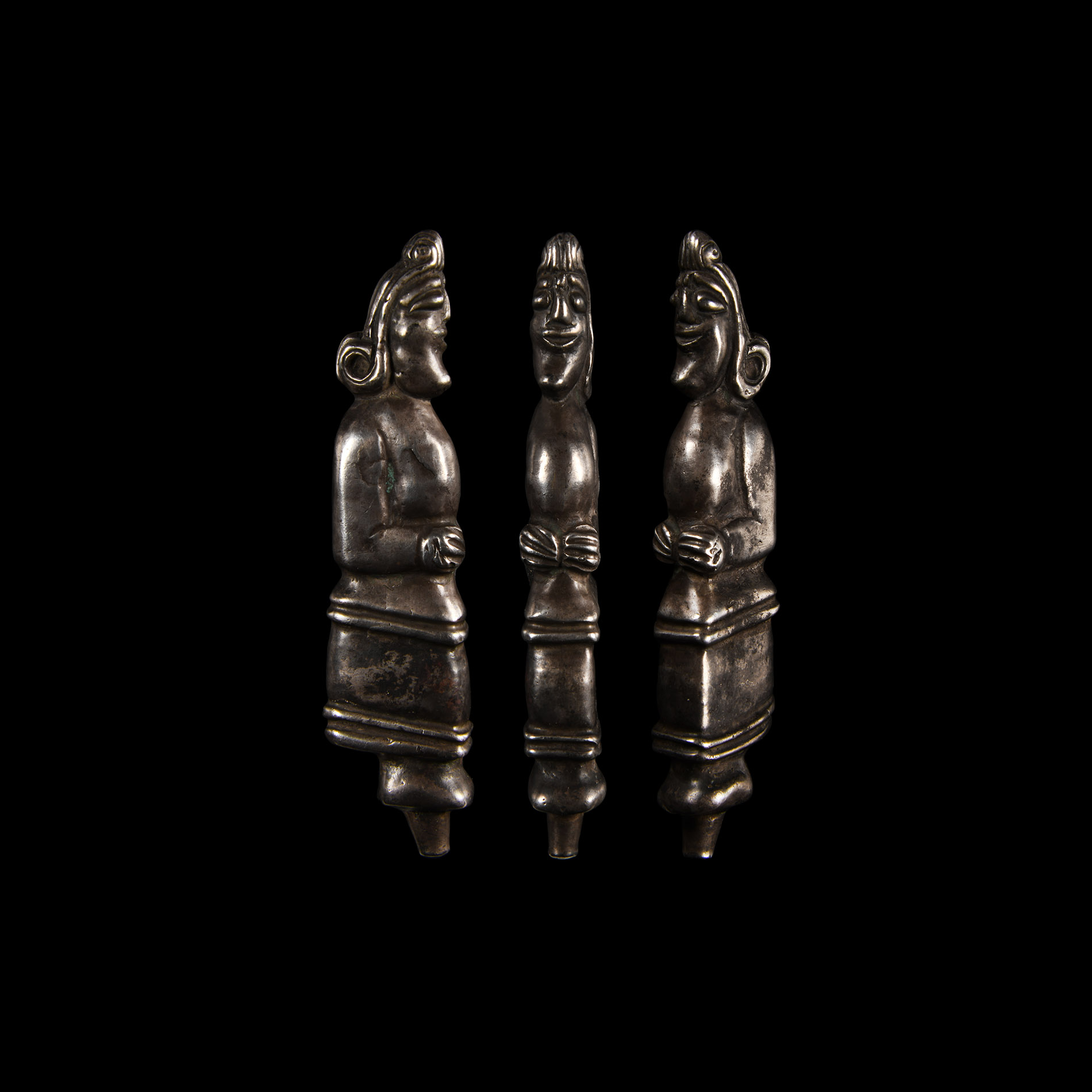
Parthian Figural Silver Dagger Hilt
3RD-1ST CENTURY B.C.
3 3/8 in. (66 grams, 86 mm).
Formed as a standing male figure with swept back, shoulder-length hair, hands held at the waist; mounting lug below.
Provenancewith a London, UK gallery 1971-early 2000s.
FootnotesThis hilt was probably for an acinaces blade, usually 14-18 inches long and used throughout a vast swath of territory encompassing the eastern Mediterranean, the Near East and central Asia, by such diverse cultures as the Parthians, the Medes, the Greeks, and the Scythians.
CONDITIONTimeLine Auctions follows a vetting process to ensure the authenticity and legality of all items, reinforcing our commitment to integrity and responsible trading. Each antiquity, antique, and coin lot undergoes thorough examination by a vetting committee of at least ten external specialists, professional trade association members, scientists, and archaeologists: Our Vetting Process
AUCTIONS:
TimeLine is a leading auction house specialising in antiquities, ancient art, collectables, natural history, coins, medals, and books. Our auctions offer museums, collectors, historians, and enthusiasts the opportunity to acquire unique and historically significant pieces.
LOT 0049
Parthian Figural Silver Dagger Hilt
Estimate £800 - 1,000€930 - 1,160 (for guidance only)$1,080 - 1,350 (for guidance only)
-
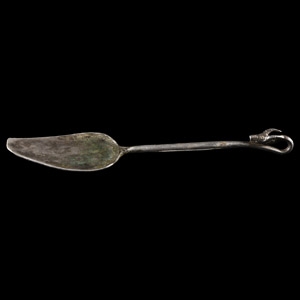
Graeco-Persian Silver Spoon
Circa 3rd century B.C.Sold for (Inc. bp): £338
The shallow 'bowl' or plaque with a squared tip, round-section shank and horned animal had finial with stylised detailing. 30.8 grams, 15 cm
UK collection, early 1990s and before. Acquired on the UK art market since the early 2000s. From a private collection, Lancashire, UK. -
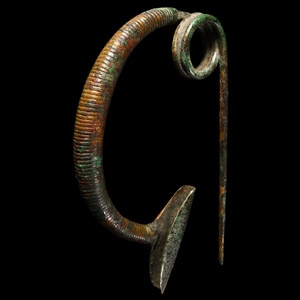
Massive Greek Bow Brooch
8th-6th century B.C.Sold for (Inc. bp): £182
Composed of a faux-twisted round-section body, tapering towards a catchplate and repaired integral coiled pin. 206 grams, 15 cm
Ex Garcia collection, France, 1990s-2000s. -
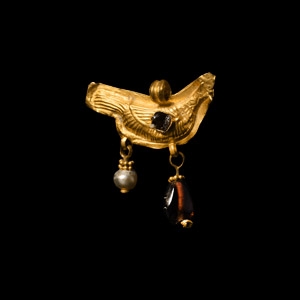
Greek Gold Bird Pendant with Garnet and Pearl Drop
5th-3rd century B.C.Estimate: £400 - 600 (+bp*)
Opening Bid: £222
Composed of a bifacial zoomorphic body in the form of a bird, with detailing to the head and feathers; circular cell to one face containing possible remains of black glass; two dangles below, one featuring a granulated gold bead above a pearl bead, the other a granulated gold bead and a polished garnet stone; ribbed suspension loop above; a marriage. 2.29 grams, 26 mm
Fine condition.
Acquired 1970-2010. Collection of a late Japanese gentleman.
