
Loading, please wait...
LOT 1974
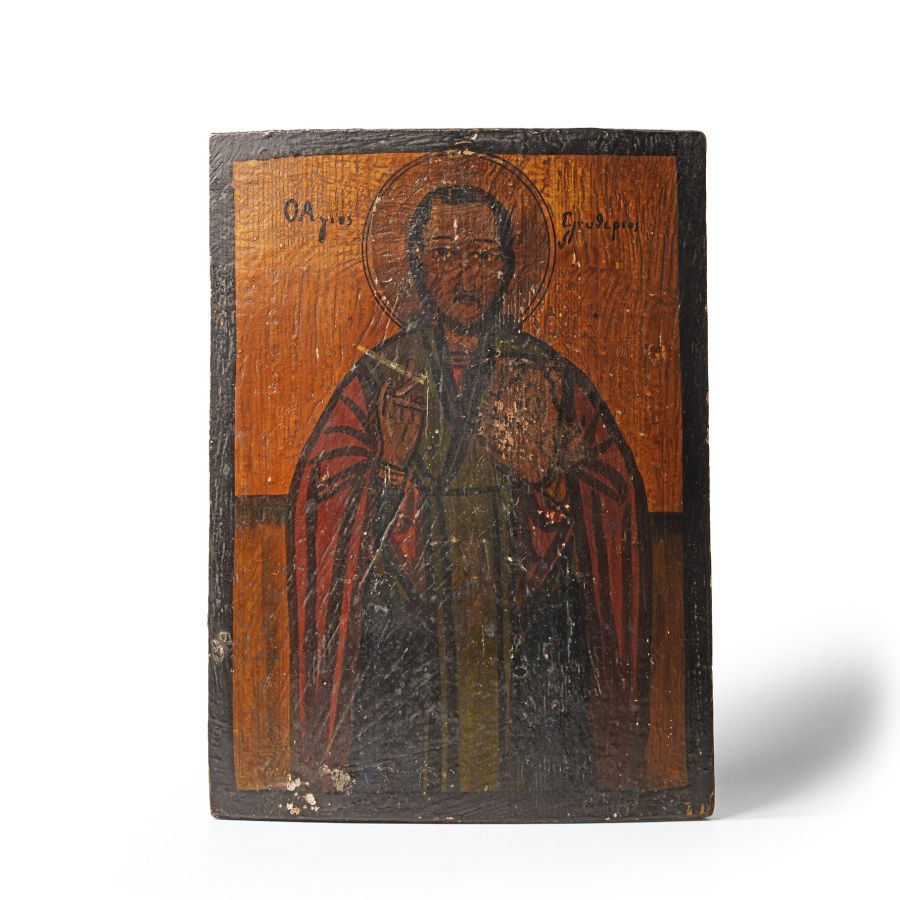
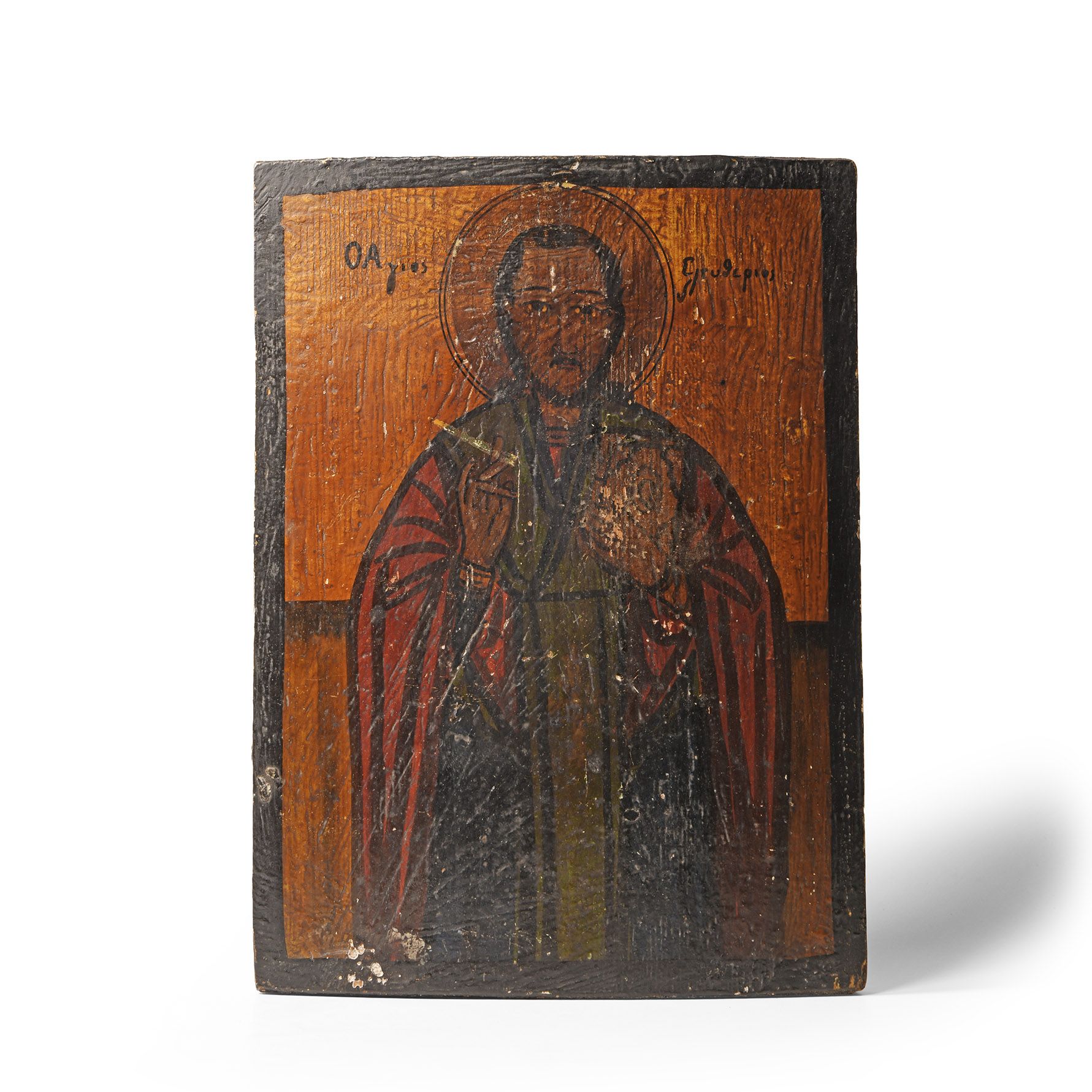
Painted Wooden Icon of Saint Eleutherios
CIRCA 19TH CENTURY A.D.
13 1/4 in. (596 grams, 33.5 cm).
Depicting a robed and nimbate figure of Saint Eleutherios, facing, hands gesturing in front of his chest, text in Greek across left and right fields reading 'O Aγιος Ἐλευθέριος,' (Saint Eleutherios).
ProvenanceEx French gallery, Paris.
LiteratureCf. similar icon (style and face) of Nikolaos Kallergis (18th century), in Byzantine Museum of Zakynthos; for the iconography of Saint Eleftherios see also Frantz, A., 'Late Byzantine paintings in the Agora' in American School of Classic Studies in Athens,Volume 4, Issue 3, pp. 442-469, pl.VI.
FootnotesAs bishop in Illyricum, Eleutherios promoted Christianity at a time when the persecutions not only made it difficult to win and hold converts, but also at a time when it was very dangerous to be a high-ranking prelate of the church. Oblivious to this threat, he was acclaimed in the inner circle of Christianity as the brightest luminary of Christian Rome since the apostles. His immense popularity grew and thereby became more dangerous to the state. He was finally brought to the attention of Emperor Hadrian, who ordered his arrest, tortured and put him to death on December 15th.
CONDITIONTimeLine Auctions follows a vetting process to ensure the authenticity and legality of all items, reinforcing our commitment to integrity and responsible trading. Each antiquity, antique, and coin lot undergoes thorough examination by a vetting committee of at least ten external specialists, professional trade association members, scientists, and archaeologists: Our Vetting Process
AUCTIONS:
TimeLine is a leading auction house specialising in antiquities, ancient art, collectables, natural history, coins, medals, and books. Our auctions offer museums, collectors, historians, and enthusiasts the opportunity to acquire unique and historically significant pieces.
LOT 1974
Painted Wooden Icon of Saint Eleutherios
Estimate £200 - 300€230 - 350 (for guidance only)$270 - 410 (for guidance only)
-
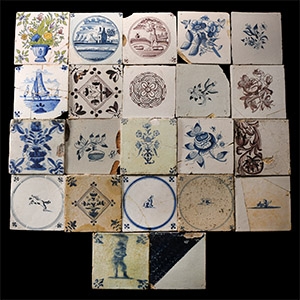
Post Medieval Dutch Glazed Ceramic Tile Group
Circa 17th-18th century A.D.Sold for (Inc. bp): £111
Comprising glazes of different colours and designs, including geometric motifs, wild animals, flowering plants, figural scenes and buildings in landscapes. 5.8 kg total, 13 x 13 - 13 x 13.5 cm
Acquired 1990s-early 2000s. East Anglian private collection. -
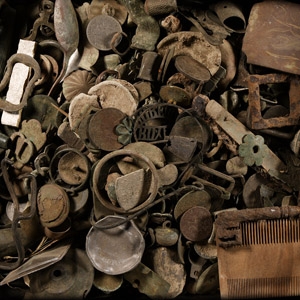
Mixed Copper-alloy Artefact Collection
20th century A.D. and earlierSold for (Inc. bp): £13
Comprising a large quantity of buttons, coins, furniture and other fittings, weights, buckles, crotal bells, thimbles, knives and other miscellaneous items. 4.5 kg total, 1-10.5 cm
Acquired 1990s-early 2000s. East Anglian private collection. -
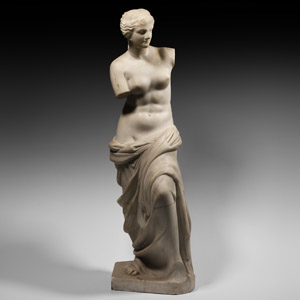
Marble Venus of Milo Statue
19th century A.D.Estimate: £1,000 - 1,400 (+bp*)
Opening Bid: £556
A copy of the famous Venus of Milo, naturalistically portrayed with her garment having fallen from her shoulders, hanging loose at her waist and exposing her breasts. 34.8 kg, 77 cm high
French collection, 1960s-early 2000s. From an important Paris gallery, France.
Aphrodite of Milos, better known as the Venus of Milo, is an ancient Greek statue and one of the most famous works of ancient Greek sculpture known today, created between 130-100 years B.C. The original is currently displayed at the Louvre in Paris.
