Loading, please wait...
LOT 1054
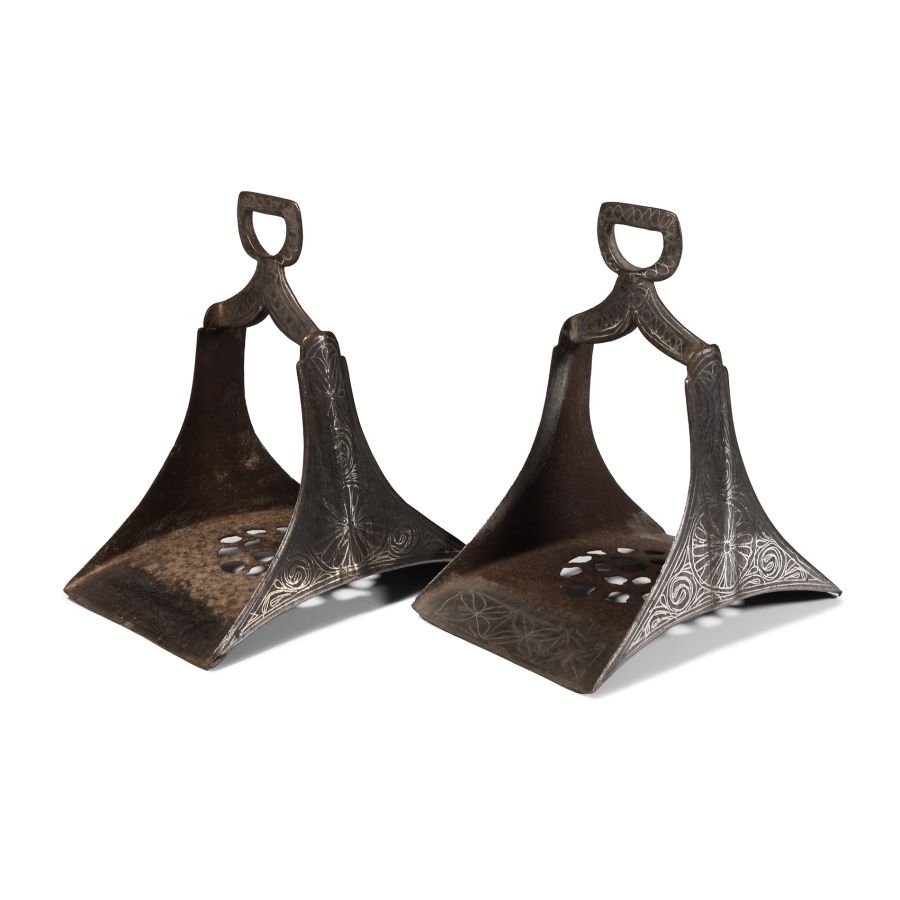
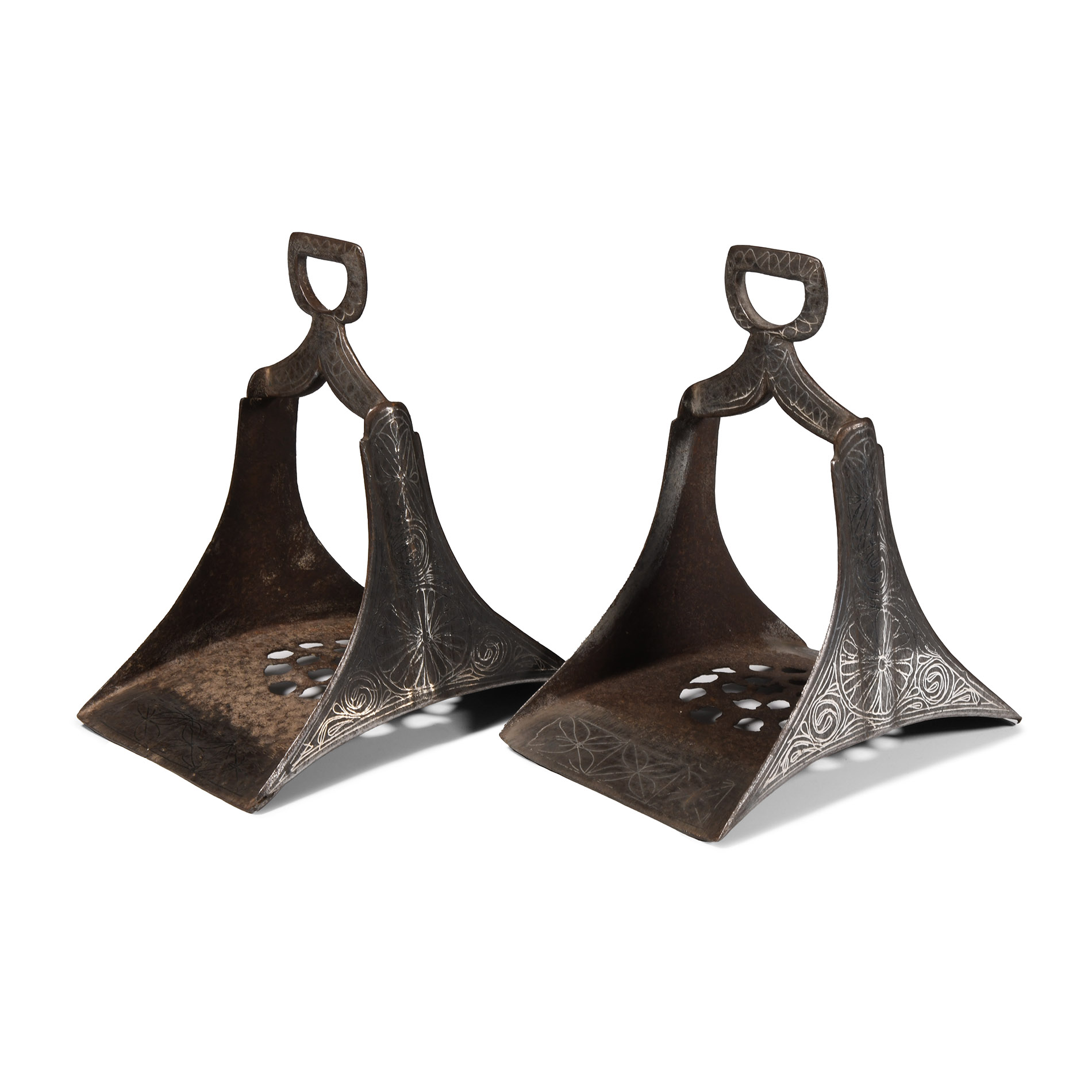
Ottoman Silvered Stirrup Pair
18TH CENTURY A.D.
7 7/8 in. (1.29 kg total, 20 cm high each).
Each with a broad arched and footrest with bell-shaped piercings, triangular sidepieces chiselled with geometric patterns and retaining the majority of their silver inlay, rising to D-shaped strap ring; the surfaces chiselled with geometric patterns. [2]
ProvenanceAcquired from Garth Vincent, Antique Arms & Armour, Lincolnshire, UK, 2015.
The Kusmirek Collection, UK.
Accompanied by copy of the purchase invoice and description.
TimeLine Auctions follows a vetting process to ensure the authenticity and legality of all items, reinforcing our commitment to integrity and responsible trading. Each antiquity, antique, and coin lot undergoes thorough examination by a vetting committee of at least ten external specialists, professional trade association members, scientists, and archaeologists: Our Vetting Process
AUCTIONS:
TimeLine is a leading auction house specialising in antiquities, ancient art, collectables, natural history, coins, medals, and books. Our auctions offer museums, collectors, historians, and enthusiasts the opportunity to acquire unique and historically significant pieces.
-
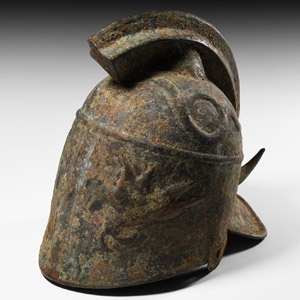
Pseudo-Illyrian Chalcidian Variant Bronze Helmet
4th-1st century B.C.Estimate: £5,000 - 7,000 (+bp*)
Opening Bid: £1,667
Large rounded two-part bowl rivetted beneath the repoussé crest extending across the brow and around the circumference; repoussé arches above the eyes extending to the nasal; lateral D-shaped cheek-pieces with scallop to the forward edge, pierced for a chin-strap; some restoration of the bowl and one cheek-piece; mounted on a custom-made display stand. 4.7 kg total, 48 cm high including stand
Acquired 1971-1972. From the collection of the vendor's father. Property of a London, UK, collector. Accompanied by an academic report by Dr Raffaele D’Amato. This lot has been checked against the Interpol Database of stolen works of art and is accompanied by search certificate number no.11751-202770.
According both to Symonenko and Dedjulkin (2014, p.189, fig.9, nn.4-5-6), this category of helmet derives from Chalcidian types (with pseudo-Illyrian elements). As with Chalcidian helmets, our specimen shows vertical decorative lines on the bowl and triangular brow ornament. Distinct from Attic types, it does not have a protruding neck guard introduced on variant III of such helmets (Symonenko, 2014, fig. 15,2-3). According to Dedjulkin, these helmets derive from Greek prototypes, but are simplifications of the original models and made by local artisans. They were widely worn by mercenaries in the Hellenised armies of Pontus and other Hellenistic kingdoms across the Eastern Mediterranean. -
Western Asiatic Bronze Long Sword
2nd-1st millennium B.C.Sold for (Inc. bp): £182
Composed of a tanged and barbed blade with raised midrib to both faces, extending the full-length of the weapon. 470 grams, 57 cm
Private UK collection, 1980s. Ex London gallery.
In the last ninety years many such tanged blades have been considered coming from centres of production of North-West Iran, like Amlash and Marlik. Without context an accurate dating is impossible, but the shape recalls the rapiers of Bronze Age or Early Iron Age. -
Volga Silver-Gilt Sword Belt Mount Group
11th-12th century A.D.Sold for (Inc. bp): £195
Comprising: two matching ogival plates with pellet borders; a trefoil plate with border of radiating lines framing three concentric circle and oval motifs; a plate with five lobes decorated with dashed lines and six concentric oval motifs at the centre; ogival plate with scalloped border, trefoil motif at centre; ogival plate with pellet border divided into three 'petals' by larger single pellets, scrolling vegetal motif; a floral style plate composed of discoid dimples; irregular hexagonal plate, the shape repeated at the centre, pellet border; trilobate plate with three single pellets to the perimeter and pellet border; ogival plate with expanded waist, raised 'wings' and rounded lozenge against a background of radiating lines; nine with three attachment lugs to reverse, one with two lugs. 31.8 grams total, 17-26 mm
Fine condition.
Acquired in the 1980s-1990s. Ex an important central London gallery, London W1.
The belt fittings find various comparisons with non-ferrous belt appliqués found in the territories of the Volga Bulgars, like specimens from the Semenovsky village. These items were parts of long warrior belts, the leather surfaces decorated all over with such bronze and silver appliqués. Symbols of ranks and elite warrior aristocracy, these belts also served a utilitarian purpose of suspending weapons such as a bow, quiver or a sabre.