
Loading, please wait...
_900x900.jpg "Orange Glass Intaglio")
_200x200.jpg "Orange Glass Intaglio")
.jpg "Orange Glass Intaglio")
LOT 0901
Orange Glass Intaglio
ROMAN, 3RD-4TH CENTURY A.D. OR LATER
3/4 in. (2.61 grams, 19 mm).
The banded glass imitating banded agate; intaglio scene composed of a crowned figure standing right, holding a cornucopia and wreath, an eagle standing beside. [No Reserve]
ProvenanceFrom an early 20th century collection, Caernarfon, North Wales, UK.
LiteratureCf. Ravinho, G., ‘Roman Engraved Gems in the National Archaeological Museum in Lisbon’ in Studies in ancient Art and Civilization, vol.21, 2017, pp.173-245, fig.8, pl.1.
FootnotesThe gem appears to represent Zeus with a cornucopia on his right arm and a crown in his left hand, with the eagle, his symbol, at his feet. The eagle has its head turned back, and stands looking up towards him.
CONDITIONTimeLine Auctions follows a vetting process to ensure the authenticity and legality of all items, reinforcing our commitment to integrity and responsible trading. Each antiquity, antique, and coin lot undergoes thorough examination by a vetting committee of at least ten external specialists, professional trade association members, scientists, and archaeologists: Our Vetting Process
AUCTIONS:
TimeLine is a leading auction house specialising in antiquities, ancient art, collectables, natural history, coins, medals, and books. Our auctions offer museums, collectors, historians, and enthusiasts the opportunity to acquire unique and historically significant pieces.
-
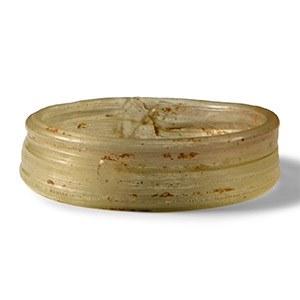
Late Roman Glass Bangle
5th-7th century A.D.Sold for (Inc. bp): £117
Aqua-coloured glass lamp-work bangle with ribbed construction. 29.5 grams, 66 mm
Acquired from Allan Cherry, Bournemouth, UK, 2005. Ian Wilkinson collection, Nottinghamshire, UK. Accompanied by an illustrated display card.
The type is well known in the Eastern Empire from the 5th to the 7th century A.D. Usually these bracelets are decorated on outer surface with five continuous parallel horizontal ribs. -
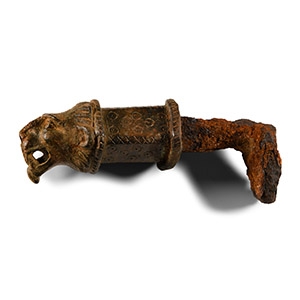
Large Roman Bronze Lion-Headed Iron Key
1st-4th century A.D.Sold for (Inc. bp): £572
Iron shank with perpendicular wards, square-section bronze handle with incised geometric ornament, lion-head finial with open mouth to accept a suspension ring. 125 grams, 86 mm
Ex German art market, 2000s. Acquired from an EU collector living in London. From the collection of Surrey, UK, gentleman. -
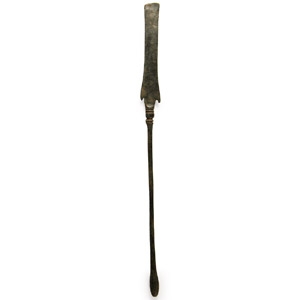
Roman Bronze Ligula Medical Instrument
1st-4th century A.D.Sold for (Inc. bp): £72
Comprising a round-section shank with bulb finial, balustered neck, flat chisel-blade with barbs to the rear. 11 grams, 17.6 cm
From the Garcia collection, France, 1990s.
