
Loading, please wait...
_900x900.jpg "Old Babylonian Haematite Cylinder Seal with Inscription")
_200x200.jpg "Old Babylonian Haematite Cylinder Seal with Inscription")
.jpg "Old Babylonian Haematite Cylinder Seal with Inscription")
LOT 0242
Old Babylonian Haematite Cylinder Seal with Inscription
CIRCA 1900-1600 B.C.
1 1/4 in. (15.9 grams, 30 mm).
Accompanied by a copy of an old scholarly note, typed and signed by W.G. Lambert, late Professor of Assyriology, University of Birmingham, 1970-1993, which states: 'Two standing gods face a complex scene. The first deity is a Lamma goddess, in horned tiara, long flounced robe, and she is raising both hands. Behind her stands the god with mace: hat with deep brim, clothes to the knees, and holding his mace at the waist. What they are witnessing is a standing monster: general build of a lion, but wings, a brush tail and talons of a bird of prey for legs. Its head is leaning down. Above it stands a god in long robe and long tiara, with one leg projecting and foot resting on some strange being. The god holds a whip over one shoulder and forked lightning in the other hand. Facing him in the distance is a small walking figure holding up some object. A two-line cuneiform inscription names two gods: Adad and Shala. This is an Old Babylonian seal, c. 1900-1600 B.C. It is somewhat worn, but the design is rare for the animal and god above it. This god is Adad, the storm god, identified by whip, forked lightning, and the animal on which he stands, which was passed down to the Old Babylonian period from the Akkad period. Thus the design is of considerable interest. Shala was the wife of Adad.'; supplied with a museum-quality impression.
ProvenanceFrom the private collection of a North American lady, formed 1970s-early 1990s, with collection reference no.P105.
Accompanied by a copy of a scholarly note, typed and signed by Professor Wilfrid George Lambert.
This lot has been cleared against the Art Loss Register database, and is accompanied by an illustrated lot declaration signed by the Head of the Antiquities Department, Dr Raffaele D'Amato.
TimeLine Auctions follows a vetting process to ensure the authenticity and legality of all items, reinforcing our commitment to integrity and responsible trading. Each antiquity, antique, and coin lot undergoes thorough examination by a vetting committee of at least ten external specialists, professional trade association members, scientists, and archaeologists: Our Vetting Process
AUCTIONS:
TimeLine is a leading auction house specialising in antiquities, ancient art, collectables, natural history, coins, medals, and books. Our auctions offer museums, collectors, historians, and enthusiasts the opportunity to acquire unique and historically significant pieces.
LOT 0242
Old Babylonian Haematite Cylinder Seal with Inscription
Sold for (Inc. bp): £1,040
-
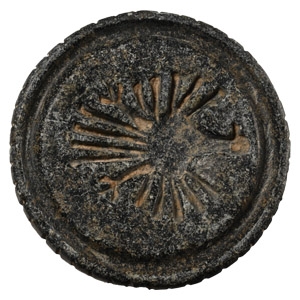
Anatolian Black Stone Stamp Seal
2nd-1st millennium B.C.Sold for (Inc. bp): £130
Discoid in plan with hatching to the rim and the pierce lug to the reverse; deep border and intaglio motif of a spread eagle with segmented wings and tail. 42 grams, 49 mm
From the collection of Mr S.M., London, UK, formed from 1979-1999. This lot has been cleared against the Art Loss Register database, and is accompanied by an illustrated lot declaration signed by the Head of the Antiquities Department, Dr Raffaele D'Amato. -
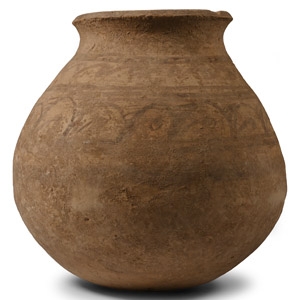
Western Asiatic Painted Terracotta Jar
2nd-1st millennium B.C.Sold for (Inc. bp): £59
Globular in profile with broad everted rim, bands of painted frieze detailing. 3 kg, 26 cm
From a West London, UK, collection, 1990s. This lot has been cleared against the Art Loss Register database, and is accompanied by an illustrated lot declaration signed by the Head of the Antiquities Department, Dr Raffaele D'Amato. -
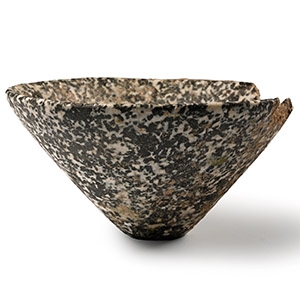
Mesopotamian Granite Bowl
3rd millennium B.C.Sold for (Inc. bp): £234
Conical in profile with narrow base and rounded rim; diorite; rim chipped. 184 grams, 10 cm
Private Swiss collection. Acquired in 1999. Private collection, Europe. This lot has been cleared against the Art Loss Register database, and is accompanied by an illustrated lot declaration signed by the Head of the Antiquities Department, Dr Raffaele D'Amato.
