
Loading, please wait...
_900x900.jpg "Old Babylonian Cuneiform Administrative Tablet Listing Twelve Names")
_200x200.jpg "Old Babylonian Cuneiform Administrative Tablet Listing Twelve Names")
_900x900.jpg "Old Babylonian Cuneiform Administrative Tablet Listing Twelve Names")
_200x200.jpg "Old Babylonian Cuneiform Administrative Tablet Listing Twelve Names")
.jpg "Old Babylonian Cuneiform Administrative Tablet Listing Twelve Names")
.jpg "Old Babylonian Cuneiform Administrative Tablet Listing Twelve Names")
LOT 0186
Old Babylonian Cuneiform Administrative Tablet Listing Twelve Names
20TH-19TH CENTURY B.C.
3 in. (73 grams, 76 mm).
Tongue-shaped tablet with impressed cuneiform text to one broad face and the upper part of the reverse.
ProvenanceFrom the private collection of the late Dr D.G., 1990s.
LiteratureCf. cuneiform text from Babylon now in the Metropolitan Museum of Art, New York, under accession no.86.11.282.
CONDITIONTimeLine Auctions follows a vetting process to ensure the authenticity and legality of all items, reinforcing our commitment to integrity and responsible trading. Each antiquity, antique, and coin lot undergoes thorough examination by a vetting committee of at least ten external specialists, professional trade association members, scientists, and archaeologists: Our Vetting Process
AUCTIONS:
TimeLine is a leading auction house specialising in antiquities, ancient art, collectables, natural history, coins, medals, and books. Our auctions offer museums, collectors, historians, and enthusiasts the opportunity to acquire unique and historically significant pieces.
LOT 0186
Old Babylonian Cuneiform Administrative Tablet Listing Twelve Names
Sold for (Inc. bp): £1,170
-
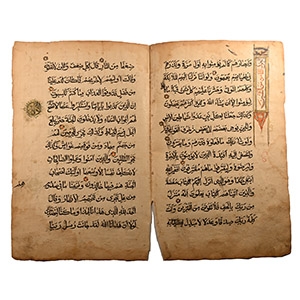
Quran Manuscript Two-Page Spread
18th-19th century A.D.Sold for (Inc. bp): £20
Loose paper pages with handwritten text in Naskh script, thirteen lines of text to each side, red and blue inked rings as punctuation, decorative side-panel with perpendicular text; torn at the central fold, edges chipped. 11 grams, 34.5 x 43 cm
From the private collection of M. Cummings, Lincolnshire, UK, 1990s. -
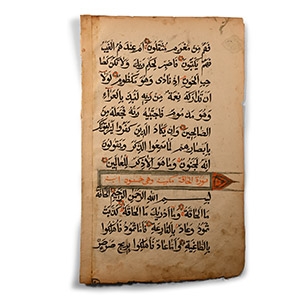
Single Quran Manuscript Page
18th-19th century A.D.Sold for (Inc. bp): £20
Loose paper leaf with handwritten text in Naskh script, thirteen lines of text to each side, red and blue inked rings as punctuation, decorative inset panel with red-ink text, marginal arabesque painted motif; one long edge reinforced, edges chipped. 6 grams, 34 cm
From the private collection of M.Cummings, Lincolnshire, UK, 1990s. -
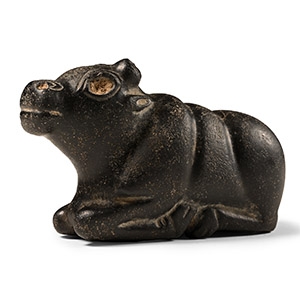
Large Uruk Period Black Stone Bull Figure
3rd-2nd millennium B.C.Sold for (Inc. bp): £4,550
Carved in the round as a crouching bull with its legs folded underneath the body, tail tucked between the hindlegs and resting against the side of the right side of the body; the beast's head held high with drilled nostrils and recessed eyes to accept inlays, the base of the horns drilled to accept separate inserts. 223 grams, 90 mm
Ex S. collection, London, UK, 1980s-2000s. This lot has been checked against the Interpol Database of stolen works of art and is accompanied by search certificate number no.12254-222311.
