
Loading, please wait...

LOT 1384
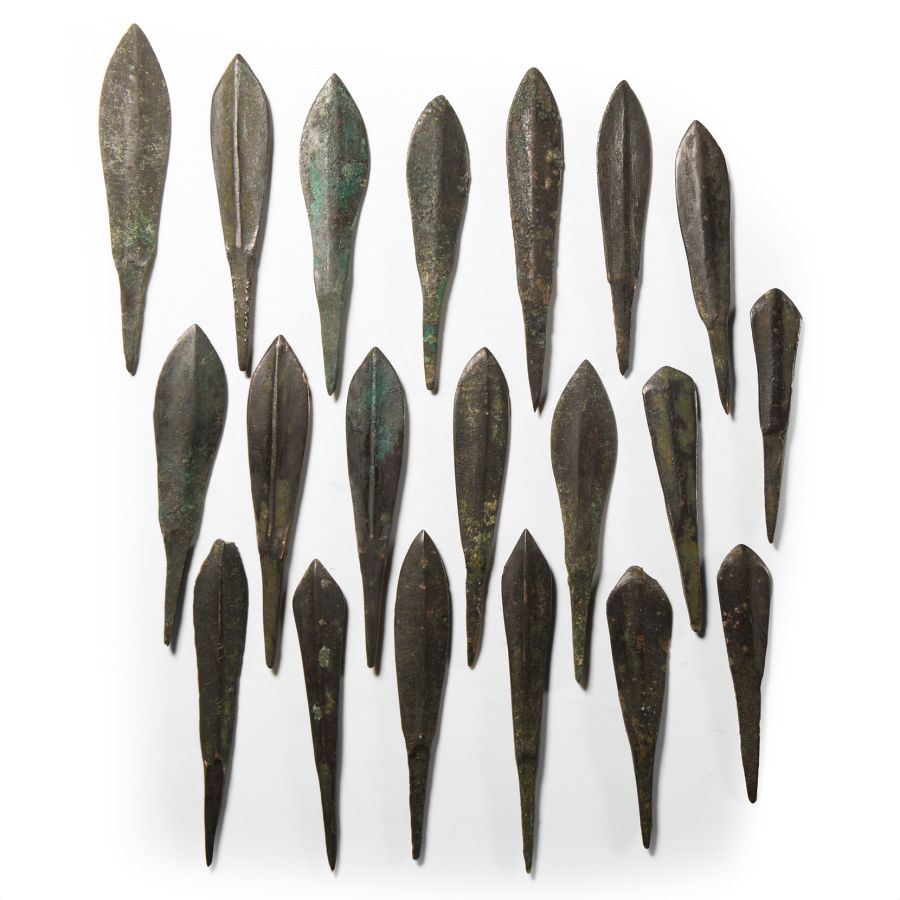
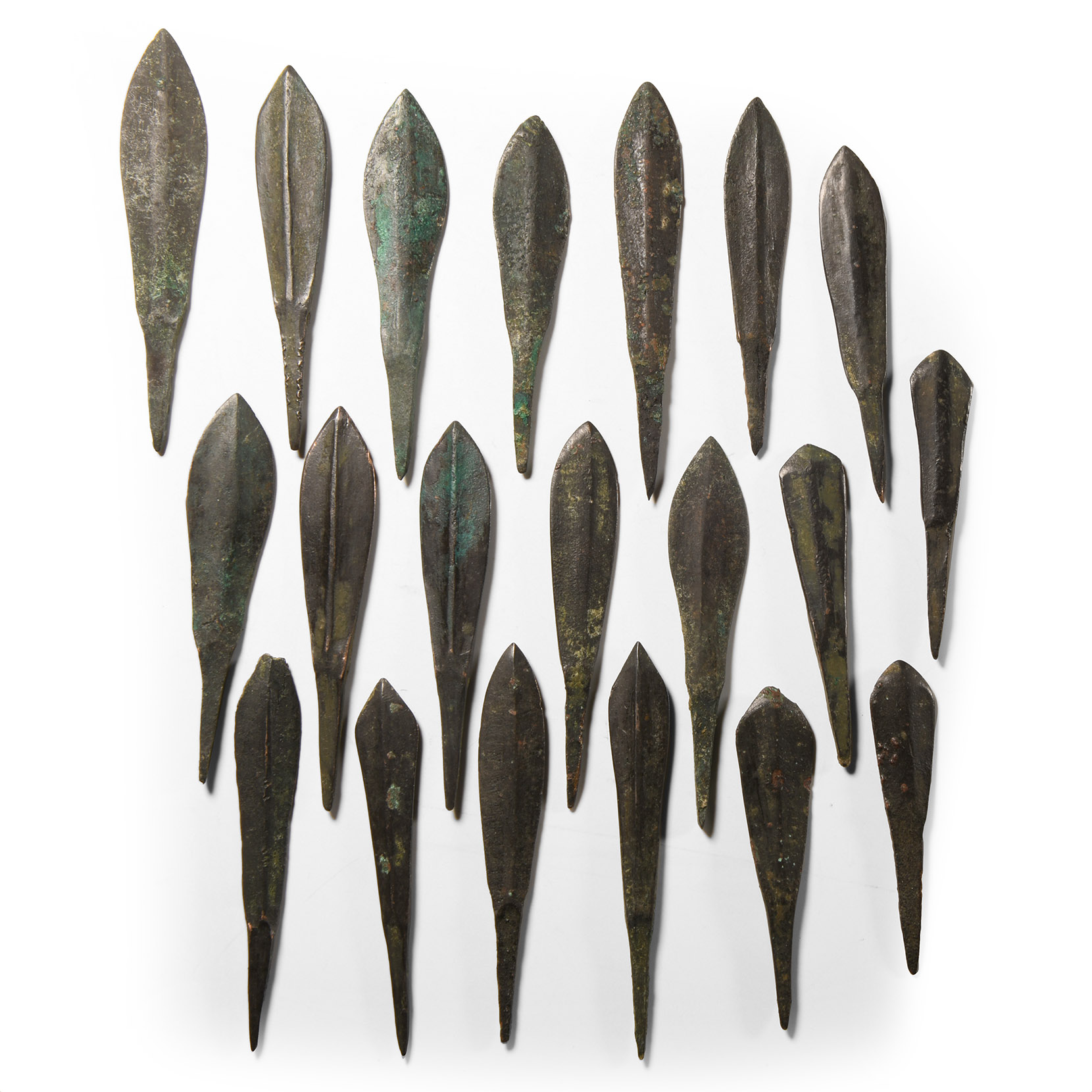
Old Babylonian Bronze Arrowhead Collection
1800-1500 B.C
2 1/4 - 3 1/8 in. (177 grams total, 57-80 mm).
Comprising paddle-shaped arrowheads with a flat, comparatively wide mid-rib. [20, No Reserve]
ProvenanceUK private collection before 2000.
Acquired on the UK art market.
Property of a London gentleman.
Cf. for similar arrow-points Gorelik, M., Weapons of Ancient East, IV millennium BC-IV century BC, Saint Petersburg, 2003, in Russian, (plate XLIII, nos.26-27, 92-93).
FootnotesThese kind of arrowheads were typical of the Old Babylonian Empire. The shoulders were pronounced and the arrowhead had a rectangular-section tapering tang. This simple form was popular throughout and show comparative common finds in the Holy Land.
CONDITIONTimeLine Auctions follows a vetting process to ensure the authenticity and legality of all items, reinforcing our commitment to integrity and responsible trading. Each antiquity, antique, and coin lot undergoes thorough examination by a vetting committee of at least ten external specialists, professional trade association members, scientists, and archaeologists: Our Vetting Process
AUCTIONS:
TimeLine is a leading auction house specialising in antiquities, ancient art, collectables, natural history, coins, medals, and books. Our auctions offer museums, collectors, historians, and enthusiasts the opportunity to acquire unique and historically significant pieces.
-
Viking Age Ugro-Finnian Battle Axehead
11th-12th century A.D.Sold for (Inc. bp): £117
A hand-forged iron axehead with square chin to the blade, flanges raised to the socket, rear round hammer-head. 200 grams, 15.5 cm
From the private collection of a London gentleman, from his grandfather's collection formed before the early 1970s.
The more commonly used weapons of the Finno-Ugrian people were axes, commonly found in all Finnic areas, as well as spears. Iron axeheads of this typology show a sub-trapezoidal asymmetrical blade. -
Western Asiatic Bronze Short Sword with Integral Hilt with Horns
Late 2nd-1st millennium B.C.Estimate: £200 - 300 (+bp*)
Opening Bid: £100
A bronze dagger blade with prominently curved guard, which extends out from the ricasso of the blade and partly frames the hilt, thick flat midrib extending slightly above the ricasso where it held the hilt. 466 grams, 53 cm
Acquired 1980-2015. Ex Abelita family collection.
The hilt of such swords was made separately, and unfortunately is nearly always missing from the archaeological records. Similar daggers had a northern Iranian background and excavated examples have been recorded from the South Caspian Area from Tomadjan and Ghalekuti. -
.jpg)
Arab 'Greek Fire' Ceramic Fire Bomb or Hand Grenade
13th century A.D.Sold for (Inc. bp): £169
Piriform body decorated with concentric circles inside a pointed star pattern, with domed filler-hole, intended to be filled with explosive liquid and wick, used as a hand grenade. 610 grams, 11.5 cm
Acquired 1980-2015. Ex Abelita family collection.
The Arabs, following the Roman examples, made great use of these weapons. The efficiency of the weapon appears, for example, from the account of the siege of Akka in 1189, given by the contemporary historian Ibn al-Athir. He tells how the Christians exercised their engineering skill and built mighty beffroys. The situation was hopeless for the defending Arabs until a man from Damascus showed up, because he knew how to produce Greek Fire: ‘To trick the Christians he first threw some vesseIs with naptha and other things, which were not set on fire, upon one of the beffroy’s, and it was without power. The Christians...climbed the top of the beffroy...the man from Damascus waited until the contents of the vessels were spread all over. When the moment came, he threw a new pot, which was set on fire. In a few moments the fire was spread all over, and the beffroy was eaten up by the flames. The fire was spread in such a hurry that the Christians could not manage to climb down from the beffroy. Men, weapons, everything was eaten up by the flames.’
