
Loading, please wait...
_900x900.jpg "Old Babylonian Alabaster Cylinder Seal")
_200x200.jpg "Old Babylonian Alabaster Cylinder Seal")
.jpg "Old Babylonian Alabaster Cylinder Seal")
LOT 1310
Old Babylonian Alabaster Cylinder Seal
EARLY 2ND MILLENNIUM B.C.
1/2 in. (1.16 grams, 14 mm).
With frieze of robed figures in procession; supplied with a museum-quality impression. [No Reserve]
ProvenanceEx Cotswold collection, UK, 1980-1990.
Examined by Professor Wilfrid George Lambert FBA (1926-2011), historian, archaeologist, and specialist in Assyriology and Near Eastern archaeology, in the late 1980s and 1990s.
TimeLine Auctions follows a vetting process to ensure the authenticity and legality of all items, reinforcing our commitment to integrity and responsible trading. Each antiquity, antique, and coin lot undergoes thorough examination by a vetting committee of at least ten external specialists, professional trade association members, scientists, and archaeologists: Our Vetting Process
AUCTIONS:
TimeLine is a leading auction house specialising in antiquities, ancient art, collectables, natural history, coins, medals, and books. Our auctions offer museums, collectors, historians, and enthusiasts the opportunity to acquire unique and historically significant pieces.
-
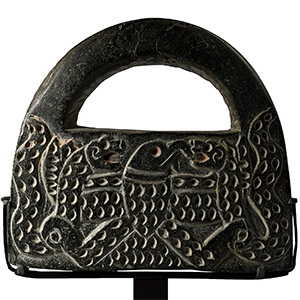
Bactrian Black Chlorite 'Hand Bag' Ceremonial Weight
3rd millennium B.C.Sold for (Inc. bp): £9,750
D-shaped in profile with void below the curved edge, obverse with reserved serpent and lion opposed, the lion's claw grasping the serpent; reverse with spread eagle flanked by rearing serpents; all bodies with sockets to accept coloured inserts; mounted on a custom-made stand. 2.95 kg total,18.5 cm (22.5 cm including stand)
with Gallery Rosen Ancient Art, Tel Aviv, 1960s. Ex London, UK, gallery, 1971-early 2000s. London, UK, collection. This lot has been checked against the Interpol Database of stolen works of art and is accompanied by a search certificate no.12774-237878.
The object could have been carried or swung in ceremonies or processions. On one side is a bird of prey, with its claws surrounded by the writhing bodies of two serpents, whose heads flank the bird's head. This symmetrical scheme probably renders a version of the enmity of eagle and serpent, which must have been an important theme of ancient Iranian art; the motif was later diffused throughout the world. -
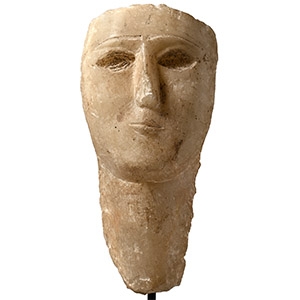
South Arabian Alabaster Head of a Woman
6th-4th century B.C.Sold for (Inc. bp): £1,105
Large female head with angular nose with straight ridge, rounded cheeks and chin, large sockets for inlaid eyes with rounded depressions in the centre of the eyes, grooved eyebrows and outlines of the eyes, the tapering neck long and cylindrical, the back left roughly tooled; mounted on a custom-made display stand. 3.66 kg total, 31.4 cm including stand
UK collection, 1990s. Acquired on the UK art market, before 2000. Private collection, Mr M.V., a London-based businessman.
This finely carved calcite-alabaster head was originally set within a stela and inscribed with the name of the deceased. Six hundred of these funerary stelae were discovered in localities like Mārib, and other examples were later found during the excavations of the Awwam temple cemetery. -
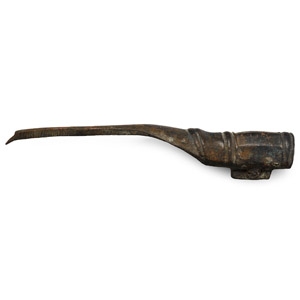
Western Asiatic Bronze Stylus
Late 1st millennium A.D.Estimate: £100 - 140 (+bp*)
Opening Bid: £50
Comprising a barrel-shaped facetted socket with a rivetted lug to the rear, the body extending to a tapering nib with a sharp point. 17.8 grams, 84 mm
From the collection of a gentleman, acquired on the London art market in the 1990s.
