
Loading, please wait...
LOT 1007
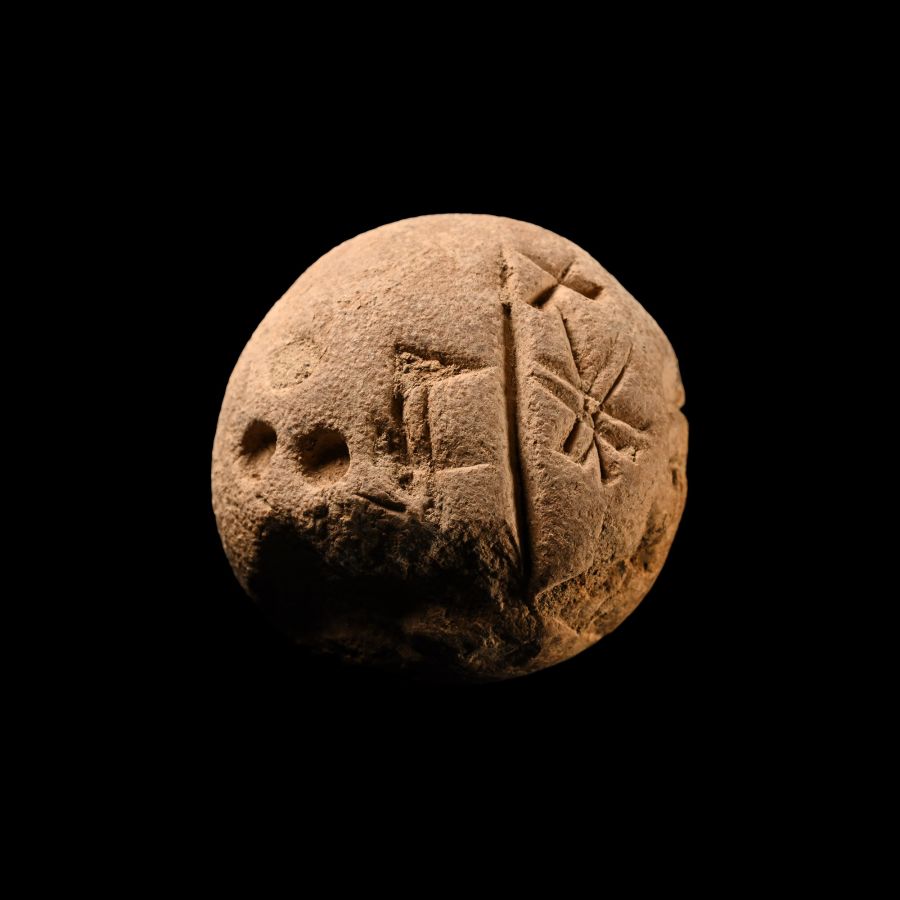
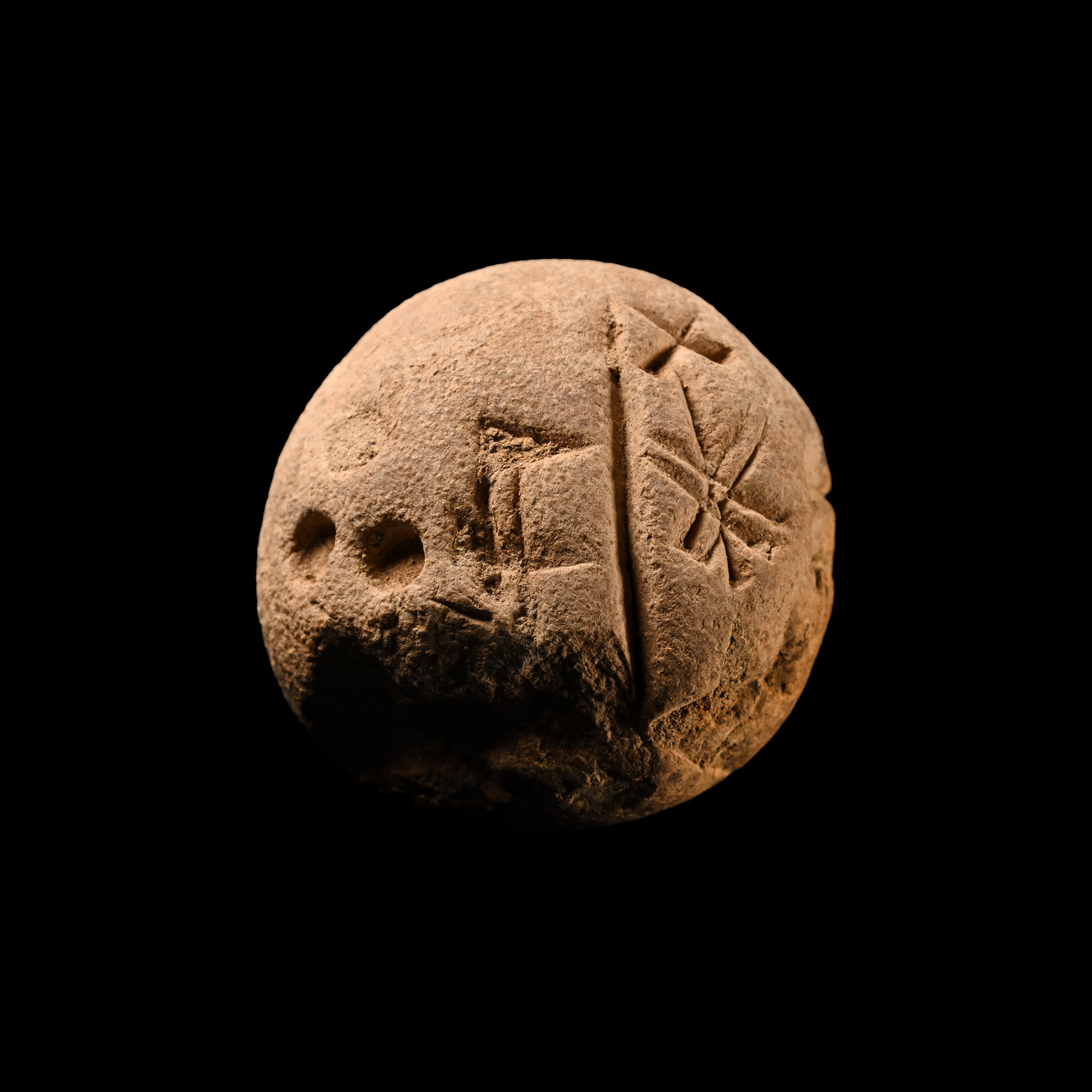
Old Akkadian Terracotta Round Tablet Recording Amounts of Grain
CIRCA 2340-2200 B.C.
1 in. (14.3 grams, 26 mm).
Spherical with cuneiform text to the upper face.
ProvenancePrivate collection, Jerusalem, assembled in the 1970s-1980s.
European private collection, acquired in 1998.
This lot has been cleared against the Art Loss Register database, and is accompanied by an illustrated lot declaration signed by the Head of the Antiquities Department, Dr Raffaele D'Amato.
TimeLine Auctions follows a vetting process to ensure the authenticity and legality of all items, reinforcing our commitment to integrity and responsible trading. Each antiquity, antique, and coin lot undergoes thorough examination by a vetting committee of at least ten external specialists, professional trade association members, scientists, and archaeologists: Our Vetting Process
AUCTIONS:
TimeLine is a leading auction house specialising in antiquities, ancient art, collectables, natural history, coins, medals, and books. Our auctions offer museums, collectors, historians, and enthusiasts the opportunity to acquire unique and historically significant pieces.
LOT 1007
Old Akkadian Terracotta Round Tablet Recording Amounts of Grain
Sold for (Inc. bp): £211
-
Mitanni Fawn Stone Cylinder Seal with Female Figures
Circa 1400-1200 B.C.Sold for (Inc. bp): £364
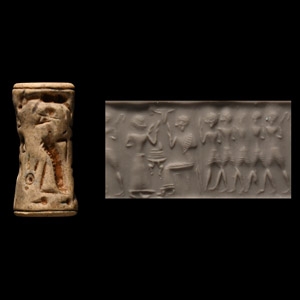
Cylinder with cord and bead handles; accompanied by a copy of an old scholarly note, typed and signed by W.G. Lambert, late Professor of Assyriology, University of Birmingham, 1970-1993, which states: 'Cylinder Seal in Fawn Stone, Concave, 25 x 12.5 mm. The main figures are three; a nude female frontally shown save for her head, which is sideways; facing her a standing figure in a long fringed robe, with one arm awkwardly placed behind him; on the other side of the nude female a kneeling figure holding up a bull by the hind leg. Above the main scene are two browsing quadrupeds, one clearly a stag. Between the nude female and the figure on the left is a head of a horned animal. A second such animal's head above a sideways browsing stag forms a terminal. The whole design is placed between two lines. The seal is Mitanni, c 1400-1200 B.C., from anywhere between the eastern Mediterranean and Kurdistan. It has a very full design and looks like a "common style", but it is cut on stone, not made of frit, and the design is very deeply cut so that a fine, well-rounded impression is given. Also, being of stone, it is more durable than those of frit. Though there is some wear, the deep outlining means that nothing has been lost as a result.'; supplied with a museum-quality impression. 6.34 grams, 25 mm
UK private collection, acquired 1980-1983. Accompanied by a copy of a scholarly note, typed and signed by Professor Wilfrid George Lambert in July 1991. This lot has been cleared against the Art Loss Register database, and is accompanied by an illustrated lot declaration signed by the Head of the Antiquities Department, Dr Raffaele D'Amato. -
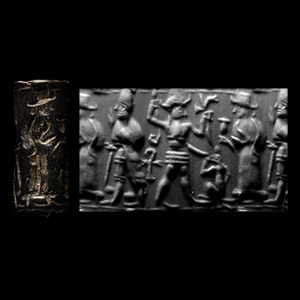
Western Asiatic Haematite Cylinder Seal
2nd-1st millennium B.C.Estimate: £400 - 600 (+bp*)
Opening Bid: £200
With frieze of standing robed figures, central figure wearing a headdress with cow horns and wielding an axe(?), an ankh behind him; before him a standing figure wearing long robes and a cow-horn headdress, holding a vessel in his hands and a snake(?) suspended around his neck, a small crouching figure between the two figures; behind a standing figure holding one hand up in adoration and wearing a tall conical headdress, holding a short staff in the other hand; supplied with a museum-quality impression. 2.28 grams, 19 mm
From the 'S' collection, acquired 1970-1990s. The collection was seen and studied by W.G. Lambert, late Professor of Assyriology at the University of Birmingham, 1970-1993. This lot has been cleared against the Art Loss Register database, and is accompanied by an illustrated lot declaration signed by the Head of the Antiquities Department, Dr Raffaele D'Amato. -
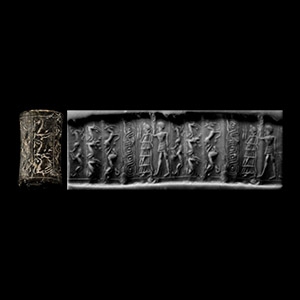
Syrian Stone Cylinder Seal with Figure Wearing Kilt
Circa 1800-1700 B.C.Sold for (Inc. bp): £416
Cylinder with cord and bead handles; accompanied by a copy of an old scholarly note, typed and signed by W.G. Lambert, late Professor of Assyriology, University of Birmingham, 1970-1993, which states: 'Cylinder seal of dark-brown stone with white inclusions, 14 x 8.5 mm. Slight chipping on top, otherwise condition fine. Male figure wearing short kilt and raising one hand, in front of him female figure wearing long, flounced garment and raising both hands; both facing four bands containing (i) guilloche, (ii) backwards-facing rampant horned quadruped above sideways recumbent lion, (iii) recumbent stage between two other recumbent horned quadrupeds, (iv) slender dog (?) chasing quadruped with horns or long ears. From Syria, c. 1800-1700 B.C. For similar seals, see D. Collon, "The Green Jasper Cylinder Seal Workshop" in M.K. Buccellati et al. (eds.), Papers in Honor of Edith Porada.'; supplied with a museum-quality impression. 2.88 grams, 14 mm
UK private collection, acquired 1980-1983. Accompanied by a copy of a scholarly note, typed and signed by Professor Wilfrid George Lambert in January 1989. This lot has been cleared against the Art Loss Register database, and is accompanied by an illustrated lot declaration signed by the Head of the Antiquities Department, Dr Raffaele D'Amato.
