
Loading, please wait...


LOT 1361
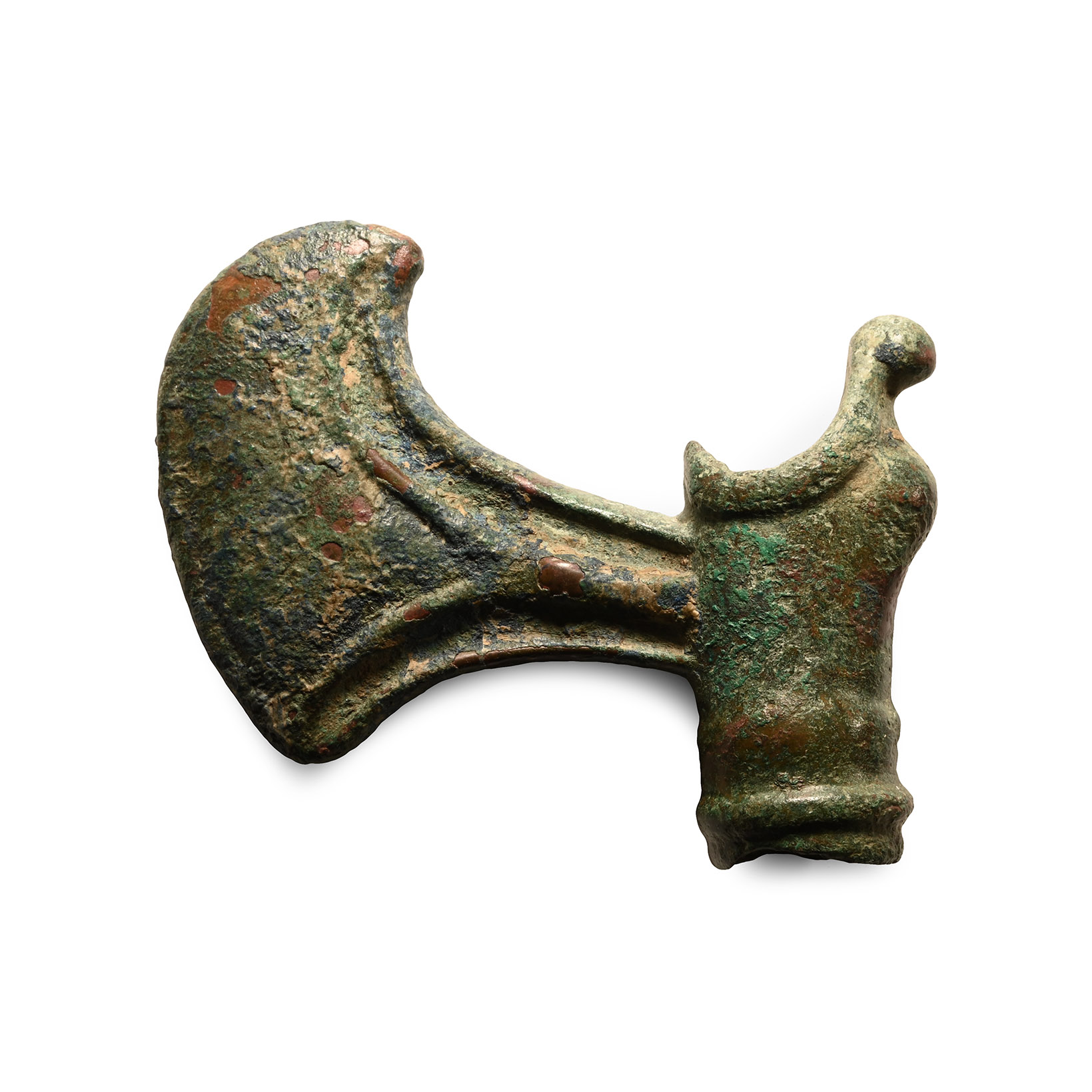
North-Western Persian Elamite Bronze Axehead
2ND MILLENNIUM B.C.
3 3/4 in. (267 grams, 97 mm).
With crescent blade and rounded knot at the butt, ornamental curved edging to the upper shaft hole, a cord edge on the lower shaft hole, incised band around the edge of the blade.
ProvenanceUK private collection before 2000.
Acquired on the UK art market.
Property of a London gentleman.
Cf. Mahboubian, H., Art of Ancient Iran, copper and bronze, London, 1997, p.166, fig.172b, for identical type; Gernez, G., L’armament en métal au Proche et Moyen-Orient: des origines a 1750 av. J.C., Paris, 2007, p.146, fig.2.14, subtype H2.H.a.
FootnotesThe type corresponds to the Gernez type H.2.H.a, of axes with collar and short sleeve lined with mouldings, fan-shaped blade and rear knot. It was a variant only known in Elam and Luristan. In Luristan one identical specimen was found at Chigha Sabz (grave M7). In Elam the majority of these axes were found in the Middle-Bronze Age (Age of Isin-Larsa or Early Babylonian Age) tombs of Sarcophagi, at Susa.
CONDITIONTimeLine Auctions follows a vetting process to ensure the authenticity and legality of all items, reinforcing our commitment to integrity and responsible trading. Each antiquity, antique, and coin lot undergoes thorough examination by a vetting committee of at least ten external specialists, professional trade association members, scientists, and archaeologists: Our Vetting Process
AUCTIONS:
TimeLine is a leading auction house specialising in antiquities, ancient art, collectables, natural history, coins, medals, and books. Our auctions offer museums, collectors, historians, and enthusiasts the opportunity to acquire unique and historically significant pieces.
-
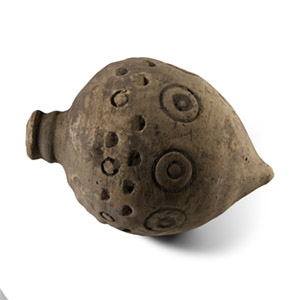
Byzantine 'Greek Fire' Ceramic Fire Bomb or Hand Grenade
9th-11th century A.D.Sold for (Inc. bp): £111
A ceramic missile, piriform in profile with band of impressed rings to the equator and larger ring-and-dot motifs beneath, domed filler-hole above, intended to be filled with explosive liquid and wick, used as a hand grenade. 829 grams, 14.6 cm
From a military inspired collection formed from the 1990s. Accompanied by an academic paper by military specialist Dr Raffaele D'Amato, dated 15 July 2019 and titled 'Eastern Roman Empire - Greek Fire Bomb or Hand Grenade (μεσαίον kακάβιον) 9th-11th century AD'.
Apart from the use of siphons or manual flame-throwers called cheirosiphona, special corps of Roman soldiers employed terracotta grenades, in the form of small jars, abundantly evidenced in archaeological excavations. They were called μεσαία kακαβιά or κυτροκακάβια where the former had a bulbous shape and the latter a more cylindrical form. -
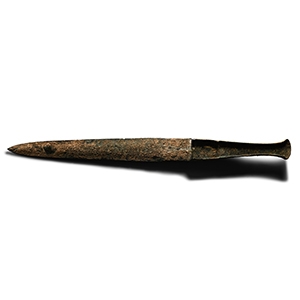
Luristan Bronze Dirk
13th-12th century B.C.Estimate: £300 - 400 (‡+bp*)
Opening Bid: £167
With lentoid-section blade, tongue-shaped in plan, integral tapering hilt with flared finial, lateral flanges to accept a panel of bone or wood to each face forming the grip. 174 grams, 34 cm
Ex Joseph J. Gancie (1923-2010), Washington, Silver Spring, Maryland. with Alex Cooper Auctioneers Inc., sale 1035, 27 January 2013, lot 162a.
The dirk belongs to the type III in the Medvedskaya classification, used in Near East from the 13th to the 6th century B.C. The type is the 32a of the Maxwell-Hyslop study. The Asiatic daggers of this type are confined to Syria and Persia, but Transcaucasia also provides an interesting analogy from Kalekent on the Baku peninsula, where a pointed straight-sided dagger blade has a flanged hilt with the whole of the side flanges bent over the centre. -
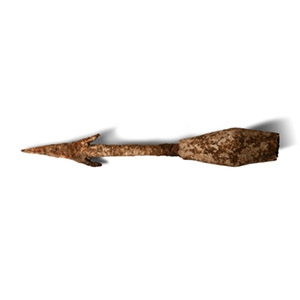
Roman Iron Plumbata
4th-5th century A.D.Sold for (Inc. bp): £364
The barbed head with tapering cylindrical stem and biconical lead weight; socket to the reverse. 95 grams, 13.4 cm
Ex B. Posey collection, UK, 1990s.
The lead-weighted darts known as plumbatae mamillatae (or 'breasted javelin') were short darts mounted upon a shaft of the same shape, and thrown from a short distance. A Roman soldier would typically carry around 5-6 of these darts at any one time, fastened to the back of his shield. They could be thrown overhand or underhand, with an effective throwing range of up to 60 metres by trained soldiers.
