
Loading, please wait...
LOT 1363
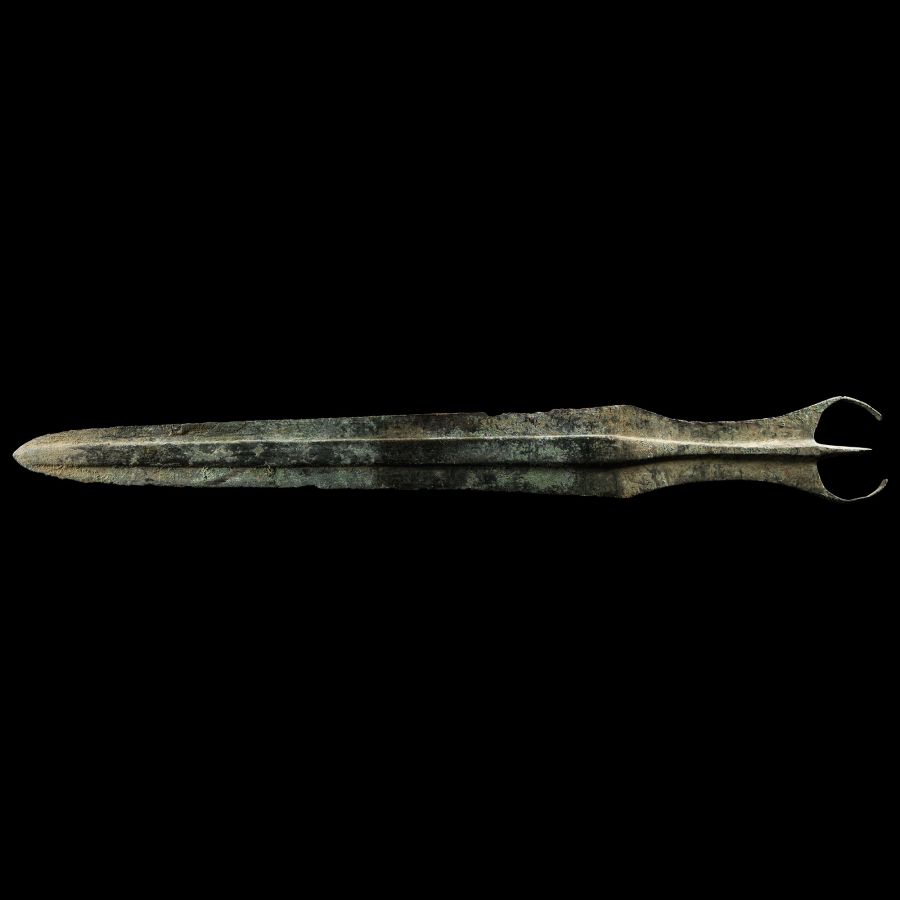
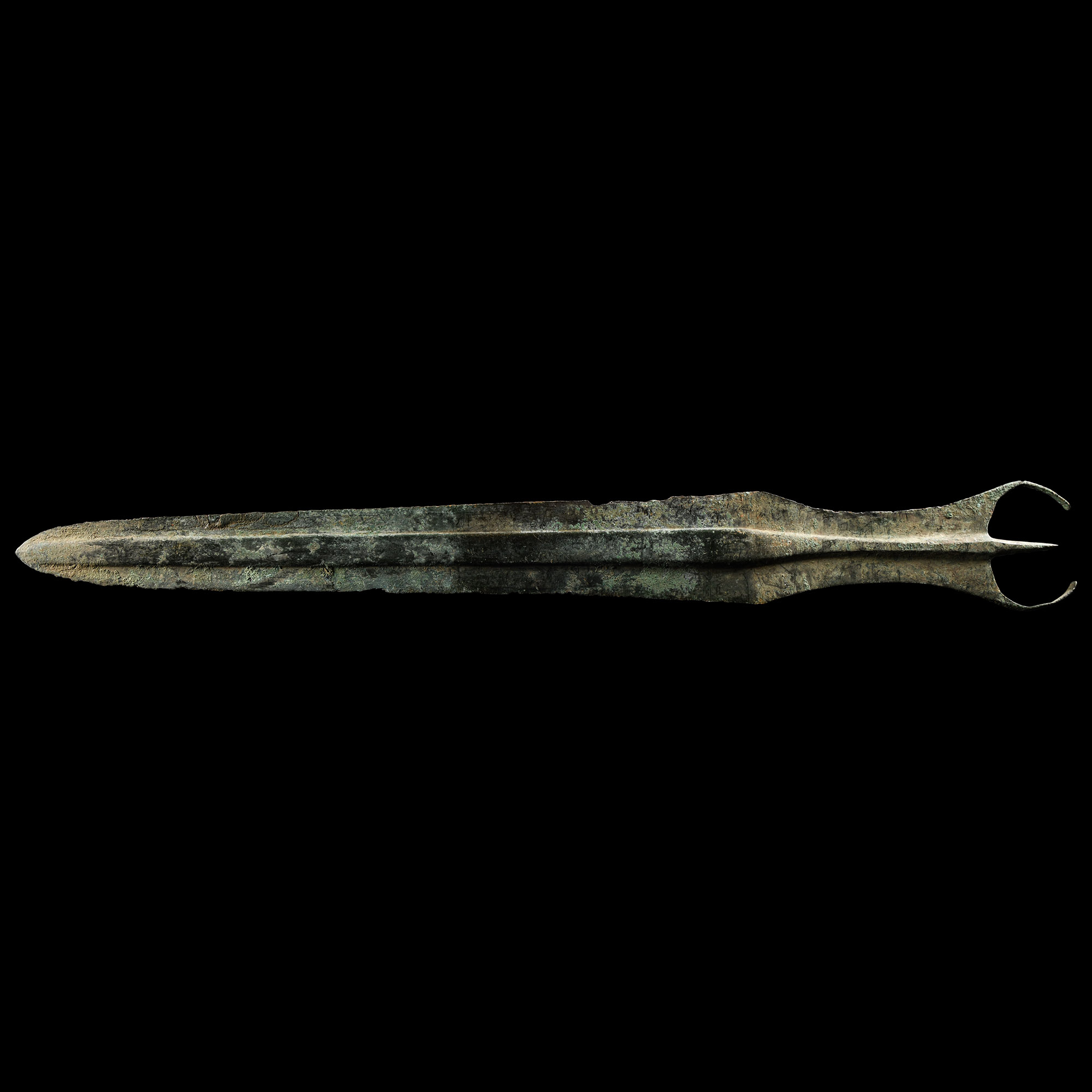
North-Western Persian Bronze Sword Blade with Horns
CIRCA 1ST MILLENNIUM B.C.
20 1/8 in. (325 grams, 51 cm).
With curved 'horns' projecting on either side at the top of the waisted grip, blade with flat mid-rib.
ProvenanceAcquired 1980-2015.
Ex Abelita family collection.
Cf. Christie's, The Axel Guttmann Collection of Ancient Arms and Armour, part 2, London, 2002, p.36, no.40.
FootnotesThe Luristani people produced a quantity of fine metalwork, which according to Dr Khorasani, could be due to a settled period which arose as a result of the defeat of the Elamites by the Babylonians, leaving the Luristani people in relative peace for a period of time after 1200 B.C. According to Khorasani 'A culture of innovation and experimentation flourished, and the repertoire of the Luristan smiths expanded in the period between 1150-1050 B.C.'
CONDITIONTimeLine Auctions follows a vetting process to ensure the authenticity and legality of all items, reinforcing our commitment to integrity and responsible trading. Each antiquity, antique, and coin lot undergoes thorough examination by a vetting committee of at least ten external specialists, professional trade association members, scientists, and archaeologists: Our Vetting Process
AUCTIONS:
TimeLine is a leading auction house specialising in antiquities, ancient art, collectables, natural history, coins, medals, and books. Our auctions offer museums, collectors, historians, and enthusiasts the opportunity to acquire unique and historically significant pieces.
-
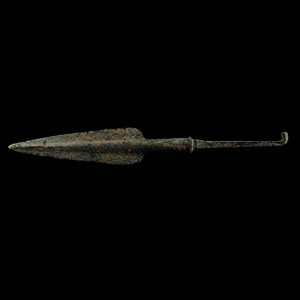
Western Asiatic Tanged Bronze Spearhead
Late 3rd-early 2nd millennium B.C.Estimate: £100 - 140 (+bp*)
Opening Bid: £50
Having foliate blade with central rib and slender shoulders, cylindrical short shaft encasing a rectangular tang with a bent end. 151 grams, 26.5 cm
Acquired 1980-2015. Ex Abelita family collection.
This variant is characterised by a blade of rhomboidal or swollen section, an intermediate part often short widened so as to form a clear stop and a curved bristle at its end, sometimes finished in a button. Most lances are of medium dimensions (23 cm to 36 cm), others are very elongated (more than 50 cm). The best parallels come from Tepe Hissar. Elements of handles found nearby the spearheads in the excavations have made it possible to reconstruct the total length of the weapon (1.40 m). -
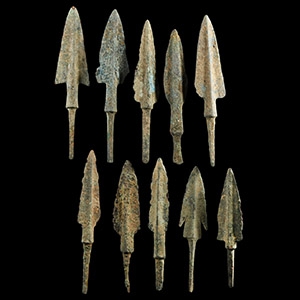
Luristan Bronze Arrowhead Group
14th-10th century B.C.Sold for (Inc. bp): £195
Comprising tanged arrowheads, including barbed and leaf-shaped examples. 158 grams total, 8-10.5 cm
Acquired 1990s. From the collection of a late Japanese weaponry collector.
The arrowheads seems to belong to the subtypes A and B of the Khorasani classification. They are mainly small triangular arrowheads with rounded and barbed shoulders. Some have angular or rounded midribs. The characteristic is also the cylindrical stem and the rectangular-sectioned tang. Many similar arrowheads were found in the Marlik excavations. -
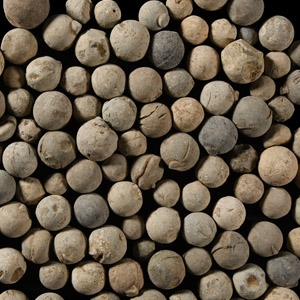
100 Civil War Period Lead Musket Balls
Circa 17th-18th century A.D.Sold for (Inc. bp): £26
Mixed group of lead-alloy pistol, musket and carbine balls, some with casting seam and sprue nipple. 1.64 kg total, 9-19 mm
Found Hertfordshire, UK.
