
Loading, please wait...
LOT 1398
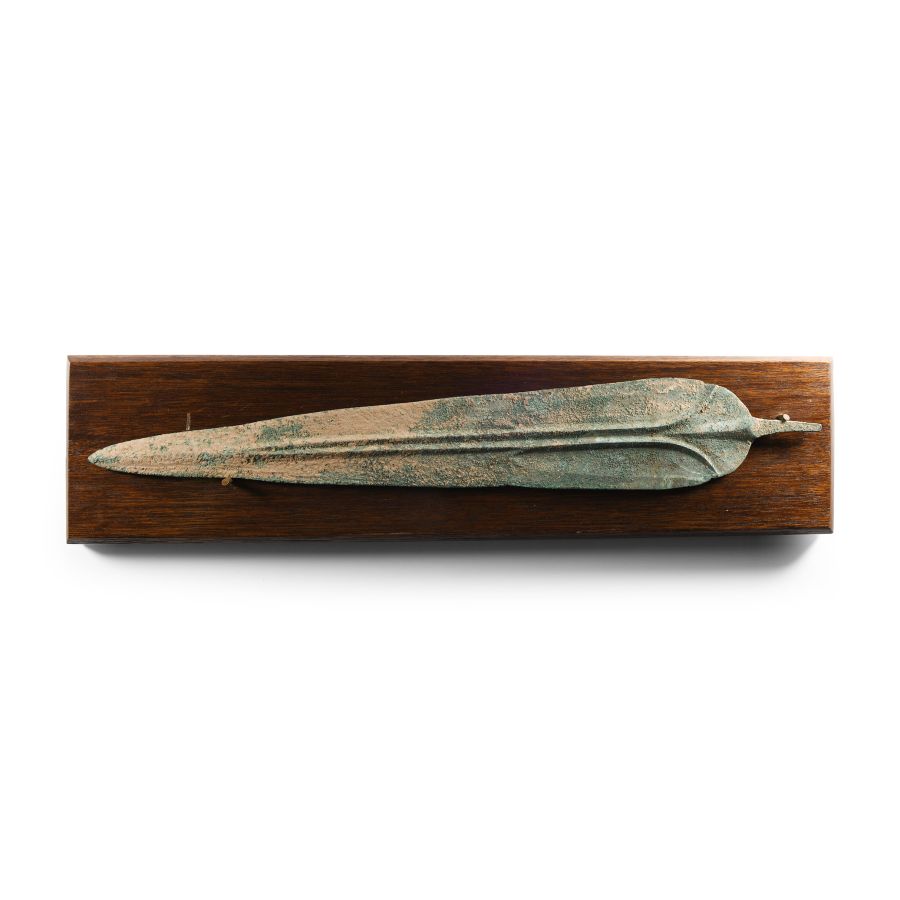
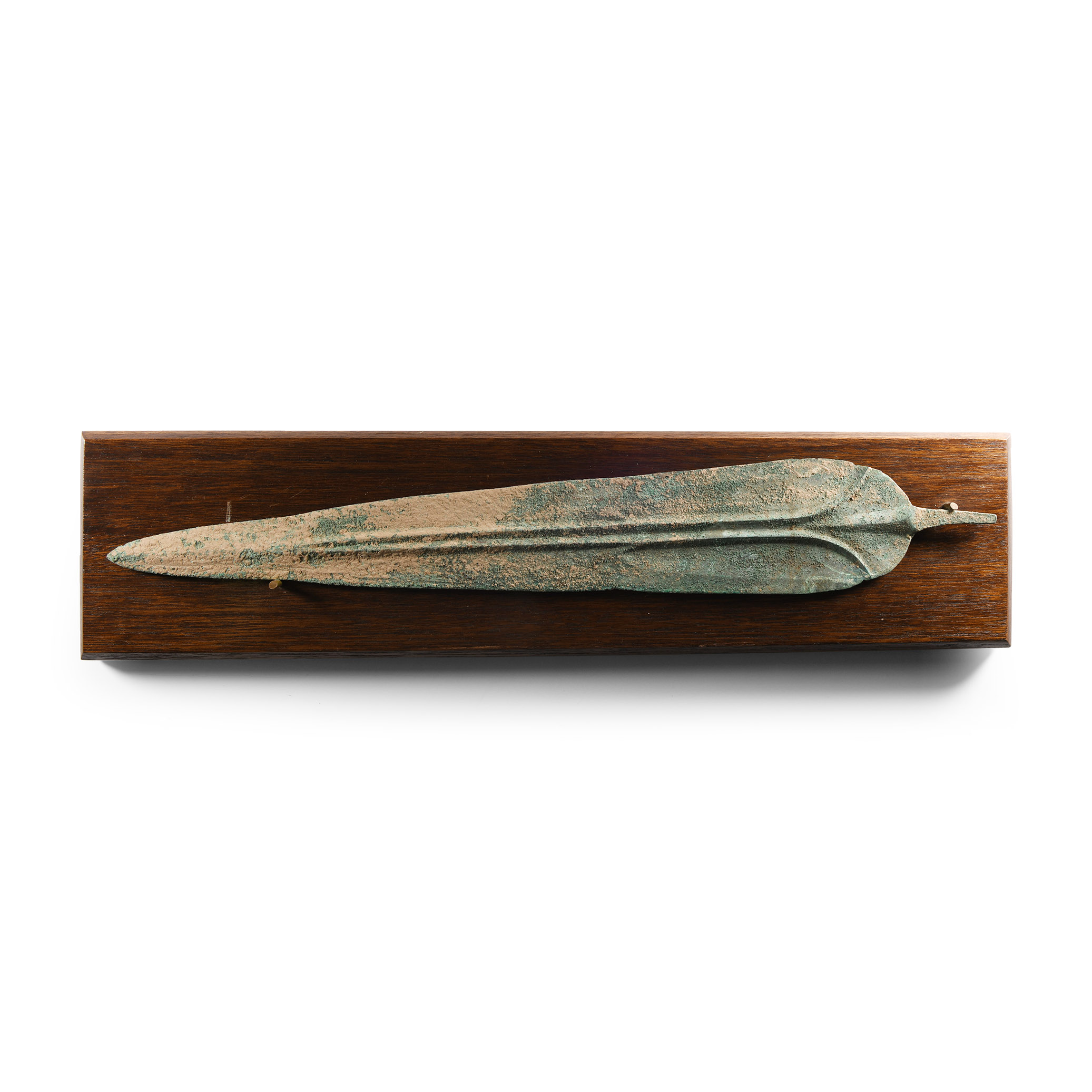
North West Persian Short Sword with Blood Channels
2ND-1ST MILLENNIUM B.C.
18 in. (19 1/4 in.) (1.18 kg total, 45.5 cm (49 cm including stand)).
With short tang for an organic hilt, the blade showing multiple grooves forming a pronounced mid-rib spanning roughly more than three-quarters of the blade; accompanied by a custom-made display stand.
ProvenanceEx P.A., Hertfordshire, UK, specialist collection of Greek art, 1980-1990s.
LiteratureCf. Christie's, The Axel Guttmann Collection of Ancient Arms and Armour, part 2, London, 2004, item 36, p.33.
FootnotesLuristan was hardly an ethnic or political entity, but the people of Luri had relations through warfare and traded with Sumerians, Lullubi, Assyrians, Babylonians and Elamites over a long period of time, spanning from the 3rd to the 2nd millennium B.C. The ruling elites of warrior horsemen were buried with their weapons and horses.
CONDITIONTimeLine Auctions follows a vetting process to ensure the authenticity and legality of all items, reinforcing our commitment to integrity and responsible trading. Each antiquity, antique, and coin lot undergoes thorough examination by a vetting committee of at least ten external specialists, professional trade association members, scientists, and archaeologists: Our Vetting Process
AUCTIONS:
TimeLine is a leading auction house specialising in antiquities, ancient art, collectables, natural history, coins, medals, and books. Our auctions offer museums, collectors, historians, and enthusiasts the opportunity to acquire unique and historically significant pieces.
LOT 1398
North West Persian Short Sword with Blood Channels
Estimate £250 - 350€290 - 410 (for guidance only)$340 - 470 (for guidance only)
-
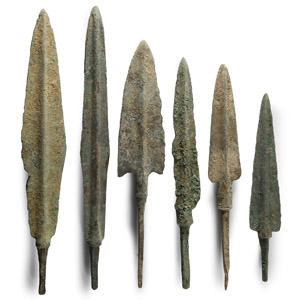
Luristan Bronze Arrowhead Group
12th-9th century B.C.Sold for (Inc. bp): £195
Comprising arrowheads of various types, mainly leaf-shaped and barbed types, with midribs. 216 grams total, 12.2 - 18 cm
Acquired 1990s. From the collection of a late Japanese weaponry collector.
The barbed arrowhead seems to belong to the type V, subcategory type C, according to the classification of Khorasani and Negahban. In the four categories of triangular bronze arrowheads from Luristan, Marlik and Northern Iran individuated by Negahban, subtypes C and D of type V are larger arrow or javelin heads, C large triangular arrowheads with barbed shoulders and D with lanceolate shape and rounded midrib. The straight shoulders recalls a Marlik typology (see Khorasani, 2006, p.307, fig.379). -
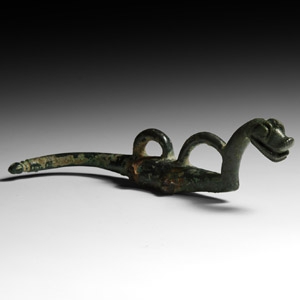
Luristan Bronze Horse Harness Cheekpiece
11th-8th century B.C.Estimate: £300 - 400 (+bp*)
Opening Bid: £160
In the form of a righthand side bar, surmounted by two loops for additional straps, ending in a lion's head at the front, the other extremity bending outwards and ending with a conical tip, remains of the iron bar visible on the sides; once belonging to an articulate bit. 130 grams, 13.5 cm wide
Fine condition.
Acquired mid 1980s to early 1990s. Private family collection formed in London, UK.
The association of Psalia in the shape of a bar and with an articulated bit is documented in Assyria, in Media and in central Iran starting from the 10th century B.C., but the zoomorphic elements of this specimen suggest that it was produced in Luristan. The use of articulated bits, which moved inside the horse's mouth, exerting a minimal pressure on the reins, allowed for better control of the mount. -
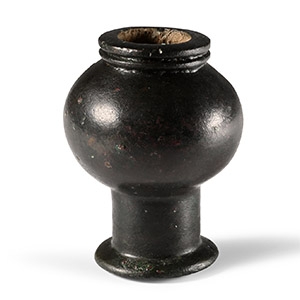
Luristan Sar-e Gorz Bronze Macehead
14th-13th century B.C.Sold for (Inc. bp): £208
With plain globular body, extended to a small raised ring encircling the top of the mace-head, circular short shaft expanding to a circular flat base. 279 grams, 70 mm high
Acquired 1980-2015. Ex Abelita family collection.
Caucasian stone and bronze maces were distinguished by modestly finished, clean processed and predominantly close-to-ball shapes (with a variety of surface finishing, ranging from the smooth, ribbed, lobular forms to the rounded with protrusions and spikes), and the Western Iranian maces, especially the Luristan ones, notable for the variety of different forms. Similar mace-heads, probably realised in Luristan, decorated the head of the sceptres of Assyrian kings like Tukulti-Ninurta I (1243-1207 B.C.).
