
Loading, please wait...
LOT 1064
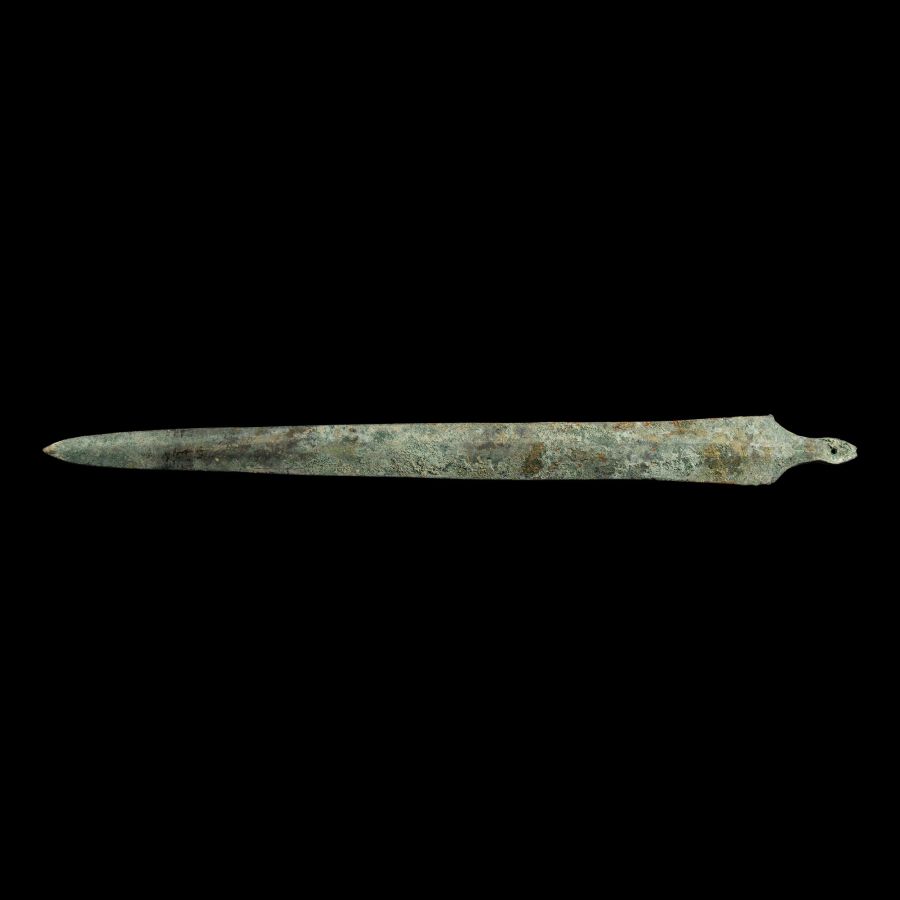
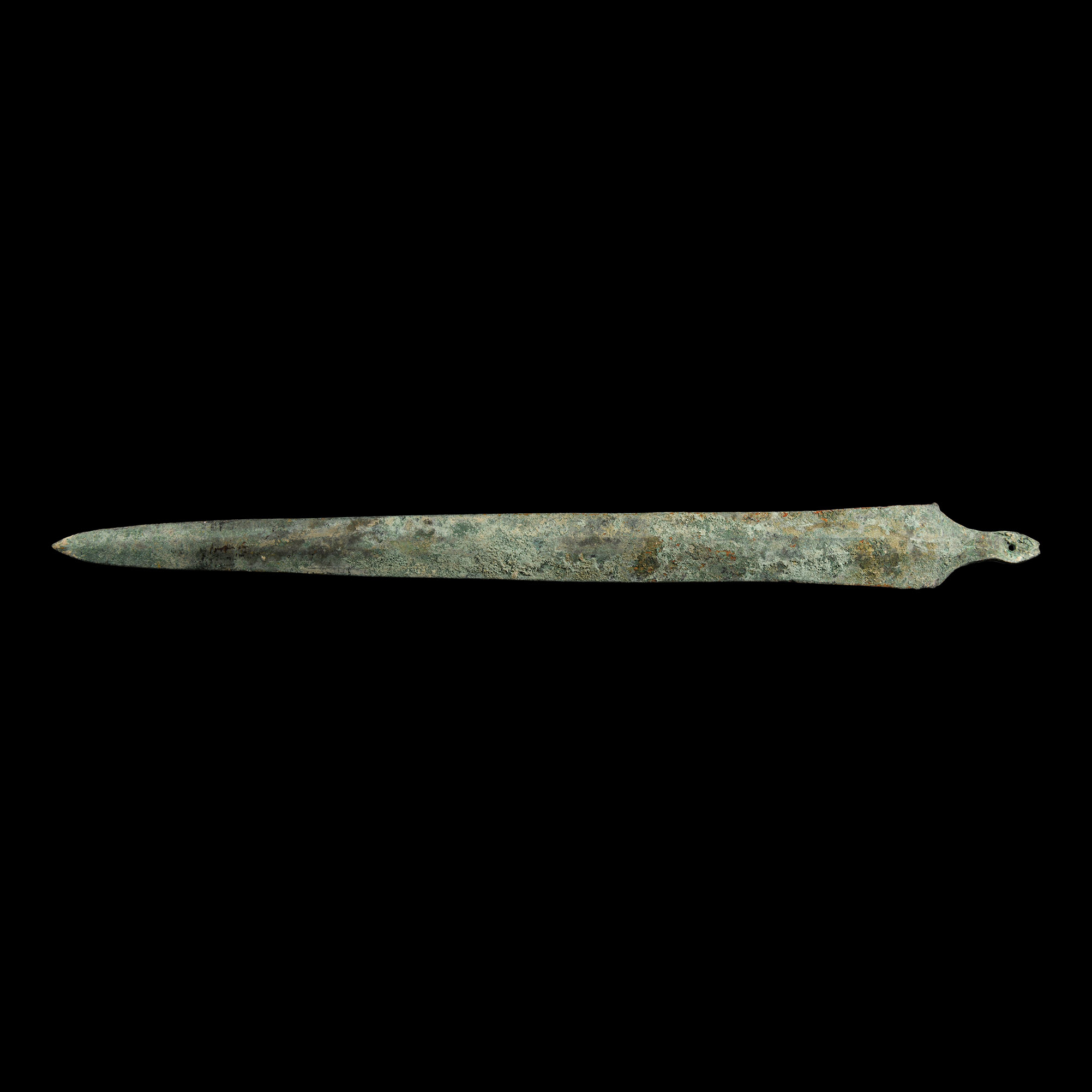
North-West Persian Bronze Sword Blade
EARLY 1ST MILLENNIUM B.C.
17 3/4 in. (370 grams, 45 cm).
Narrow triangular blade with raised median panel, scooped shoulders and short tang with pierced bulb finial.
ProvenanceEx German collection, Cologne, 1980-1990s.
LiteratureCf. Christie's, The Axel Guttmann Collection of Ancient Arms and Armour, part 1, London, 2002, p.34, no.31.
FootnotesThe hilt of this magnificent sword would have originally been made of organic material. The forms of hilt are often replicated on cast metal counterparts. As proved by excavations of sites like Sangtarashan, stones were often used for decorating metal weapons, especially for bronze dagger pommels.
CONDITIONTimeLine Auctions follows a vetting process to ensure the authenticity and legality of all items, reinforcing our commitment to integrity and responsible trading. Each antiquity, antique, and coin lot undergoes thorough examination by a vetting committee of at least ten external specialists, professional trade association members, scientists, and archaeologists: Our Vetting Process
AUCTIONS:
TimeLine is a leading auction house specialising in antiquities, ancient art, collectables, natural history, coins, medals, and books. Our auctions offer museums, collectors, historians, and enthusiasts the opportunity to acquire unique and historically significant pieces.
-
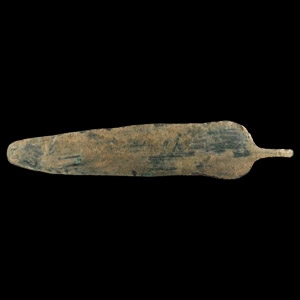
Luristan Bronze Spearhead
14th-10th century B.C.Estimate: £120 - 170 (+bp*)
Opening Bid: £60
Lanceolate profile with rounded tip and deep shoulders, short tang. 223 grams, 40 cm
Ex German collection, Cologne, 1980-1990s.
The metalworking techniques used in making bronze weapons in Luristan were very complex. Surfaces were often finished in repoussé work, and some of the weapons were chased, others engraved. The spearhead seems to belong to the type V (heavy spearheads) of the Khorasani's classification, having ovate blade with rounded and gently curved shoulders. Unfortunately the original mid-rib is today completely effaced. -
.jpg)
Byzantine 'Greek Fire' Fire Bomb or Hand Grenade
9th-11th century A.D.Sold for (Inc. bp): £182
Piriform in shape with raised lugs to the upper body with stamped concentric roundels between. 588 grams, 15.3 cm
Family collection, acquired 1980-2015. Ex property of a North London gentleman. Accompanied by an academic paper by military specialist Dr Raffaele D'Amato, dated 15 July 2019 and titled 'Eastern Roman Empire - Greek Fire Bomb or Hand Grenade (μεσαίον kακάβιον) 9th-11th century AD'.
Apart from the use of siphons or manual flame-throwers called cheirosiphona, special corps of Roman soldiers employed terracotta grenades, in the form of small jars, abundantly evidenced in archaeological excavations. Such were the γανωτα, vessels (sometimes also of bronze) used for Greek fire. They were called μεσαία kακαβιά or κυτροκακάβια where the former had a bulbous shape and the latter a more cylindrical form. -
.jpg)
Cromwellian Pikeman's Pot Helmet
1642-1651 A.D.Sold for (Inc. bp): £2,340
Of Morion Cabasset Type, the iron bowl composed of two rivetted parts with a crest; plume holder to the rear; wide sloping brim with smooth border and rivets; repaired. 1.16 kg, 35 cm
Ex Michael D Long Ltd, UK. The Kusmirek Collection, UK. Accompanied by an academic report by Dr Raffaele D'Amato. This lot has been checked against the Interpol Database of stolen works of art and is accompanied by search certificate number no.11769-204122.
A complete set of pikeman's armour consisted of a gorget, back and breast plates, and tassets. With the outbreak of the Civil War, obsolete equipment which had been stored in the Tower of London or in private armouries was brought into service together with more modern equipment. Helmets of this type were often furnished of cheek-pieces made of horizontal rows of blades.
