
Loading, please wait...
LOT 1196
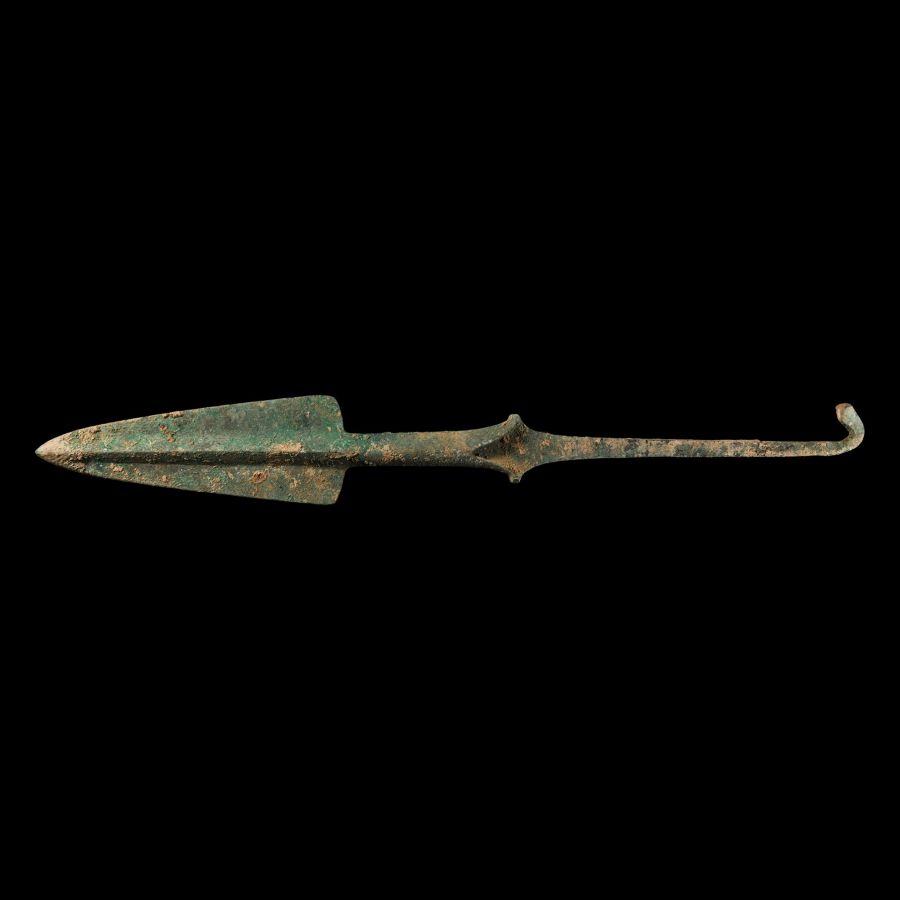
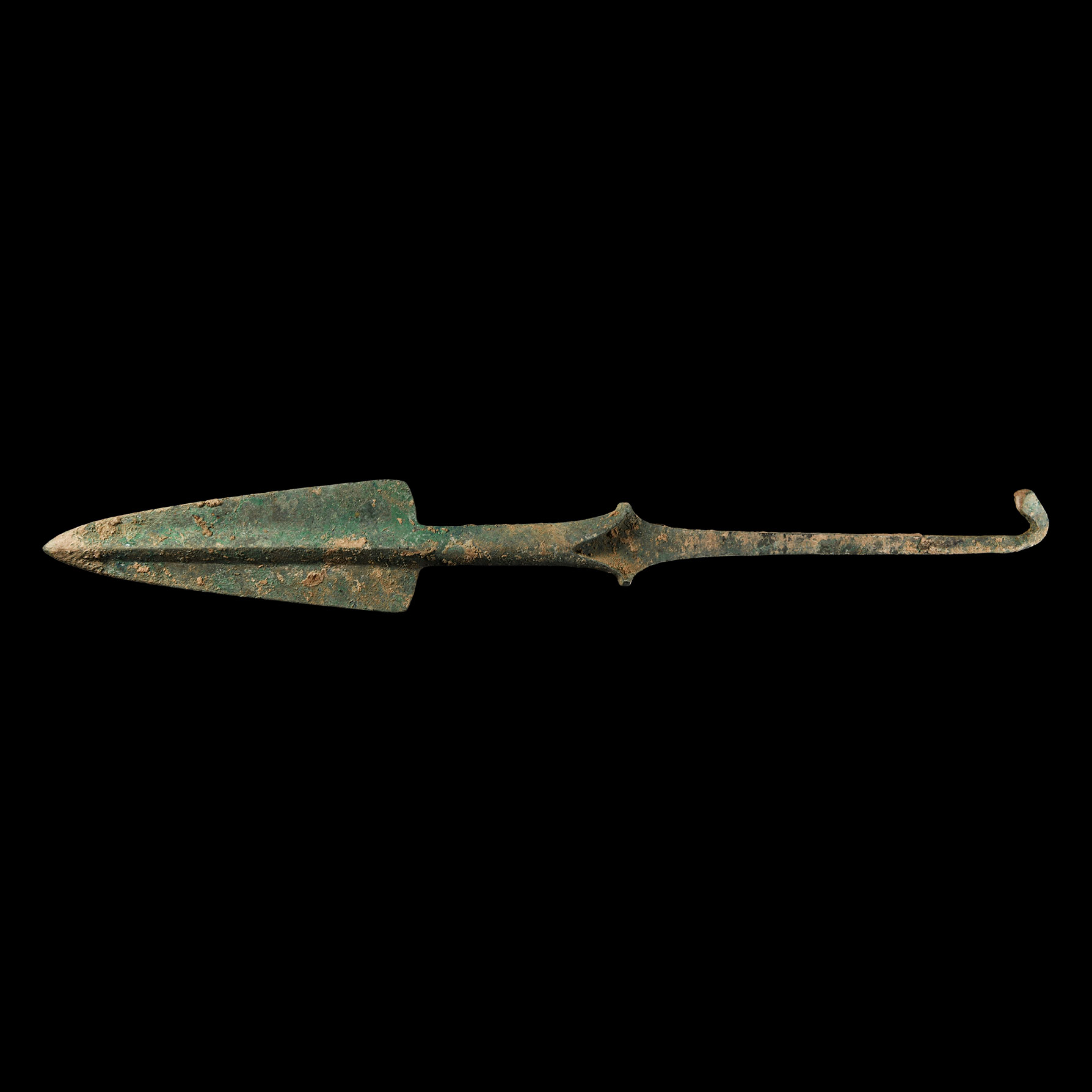
North-West Persian Bronze Spearhead
EARLY 1ST MILLENNIUM B.C.
13 5/8 in. (268 grams, 34.5 cm).
Short triangular two-edged blade with thick midrib, long round-section neck with V-shaped recesses to the lower end, tapering square-section tang.
ProvenanceEx German collection, Cologne, 1980-1990s.
LiteratureCf. Khorasani, M.M., Arms and Armour from Iran. The Bronze Age to the End of the Qajar Period, Tübingen, 2006, pp.240-241; Christie's, The Axel Guttmann Collection of Ancient Arms and Armour, part 2, London, 2004, p.36, no.40.
FootnotesThe spearhead belongs to a typology of spears widespread in the Marlik region, which Negahban divided into two categories. This spearhead belongs to type II, spearheads with triangular blades with rather short blade and shaft with a long tang, the total length of the blade being less than that of the shaft and tang together.
CONDITIONTimeLine Auctions follows a vetting process to ensure the authenticity and legality of all items, reinforcing our commitment to integrity and responsible trading. Each antiquity, antique, and coin lot undergoes thorough examination by a vetting committee of at least ten external specialists, professional trade association members, scientists, and archaeologists: Our Vetting Process
AUCTIONS:
TimeLine is a leading auction house specialising in antiquities, ancient art, collectables, natural history, coins, medals, and books. Our auctions offer museums, collectors, historians, and enthusiasts the opportunity to acquire unique and historically significant pieces.
-
.jpg)
German WWII Stick Grenade Group
1914-1945 A.D.Estimate: £200 - 300 (+bp*)
Opening Bid: £94
German practice stick grenade group including: a WWII model 24 Stielhandgranate with pierced red-coloured head; together with a restored relic head of WWI date. 684 grams, 44.5 cm
Acquired from The Lanes Armoury, Brighton, and Graham Currie Militaria. The Kusmirek Collection, UK. Accompanied by copies of the listings.
The brb-code name for Richard Rinker GmbH, was used for training German armed forced during WWII. Its distinctive appearance lead to it being dubbed the stick grenade' or 'potato masher' in British army slang. It used a friction igniter, with a pull cord running through the hollow wooden handle terminating in a porcelain ball. -
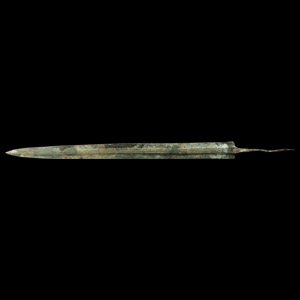
Amarlu Type Bronze Sword with Blood Channels
Late 2nd millenium B.C.Sold for (Inc. bp): £715
Formed with a long triangular blade, thick midrib with parallel fullers, rectangular guard, long tang with folded end. 668 grams, 73 cm
Acquired on the London art market, prior to 1980s. The Kusmirek Collection, UK.
This sword finds a good parallel with a bronze sword with bell-shaped pommel, today in the National Museum of Tehran. Originally these swords had separately made hilt which was then cast on the blade. These swords were more typical of the North-West Persian territory, especially in the Amlash and Gilan areas. -
.jpg)
Pseudo-Illyrian Chalcidian Variant Bronze Helmet
4th-1st century B.C.Estimate: £5,000 - 7,000 (+bp*)
Opening Bid: £1,667
Large rounded two-part bowl rivetted beneath the repoussé crest extending across the brow and around the circumference; repoussé arches above the eyes extending to the nasal; lateral D-shaped cheek-pieces with scallop to the forward edge, pierced for a chin-strap; some restoration of the bowl and one cheek-piece; mounted on a custom-made display stand. 4.7 kg total, 48 cm high including stand
Acquired 1971-1972. From the collection of the vendor's father. Property of a London, UK, collector. Accompanied by an academic report by Dr Raffaele D’Amato. This lot has been checked against the Interpol Database of stolen works of art and is accompanied by search certificate number no.11751-202770.
According both to Symonenko and Dedjulkin (2014, p.189, fig.9, nn.4-5-6), this category of helmet derives from Chalcidian types (with pseudo-Illyrian elements). As with Chalcidian helmets, our specimen shows vertical decorative lines on the bowl and triangular brow ornament. Distinct from Attic types, it does not have a protruding neck guard introduced on variant III of such helmets (Symonenko, 2014, fig. 15,2-3). According to Dedjulkin, these helmets derive from Greek prototypes, but are simplifications of the original models and made by local artisans. They were widely worn by mercenaries in the Hellenised armies of Pontus and other Hellenistic kingdoms across the Eastern Mediterranean.
