
Loading, please wait...
_900x900.jpg "North-West Persian Bronze Short Sword with Mushroom Pommel")
_200x200.jpg "North-West Persian Bronze Short Sword with Mushroom Pommel")
_900x900.jpg "North-West Persian Bronze Short Sword with Mushroom Pommel")
_200x200.jpg "North-West Persian Bronze Short Sword with Mushroom Pommel")
.jpg "North-West Persian Bronze Short Sword with Mushroom Pommel")
.jpg "North-West Persian Bronze Short Sword with Mushroom Pommel")
LOT 0264
North-West Persian Bronze Short Sword with Mushroom Pommel
LATE 2ND-EARLY 1ST MILLENNIUM B.C.
23 in. (613 grams, 58.5 cm).
The hilt with conical openwork hollow-cast pommel, grip decorated with horizontal grooves and twisted zig-zag pattern, crescentic guard decorated with waves, long blade with ridged mid-grip.
ProvenanceKuizenga collection, the Netherlands, acquired in Utrecht 21 December 1977.
with Bonhams, London, 7 December 2023, no.154.
See a similar sword in Christie's, The Axel Guttmann Collection of Ancient Arms and Armour, part 1, London, 2002, item 24, p.27.
FootnotesThis category of swords has been classified by Khorasani as 'swords with a mushroom pommel' and are usually characterised by a solid-cast hilt with a penannular guard, a ribbed or variously decorated grip and the conical hollow-cast mushroom pommel. Usually the blade is multi-fullered and tapers to a sharp tip. Moorey considers them to be from the end of the 2nd millennium B.C.
CONDITIONTimeLine Auctions follows a vetting process to ensure the authenticity and legality of all items, reinforcing our commitment to integrity and responsible trading. Each antiquity, antique, and coin lot undergoes thorough examination by a vetting committee of at least ten external specialists, professional trade association members, scientists, and archaeologists: Our Vetting Process
AUCTIONS:
TimeLine is a leading auction house specialising in antiquities, ancient art, collectables, natural history, coins, medals, and books. Our auctions offer museums, collectors, historians, and enthusiasts the opportunity to acquire unique and historically significant pieces.
LOT 0264
North-West Persian Bronze Short Sword with Mushroom Pommel
Sold for (Inc. bp): £2,600
-
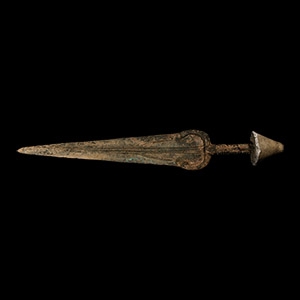
Luristan Bronze Short Sword
Late 2nd millennium B.C.Sold for (Inc. bp): £910
With solid cast hilt with penannular guard and a horizontally ribbed grip; a conical stone mushroom pommel and a multi-fullered blade tapering to a sharp tip; handle repaired. 876 grams, 56 cm
Acquired 1980-2015. Ex Abelita family collection.
According to Moorey, such category of swords were distributed in the Northern Iran area, as proved by the Amarlu finds. Based on the example from the Ashmolean Museum, he dated them to the end of the 2nd millennium B.C., more precisely to a period between 1400-1200 B.C. -
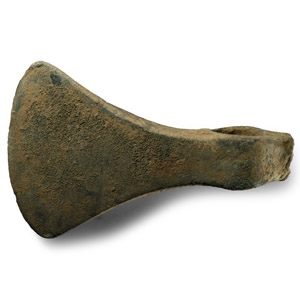
Large Western Asiatic Bronze Socketted Axehead
3rd-2nd millennium B.C.Estimate: £120 - 170 (+bp*)
Opening Bid: £60
With wide swept blade, large socket with shallow raised circumferential rib, hammer to the rear. 1.34 kg, 19 cm
Acquired 1980-2015. Ex Abelita family collection. -
.jpg)
Viking Iron Sword with Three-Lobed Pommel
10th-11th century A.D.Sold for (Inc. bp): £2,990
Double-edged cutting sword of Petersen Type S or T variant with tapering blade bearing some deep battle scars; boat-shaped straight lower guard and tapering tang; boat-shaped upper guard supporting a massive three-lobed pommel with remains of silver inlay to both sides. 1.07 kg, 92.5 cm
From the private collection of a London gentleman, from his grandfather's collection formed before the early 1970s. Accompanied by an academic report by Dr Raffaele D’Amato. This lot has been checked against the Interpol Database of stolen works of art and is accompanied by a search certificate number no.12039-216430.
These swords were widely used in the Baltic area, to the extent that V. Kazakevicius noticed a variation within the decoration of some Type T swords, creating a Curonian type T, which were most likely of Baltic manufacture (at least the hilt construction). The traces of silver ornaments are not sufficient to determine the type of ornamentation, but the remains are artistically consistent with archaeological examples of decorative work from the geographic region or estimated cultural point of origin, probably Eastern Scandinavia or the Baltic areas.
