
Loading, please wait...
LOT 1399
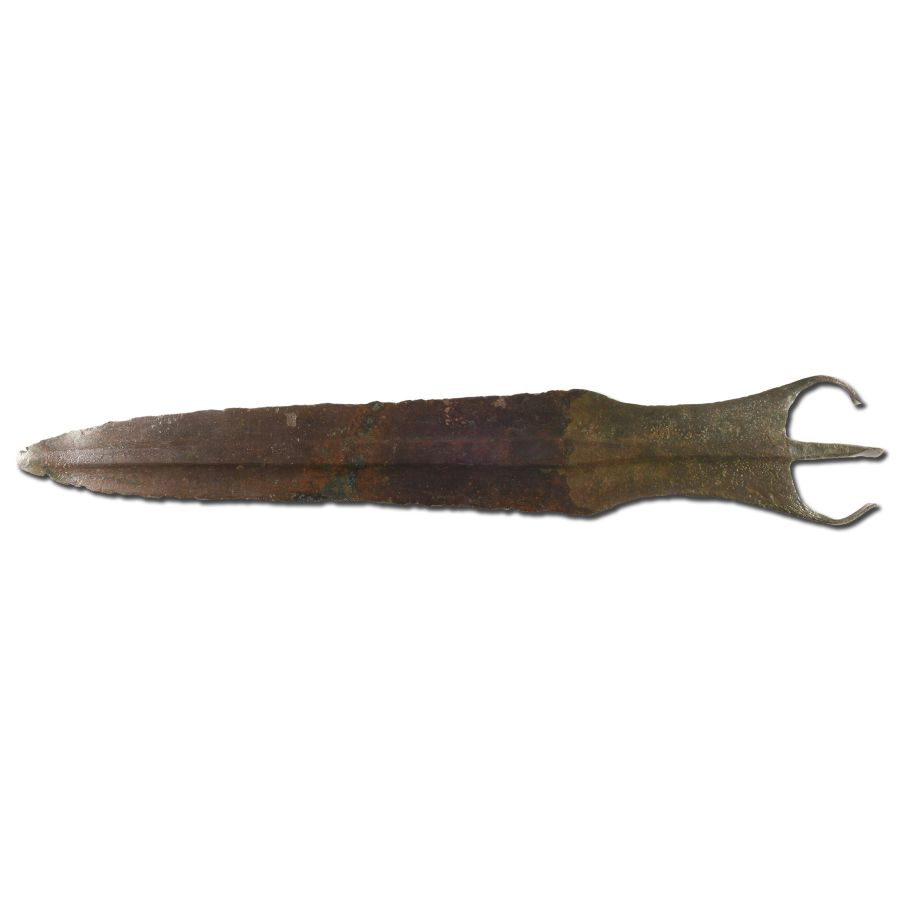
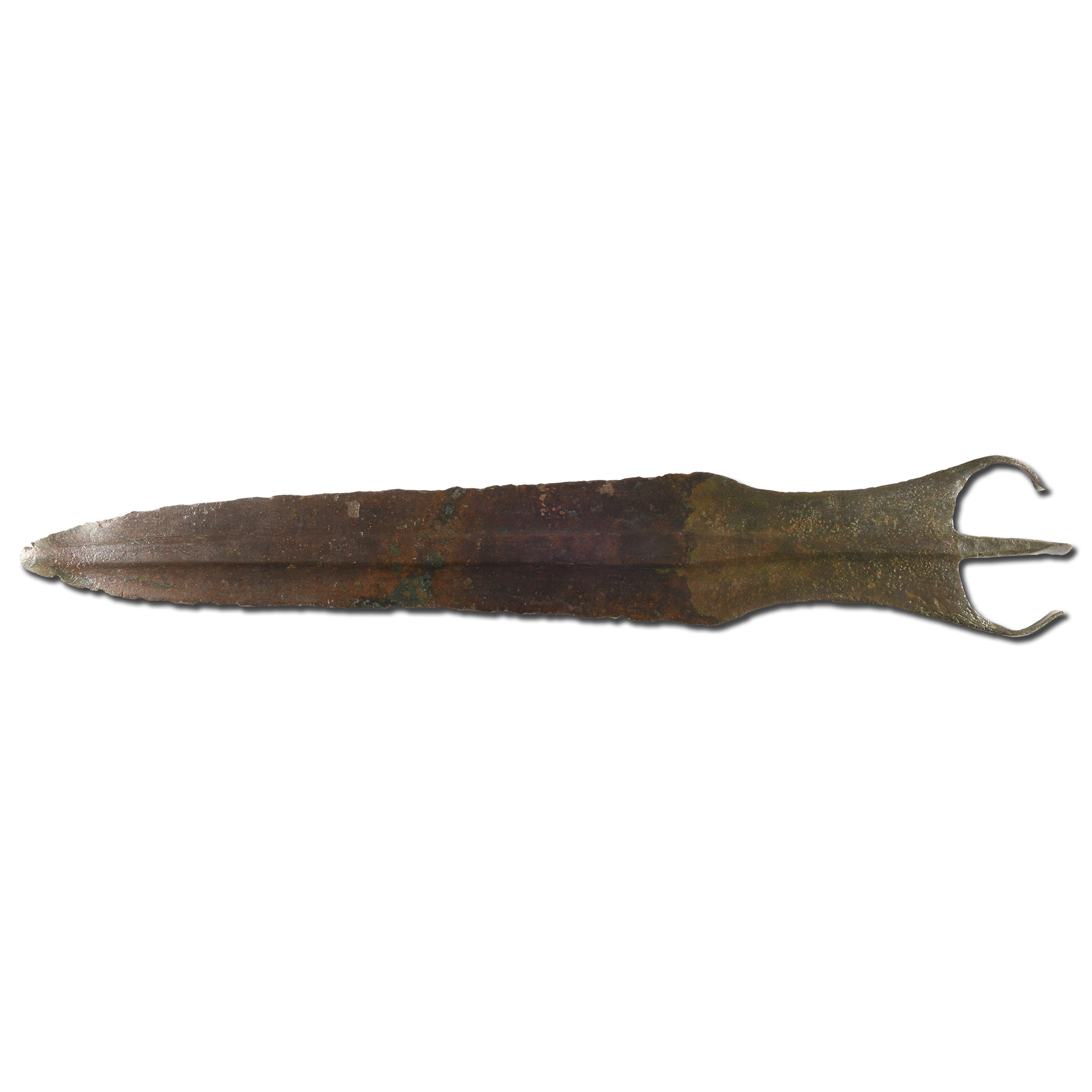
North-West Persian Bronze Short Sword with Integral Grip and Horns
CIRCA 1ST MILLENNIUM B.C.
16 3/8 in. (242 grams, 41.5 cm).
With curved 'horns' projecting on either side at the top of waisted grip, blade with flat mid-rib.
ProvenanceAcquired 1980-2015.
Ex Abelita family collection.
Cf. Christie's, The Axel Guttmann Collection of Ancient Arms and Armour, part 2, London, 2002, p.36, no.40.
FootnotesThe Luristani people produced a quantity of fine metalwork, which according to Dr Khorasani, could be due to a settled period which arose as a result of the defeat of the Elamites by the Babylonians, leaving the Luristani people in relative peace for a period of time after 1200 B.C. According to Khorasani, 'A culture of innovation and experimentation flourished, and the repertoire of the Luristan smiths expanded in the period between 1150-1050 BC.'
CONDITIONTimeLine Auctions follows a vetting process to ensure the authenticity and legality of all items, reinforcing our commitment to integrity and responsible trading. Each antiquity, antique, and coin lot undergoes thorough examination by a vetting committee of at least ten external specialists, professional trade association members, scientists, and archaeologists: Our Vetting Process
AUCTIONS:
TimeLine is a leading auction house specialising in antiquities, ancient art, collectables, natural history, coins, medals, and books. Our auctions offer museums, collectors, historians, and enthusiasts the opportunity to acquire unique and historically significant pieces.
LOT 1399
North-West Persian Bronze Short Sword with Integral Grip and Horns
Estimate £300 - 400€350 - 460 (for guidance only)$410 - 540 (for guidance only)
-
.jpg)
Viking Age Iron Sword with Seven-Lobed Pommel
Circa 11th century A.D.Sold for (Inc. bp): £4,160
Couronian sword of Petersen Type K with double-edged tapering blade and tapering fullers; bronze cross-guard extending at each end to serpent- or horse-heads, wheeled ornament to both faces; the lower guard with similar motifs; seven-lobed pommel with annulets and pellets. 1.02 kg, 86.5 cm
From the private collection of a London gentleman, from his grandfather's collection formed before the early 1970s. Accompanied by an academic report by Dr Raffaele D’Amato. This lot has been checked against the Interpol Database of stolen works of art and is accompanied by search certificate no.11925-209658.
Couronian swords of this type, with animal-head decoration on the lower guard, were widespread and used in the Eastern Baltic lands from the 10th to 13th century. Such zoomorphic detailing was a clear influence from Germanic art. Regular geometric ornamentation, derived from Romanesque art, was also widespread, with one of the most common ornaments being a cross-in-circle. -
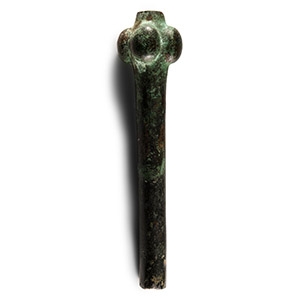
Luristan Sara-Gorz Bronze Macehead
Circa 2000-1300 B.C.Sold for (Inc. bp): £338
With long tubular shank and four hefty bulbs surrounding the shaft. 456 grams, 22.5 cm
Acquired 1980-2015. Ex Abelita family collection. Accompanied by an earlier catalogue identification card.
This rare and unusual mace finds parallels with similar pieces published by Slotta, Vatandust, and Moorey. The dating varies between 21st and 14th century B.C. Western Iranian maces, especially the Luristan ones, were notable for the variety of different forms. According to Dr D. Nicolle the gorz or mace was primarily used as an armour breaking weapon since ancient times, and was very common on the Iranian plateau. -
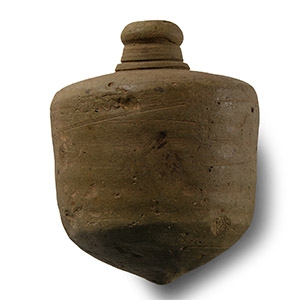
Byzantine 'Greek Fire' Ceramic Fire Bomb or Hand Grenade
9th-11th century A.D.Sold for (Inc. bp): £221
With broad shoulder, short neck, domed square-shaped lip and conical base, broad medial band, intended to be filled with explosive liquid and a wick, and used as a hand grenade. 472 grams, 10.7 cm
Acquired 1980-2015. Ex Abelita family collection. Accompanied by an academic paper by military specialist Dr Raffaele D'Amato, dated 15 July 2019 and titled 'Eastern Roman Empire - Greek Fire Bomb or Hand Grenade (μεσαίον kακάβιον) 9th-11th century AD'.
The effectiveness of these grenades was much lower than the fire liquid thrown by the siphons. They were thrown by hand as it is evident by the presence of some sort of handle on the body of some of them to better allow the grip of the object (Raimondo, 2000 Plate 11a; fig. 4, c-d). Nothing excludes that they were also launched at more long distance with catapults or other war engines. The presence of a fuse for triggering the explosion is evidenced by the narrow mouth of the largest part of the grenades.
