
Loading, please wait...
LOT 0258
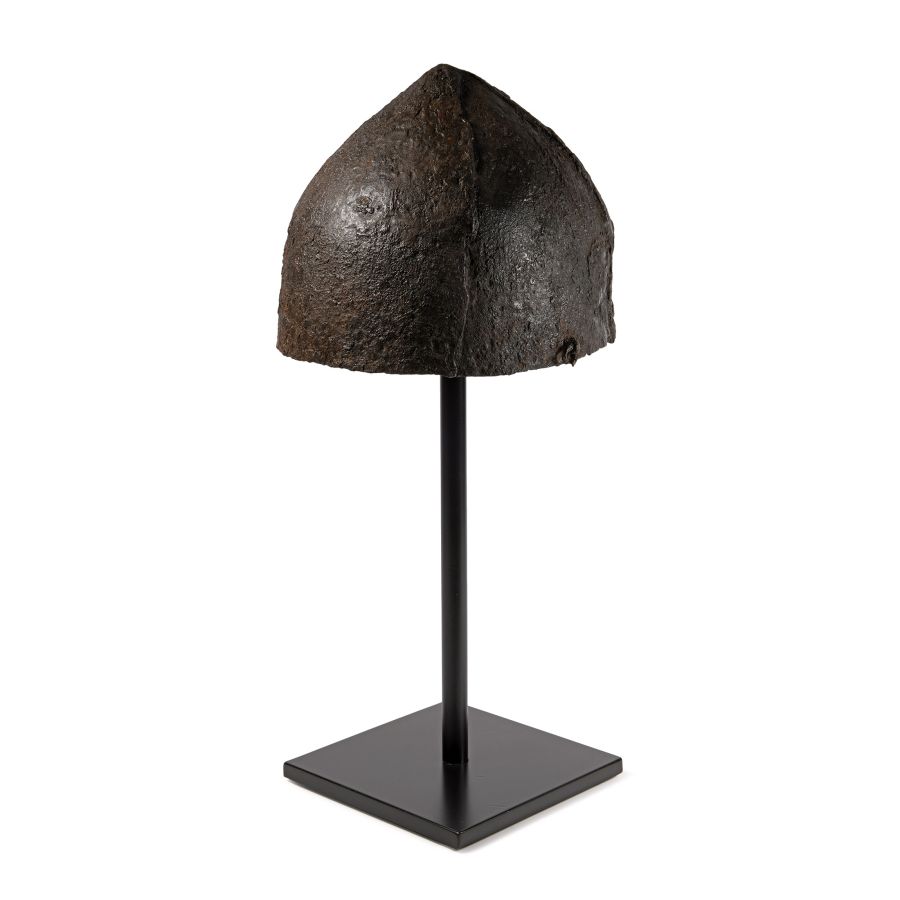
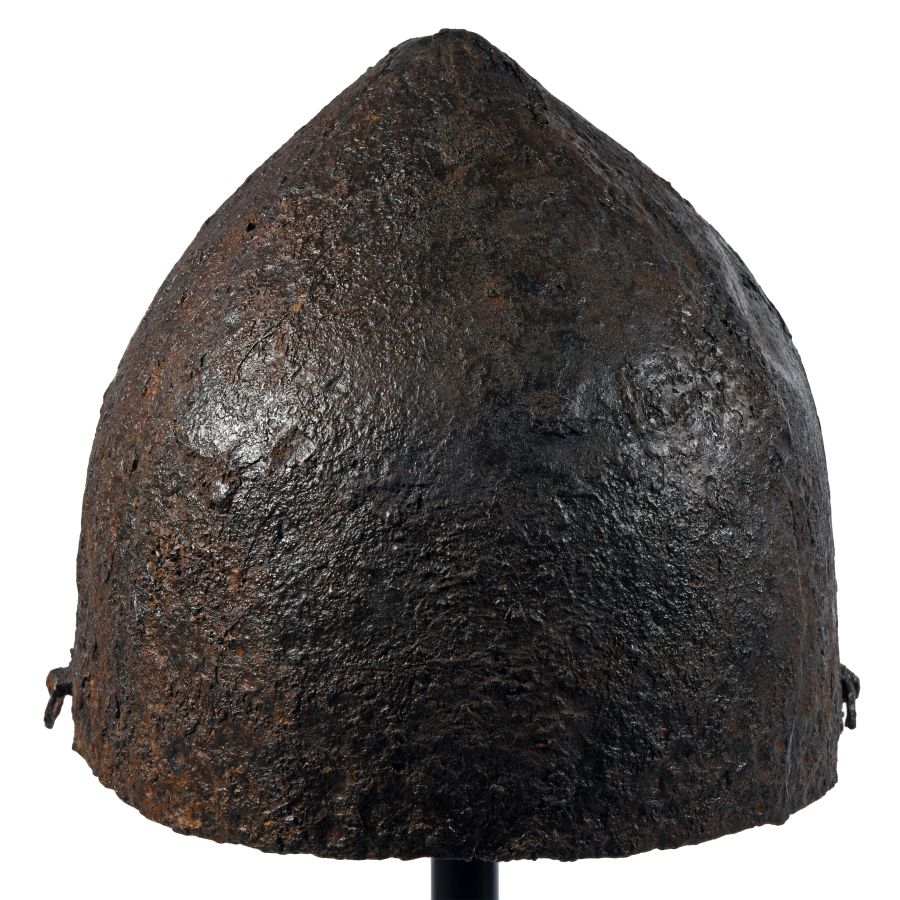
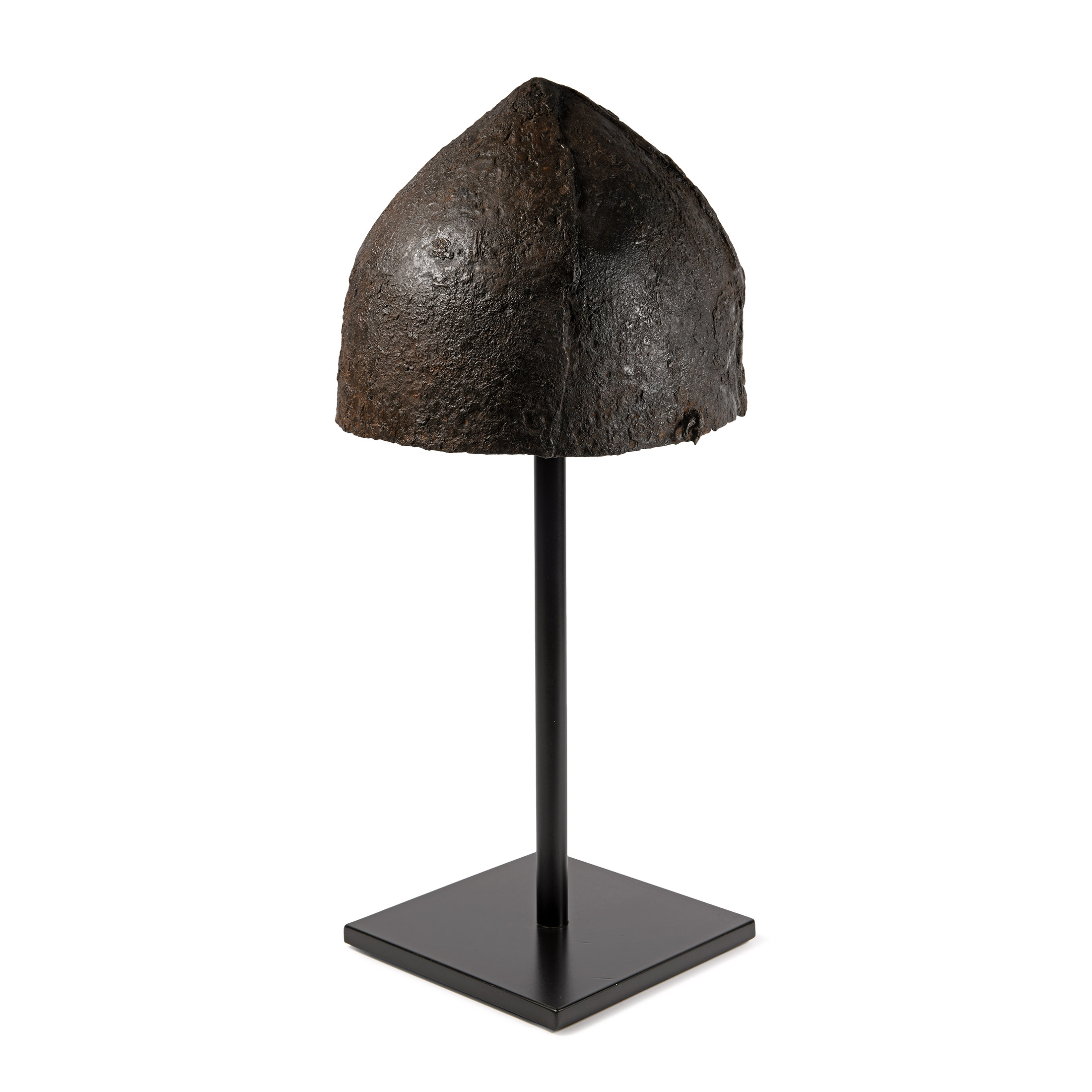
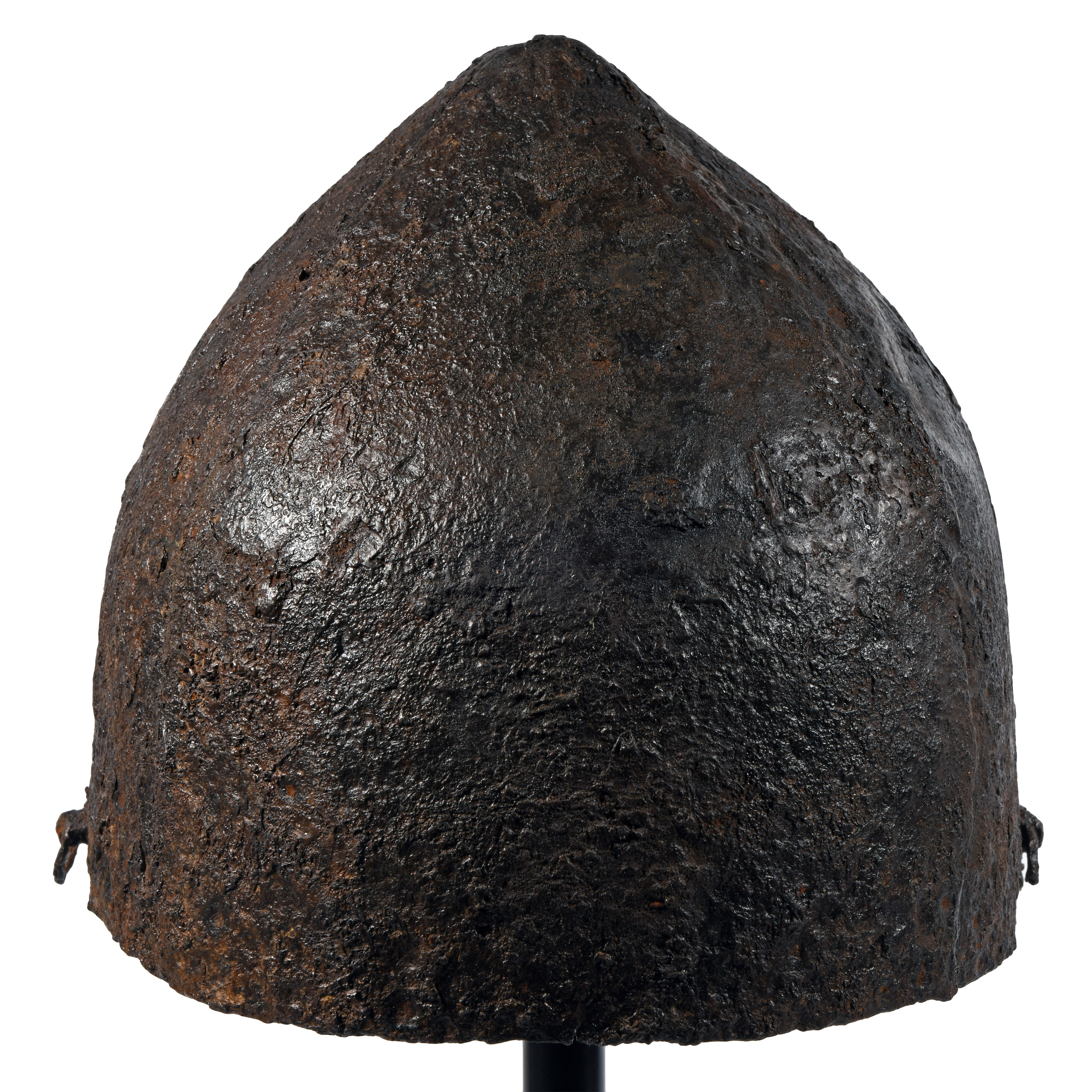
Norman or Viking Period Iron Four-Plate Helmet
CIRCA 8TH-12TH CENTURY A.D.
17 1/4 in. (3.36 kg total, 44 cm high including stand).
Comprising four triangular plates each with curved profile mounted with the frontal and rear plates overlapping the lateral ones, rivetted; two small lateral rings for attachment of cheek-plates; mounted on a custom-made display stand.
ProvenanceAcquired 1971-1972.
From the collection of the vendor's father.
Property of a London, UK, collector.
This lot has been checked against the Interpol Database of stolen works of art and is accompanied by search certificate number no. 11754-202772.
See Curtis, H.M., 2,500 Years of European Helmets, North Hollywood, 1978; Denny, N., & Filmer-Sankey, J., The Bayeux Tapestry, London, 1966; Kirpicnikow, A.N., Russische Helme aus dem Frühen Mittelalter, Waffen- und Kostumkunde, 3rd Series, Vol.15, pt. 2, 1973; D’Amato, R., ‘Old and new evidence on East-Roman helmets from the 9th to the 12th centuries,’ in Acta Militaria Medievalia, 2015, XI, pp. 27-157, items fig.23, nn.1-2 and pl.1.
FootnotesThe type of helmet composed from rivetted plates is a long-lived military fashion depicted from Late Antiquity to the medieval period.
CONDITIONTimeLine Auctions follows a vetting process to ensure the authenticity and legality of all items, reinforcing our commitment to integrity and responsible trading. Each antiquity, antique, and coin lot undergoes thorough examination by a vetting committee of at least ten external specialists, professional trade association members, scientists, and archaeologists: Our Vetting Process
AUCTIONS:
TimeLine is a leading auction house specialising in antiquities, ancient art, collectables, natural history, coins, medals, and books. Our auctions offer museums, collectors, historians, and enthusiasts the opportunity to acquire unique and historically significant pieces.
-
Amarlu Type Bronze Sword with Blood Channels
Late 2nd millenium B.C.Sold for (Inc. bp): £715
Formed with a long triangular blade, thick midrib with parallel fullers, rectangular guard, long tang with folded end. 668 grams, 73 cm
Acquired on the London art market, prior to 1980s. The Kusmirek Collection, UK.
This sword finds a good parallel with a bronze sword with bell-shaped pommel, today in the National Museum of Tehran. Originally these swords had separately made hilt which was then cast on the blade. These swords were more typical of the North-West Persian territory, especially in the Amlash and Gilan areas. -
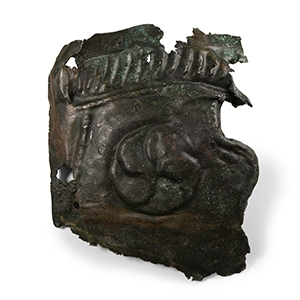
Roman Bronze Military Helmet Face Guard Section
3rd century A.D.Sold for (Inc. bp): £715
From the right side of the face mask, the upper edge with a band of embossed diagonal lines, probably intending to represent stylised hair, embossed spiral to the centre, a symbol clearly connected with the worship of the sun; a hole for the fastening thongs at ear-level which originally linked the face-guard to the bowl. 75 grams, 13 cm high
Acquired 1960s-1990s. Late Alison Barker collection, a retired London barrister.
The spiral decoration of the face-guard is connected with the solar cult. The spiral represents the rotary movement of the sun, and the spiral is probably the oldest known spiritual symbol connected with the sun, together with the swastika or tetragammadion. The connection can also be seen in Celtic art, where the representation of the spiral also follows the path of the sun, describing the movements of the heavenly body over the course of a solar year. The third century was characterised by diffusion of the solar cult, the Sol Invictus, among the Roman soldiers, with its symbols often represented on arms and weapons as an apotropaic element of protection. -
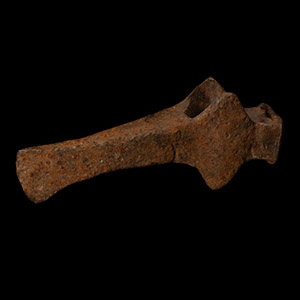
Viking Age Iron Axehead
11th-12th century A.D.Sold for (Inc. bp): £78
Composed of a sub-circular socket, lozengiform flanges above and below, rectangular hammer-style butt and axe head with straight upper and curved lower edge, convex cutting edge. 729 grams, 17.8 cm
Acquired 1990s-early 2000s. East Anglian private collection.
