
Loading, please wait...
LOT 0383
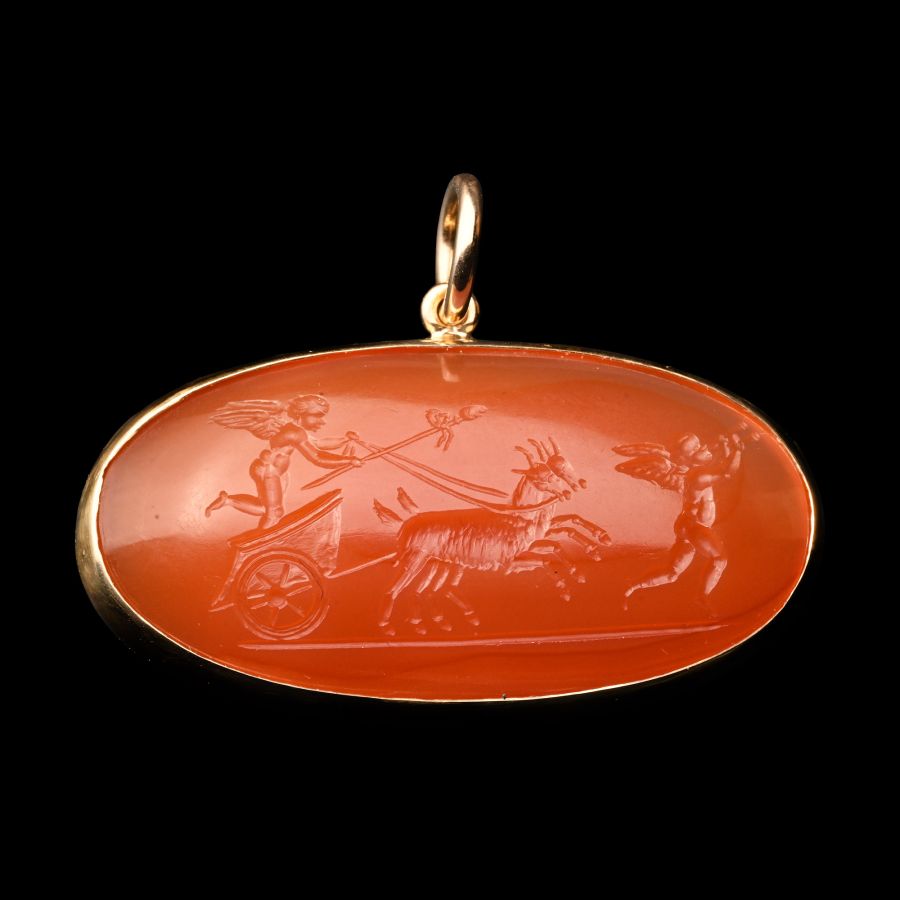
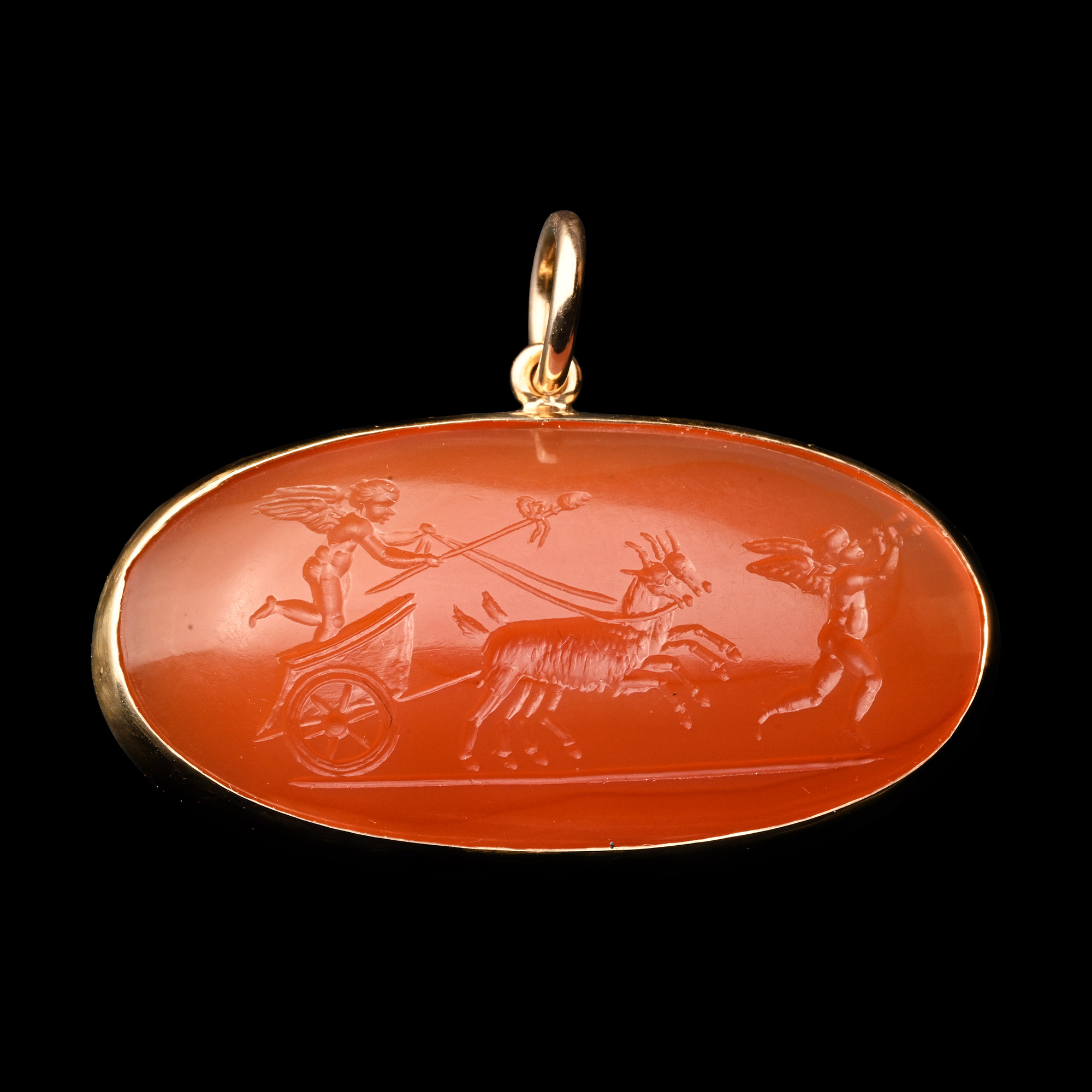
Neoclassical Carnelian Gemstone with Bacchic Procession
ITALY, 19TH CENTURY A.D.
1 1/2 in. (7.83 grams, 38 mm).
The oval intaglio carved with a lively Bacchic procession: a winged putto driving a goat-drawn chariot, grasping a thyrsus with one hand and guiding the reins with the other; before the chariot, another putto dancing and playing the pipes; set in a gold pendant.
ProvenancePrivate collection, UK.
FootnotesThe subject reflects the revival of antique themes characteristic of early 19th-century glyptic art, drawing inspiration from Roman gems and Renaissance engravings after Raphael. Such imagery of putti in Bacchic revels was emblematic of festivity, abundance, and playful triumph, well-suited to the Neoclassical fascination with classical allegory. For a comparison, see the Metropolitan Museum of Art, New York, accession no. 49.97.335, “A frieze arrangement with a putto wearing a laurel crown riding a goat at left and many infants playing musical instruments in front,” Master of the Die after Raphael, c. 1530–60.
CONDITIONTimeLine Auctions follows a vetting process to ensure the authenticity and legality of all items, reinforcing our commitment to integrity and responsible trading. Each antiquity, antique, and coin lot undergoes thorough examination by a vetting committee of at least ten external specialists, professional trade association members, scientists, and archaeologists: Our Vetting Process
AUCTIONS:
TimeLine is a leading auction house specialising in antiquities, ancient art, collectables, natural history, coins, medals, and books. Our auctions offer museums, collectors, historians, and enthusiasts the opportunity to acquire unique and historically significant pieces.
LOT 0383
Neoclassical Carnelian Gemstone with Bacchic Procession
Sold for (Inc. bp): £2,600
-
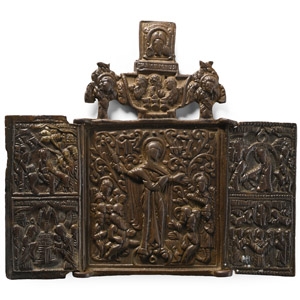
Eastern European Bronze Folding Triptych Icon of the Mother of God 'Joy of All Who Sorrow'
Circa 1850's A.D.Sold for (Inc. bp): £156
Representing the subject of the advocation of Virgin Mary, depicted as a haloed robed woman, standing with her arms extended outwards, figures kneeling at her side, Greek inscription 'ΜΡ ϴΥ’ (Mother of God) above; the other panels with the entrance of Christ in Jerusalem (top left); the Presentation to the Temple (bottom left); the Resurrection (top right) and the Ascension (bottom right); Cyrillic inscriptions over each of the scenes; on the crest and finial, the Trinity (three angels with cups) flanked by Cherubins, the Mandylion above. 85 grams, 90 mm
Acquired from Chris Martin-Zakheim, Iconastas, 5 Piccadilly Arcade, London SW1. From the private collection of a West London, UK, gentleman, formed since the early 2000s.
The icon represents the Intercession of Mary, 'Joy of all who sorrow'. It formed the central part of a triptych with the Mother of God at the centre, surmounted by iconography of veneration. The other parts of the triptych are embossed with scenes of the lives of Christ. -
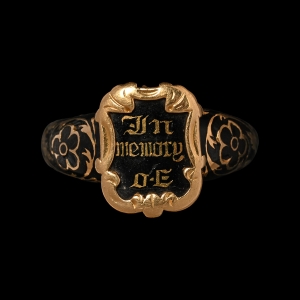
Engraved Gold and Black Enamel Memento Mori Ring
19th century A.D.Estimate: £600 - 800 (+bp*)
Opening Bid: £310
With D-section tapering hoop, black enamel finish with reserved rosettes and tendrils, the bezel an ornate heater shield with reserved text 'In memory OE' and copperplate engraving to the inner face '1852 / obt.63', 'Mrs.Sarah Hems, obt.26 May' and stamped assay marks: crown, '18', leopard's head, gothic 'k' in octagonal panel (dated to 1845). 4.14 grams, 22.74 mm overall, 17.43 mm internal diameter (approximate size British O, USA 7, Europe 14.98, Japan 14)
Acquired on the UK art market. Property of an East Sussex collector. -
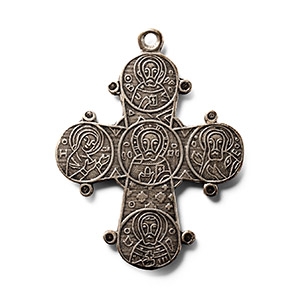
Russian Orthodox White Metal Cross Pendant
19th century A.D.Sold for (Inc. bp): £65
Cruciform plaque with lateral lobes to each arm; obverse with low-relief Corpus Christi; reverse with nimbate busts. 6.75 grams, 39 mm
Acquired from Chris Martin-Zakheim, Iconastas, 5 Piccadilly Arcade, London SW1. From the private collection of a West London, UK, gentleman, formed since the early 2000s.
