
Loading, please wait...
_900x900.jpg "Neo-Sumerian Haematite Cylinder Seal with Presentation Scene")
_200x200.jpg "Neo-Sumerian Haematite Cylinder Seal with Presentation Scene")
.jpg "Neo-Sumerian Haematite Cylinder Seal with Presentation Scene")
LOT 1154
Neo-Sumerian Haematite Cylinder Seal with Presentation Scene
UR III, 22ND-21ST CENTURY B.C.
1 in. (7.59 grams, 25 mm).
With broad central piercing, frieze with seated king in a tiered robe facing two robed supplicants, scorpion and goat to the rear. [No Reserve]
ProvenanceAcquired 1970s-1996.
Property of a North American collector, collection no.18.
London collection, 2016.
Cf. Teissier, B., Ancient Near eastern Cylinder Seals in the Marcopoli Collection, Berkeley, 1984, item 101, for type.
CONDITIONTimeLine Auctions follows a vetting process to ensure the authenticity and legality of all items, reinforcing our commitment to integrity and responsible trading. Each antiquity, antique, and coin lot undergoes thorough examination by a vetting committee of at least ten external specialists, professional trade association members, scientists, and archaeologists: Our Vetting Process
AUCTIONS:
TimeLine is a leading auction house specialising in antiquities, ancient art, collectables, natural history, coins, medals, and books. Our auctions offer museums, collectors, historians, and enthusiasts the opportunity to acquire unique and historically significant pieces.
LOT 1154
Neo-Sumerian Haematite Cylinder Seal with Presentation Scene
Sold for (Inc. bp): £910
-
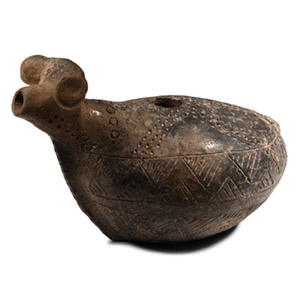
Anatolian Incised Terracotta Rhyton
19th-18th century B.C.Estimate: £4,000 - 6,000 (‡+bp*)
Opening Bid: £2,000
Ovoid in plan with ram-head finial and spout. filling-hole to the centre back and stub tail forming a handle; hatched panels to the sidewall with reserved running zigzag, radiating bands of impressed point ornament, head with forward-facing curled horns. 578 grams, 20.5 cm
with Artemis gallery, Münich. Acquired by the present owner from the above in 1992. This lot has been checked against the Interpol Database of stolen works of art and is accompanied by a search certificate number no.12260-222201. -
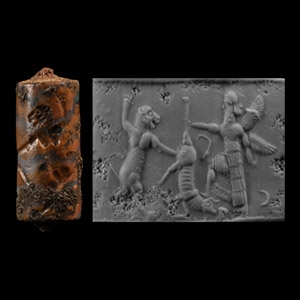
Neo-Babylonian Banded Agate Cylinder Seal with Bull-Man Contest Scene
7th-6th century B.C.Sold for (Inc. bp): £2,340
Frieze with contest scene, winged divinity in profile grasping the hindleg of a bull while lion raises its foreleg preparing to strike; supplied with a museum-quality impression. 12.6 grams, 36 mm
From the 'S' collection, acquired 1970-1990s. The collection was seen and studied by W.G. Lambert, late Professor of Assyriology at the University of Birmingham, 1970-1993. This lot has been checked against the Interpol Database of stolen works of art and is accompanied by search certificate number no.12250-222162. -
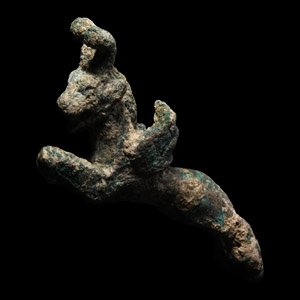
Western Asiatic Bronze Leaping Horned and Winged Lion
Mid 1st millennium B.C.Estimate: £180 - 240 (+bp*)
Opening Bid: £90
With small wings and curved horns; possibly Kushan. 160 grams, 11.8 cm
Fair condition, one wing chipped.
London collection since the 1980s. Property of a Canadian family.
