
Loading, please wait...
_900x900.jpg "Neo-Babylonian Chalcedony Duck Weight with Engraved Figure")
_200x200.jpg "Neo-Babylonian Chalcedony Duck Weight with Engraved Figure")
.jpg "Neo-Babylonian Chalcedony Duck Weight with Engraved Figure")
LOT 1263
Neo-Babylonian Chalcedony Duck Weight with Engraved Figure
CIRCA 8TH-6TH CENTURY B.C.
3/4 in. (5.07 grams, 21 mm).
The animal carved with its head and neck resting along its back; stylised figure with crescent horns or headdress engraved to base; pierced for suspension. [No Reserve]
ProvenanceFrom an early 20th century collection, Caernarfon, North Wales, UK.
LiteratureSee Anavian, H., Habib Anavian Collection, Ancient Near Eastern Cylinder and Stamp Seals from the Early 6th Millennium B.C. to 651 A.D., New York, 1976, nos.423-425, for similar crescent symbols on Sassanian seals; for Iron Age duck-weights of similar shape see Zaccagnini, C., ‘Duck Weights from Karkemish: a Historical Analysis’ (tab.XIII-XXI)’ in Orientalia, Vol.88, Nova Series, Fasc.1, pp.37-77, pls.XVI-XX.
FootnotesA corpus of similar pieces was found by Italian archaeologists in the city of Karkemish. They were produced and in use in the Iron Age I-III (i.e. from ca. 1190 B.C., date of the collapse of the Hittite Empire and the rise of the “Great Kings” of Karkemish, to 605 B.C., date of the “battle of Karkemish”, when the Babylonian army conquered the city.
CONDITIONTimeLine Auctions follows a vetting process to ensure the authenticity and legality of all items, reinforcing our commitment to integrity and responsible trading. Each antiquity, antique, and coin lot undergoes thorough examination by a vetting committee of at least ten external specialists, professional trade association members, scientists, and archaeologists: Our Vetting Process
AUCTIONS:
TimeLine is a leading auction house specialising in antiquities, ancient art, collectables, natural history, coins, medals, and books. Our auctions offer museums, collectors, historians, and enthusiasts the opportunity to acquire unique and historically significant pieces.
LOT 1263
Neo-Babylonian Chalcedony Duck Weight with Engraved Figure
Sold for (Inc. bp): £169
-
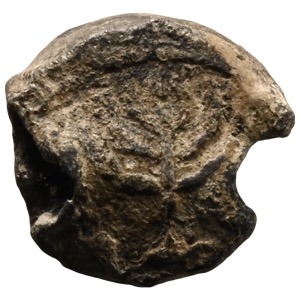
Jewish Lead Sealing with Menorah
Circa 4th century A.D. or earlierSold for (Inc. bp): £234
Impressed menorah to one side, the other side with a standing eagle. 3.69 grams, 13 mm
From the property of late Mr SM, London, UK, 1970-1990s, thence by descent. -
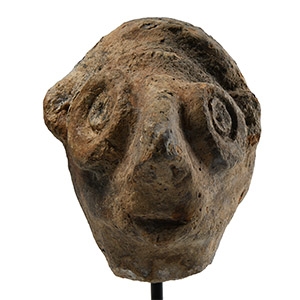
Large Syro-Hittite Terracotta Idol Head
2nd millennium B.C.Sold for (Inc. bp): £130
Modelled in the round with prominent discoid eyes, diadem to the top and rear of the head with lateral sockets (perhaps for temple-rings?); mounted on a custom-made display stand. 617 grams total, 15 cm high including stand
From a collection acquired on the UK art market from various auction houses and collections mostly before 2000. From an important Cambridgeshire estate; thence by descent. -
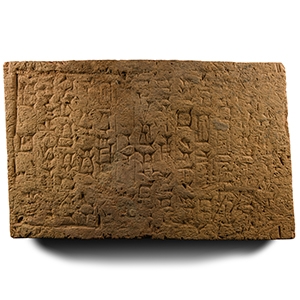
Temple Brick Section of Nebuchadnezzar II, King of Babylon
Circa 604-562 B.C.Sold for (Inc. bp): £5,200
A rectangular-section panel with fourteen columns of cuneiform text mentioning the foundation of a temple by Nebuchadnezzar II, translating as 'King of Babylon provisioner of Esagil and Ezida prime son of Nabopolassar, King of Babylon and Ebabbara, the temple of Shamash in Larsa..[...]. 1.05 kg, 21 x 13 cm
Formerly in a private collection since 1980. Acquired from the private collection of L.H., Staffordshire, UK. Previously the property of an East Sussex, UK, gentleman. From a collection acquired from various auction houses in the UK. From the estate of Mr R.W., a private Wiltshire, UK, collector; thence by descent. Accompanied by a copy of a five-page specialist report by James Brenchley. This lot has been checked against the Interpol Database of stolen works of art and is accompanied by search certificate no.12315 -215546.
The construction of the Hanging Gardens of Babylon and the destruction of Jerusalem's temple are ascribed to Nebuchadnezzar II. He is featured in the biblical Book of Daniel and is mentioned in several other books of the Bible.
