
Loading, please wait...
LOT 1211
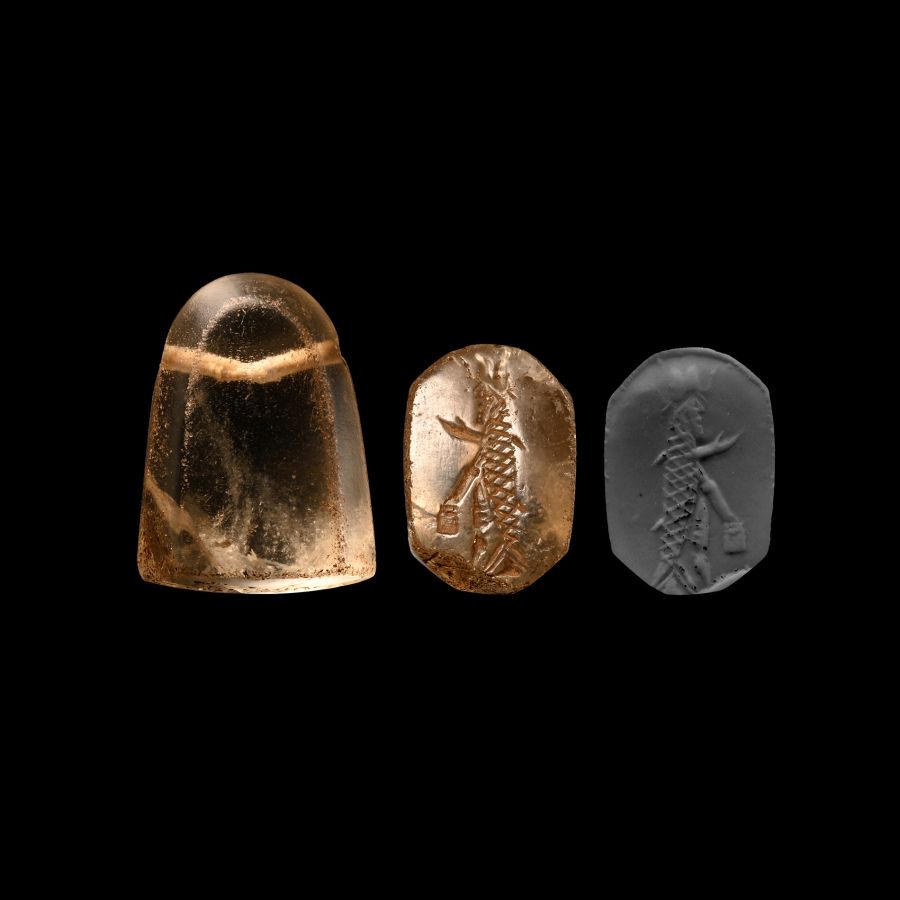
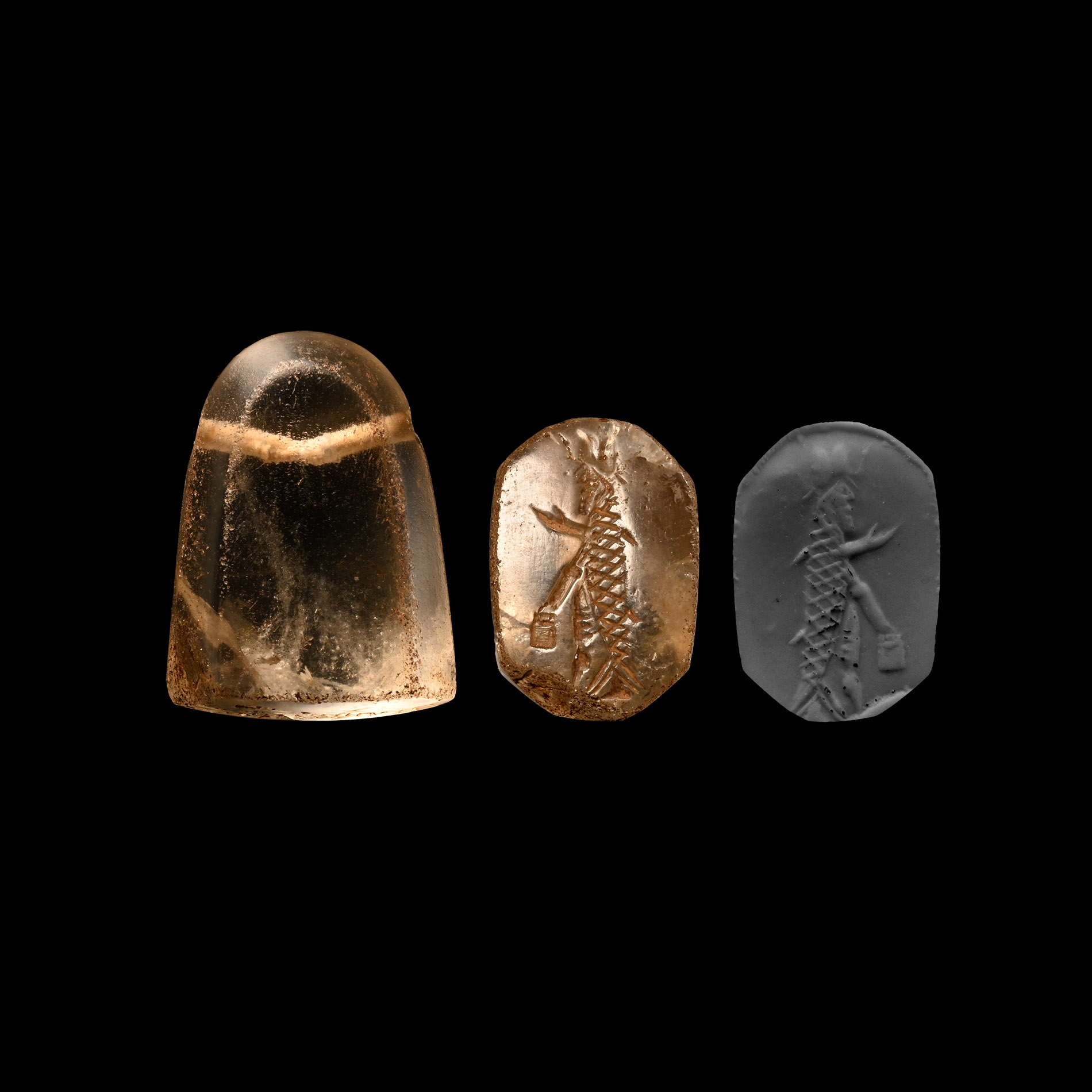
Neo-Bablyonian Rock Crystal Stamp Seal with Fish God
CIRCA 4TH-3RD CENTURY B.C.
1 in. (11 grams, 26 mm).
Octagonal in section with intaglio to the underside of a creature with the tail and scales of a fish, a man's bearded and crowned head, carrying a basket; supplied with a museum-quality impression.
ProvenanceAcquired 1970-1999.
London collection of the late Mr S.M., thence by descent.
TimeLine Auctions follows a vetting process to ensure the authenticity and legality of all items, reinforcing our commitment to integrity and responsible trading. Each antiquity, antique, and coin lot undergoes thorough examination by a vetting committee of at least ten external specialists, professional trade association members, scientists, and archaeologists: Our Vetting Process
AUCTIONS:
TimeLine is a leading auction house specialising in antiquities, ancient art, collectables, natural history, coins, medals, and books. Our auctions offer museums, collectors, historians, and enthusiasts the opportunity to acquire unique and historically significant pieces.
-
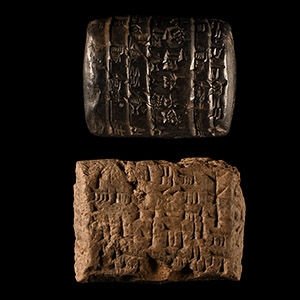
Sumerian Cuneiform Tablet Group with Legal Texts
Late 3rd-early 2nd millennium B.C.Sold for (Inc. bp): £1,690
Comprising two pillow-shaped clay tablets comprising: one in dark brown material, cuneiform text to both broad faces and one edge, polished surface, end of the third millennium but with an Akkadian administrative text; one in tan-coloured material, cuneiform text to both broad faces and three edges, a legal text from the beginning of the second millennium. 90 grams total, 45-51 mm
Acquired in the 1970s. European private collection. -
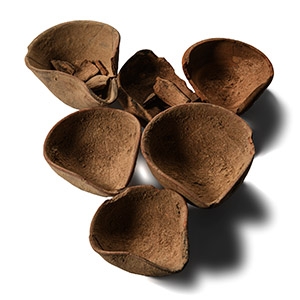
Canaanite Terracotta Lamp Fragment Group
Circa 1550-1200 B.C.Sold for (Inc. bp): £78
Comprising wheel-made buff clay oil lamps with classic 'pinched' nozzle and rounded bottoms; repaired. 323 grams total, 75-88 mm
UK gallery, early 2000s. -
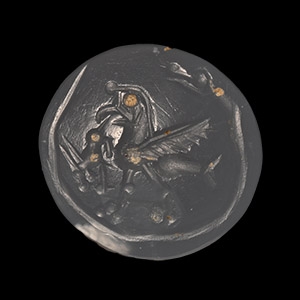
Chalcedony Pendant Stamp Seal with Mythical Creature
Circa 8th-7th century B.C.Sold for (Inc. bp): £1,690
An Assyrian or Urartian bell-shaped seal featuring a ribbed suspension loop attached to a stepped base; on the convex underside of the seal, there is an intricate engraving depicting a mythical creature that combines the body of an eagle with a fish tail; this hybrid creature is depicted facing to the left and holding a hare in its beak, with a snake coiled around the seal's perimeter; accompanied by a museum-quality impression and a typed and signed scholarly note issued by W.G. Lambert, late Professor of Assyriology at the University of Birmingham, 1970-1993, which states: 'Stamp Seal of Chalcedony / 23 x 14.5 mm. / This has a round, convex face, and above it is a cylinder with sharply concave sides, on top of which is (of one piece with the rest) a pierced lug with grooves over its top. The design on the base shows a standing composite creature: legs, wings and head of a bird, but body of a fish. In its beak it is holding a dead hare or other such creature. Around the design is a snake, whose body does not quite complete the circle. / This is an Urartian seal, from the ancient Kingdom of Urartu, c. 800-650 B.C. It comes from the area around Lake Van. The composite creature is a typical feature of the art of this kingdom. The snake is interesting, since it is the forerunner of the famous Ourobouros on magic gems of the period c. 100 B.C. to 200 A.D. It often appears surrounding a design, but it has its tail in its mouth. This seal has very slight chipping of the edges, but generally is in very good condition.' 4.71 grams, 23 mm
Private collection, England, 1990. European art market. Anonymous sale; Christie's, New York, 6 December 2007, no.374. From the 'Empire' collection, an important UK private collection of seals. with Bonhams, London, 7 December 2021, no.64 (£3,000 - £4,000). Accompanied by a copy of a typed and signed scholarly note by the late W.G. Lambert, Professor of Assyriology at the University of Birmingham, 1970-1993.
