
Loading, please wait...
_900x900.jpg "Neo-Assyrian Chalcedony Cylinder Seal for the God Samnuha from Samsanu")
_200x200.jpg "Neo-Assyrian Chalcedony Cylinder Seal for the God Samnuha from Samsanu")
.jpg "Neo-Assyrian Chalcedony Cylinder Seal for the God Samnuha from Samsanu")
LOT 0216
Neo-Assyrian Chalcedony Cylinder Seal for the God Samnuha from Samsanu
9TH-7TH CENTURY B.C.
1 5/8 in. (16.8 grams, 40 mm).
Carved with five columns of cuneiform inscription: 'To the god Samnuha, great lord, Samsanu, eunuch, for the life of [the king) Samnuha-shar-ilani, his Lord, he made and gave (this seal)'; accompanied by a museum-quality impression.
ProvenanceAcquired in the mid 1980s-1990s.
Private collection, Switzerland, thence by descent.
Private collection, since the late 1990s.
This lot has been checked against the Interpol Database of stolen works of art and is accompanied by search certificate number no.12586-232162.
This lot has been cleared against the Art Loss Register database, and is accompanied by an illustrated lot declaration signed by the Head of the Antiquities Department, Dr Raffaele D'Amato.
Cf. Von Der Osten, H.H., Ancient Oriental Seals in the collection of Mr. Edward T. Newell, Chicago, 1934, no.665, for a seal in similar writing style.
CONDITIONTimeLine Auctions follows a vetting process to ensure the authenticity and legality of all items, reinforcing our commitment to integrity and responsible trading. Each antiquity, antique, and coin lot undergoes thorough examination by a vetting committee of at least ten external specialists, professional trade association members, scientists, and archaeologists: Our Vetting Process
AUCTIONS:
TimeLine is a leading auction house specialising in antiquities, ancient art, collectables, natural history, coins, medals, and books. Our auctions offer museums, collectors, historians, and enthusiasts the opportunity to acquire unique and historically significant pieces.
LOT 0216
Neo-Assyrian Chalcedony Cylinder Seal for the God Samnuha from Samsanu
Sold for (Inc. bp): £9,100
-
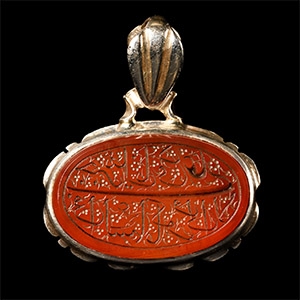
Western Asiatic Style White Metal Pendant with Carnelian Calligraphic Gemstone
20th century A.D.Sold for (Inc. bp): £52
An openwork pendant set with a carnelian gemstone, engraved calligraphic text in two lines, scallop-shaped suspension loop above. 13.4 grams, 30 mm
From the family collection of a Hampstead gentleman; formerly acquired in the 1980s. This lot has been cleared against the Art Loss Register database, and is accompanied by an illustrated lot declaration signed by the Head of the Antiquities Department, Dr Raffaele D'Amato. -
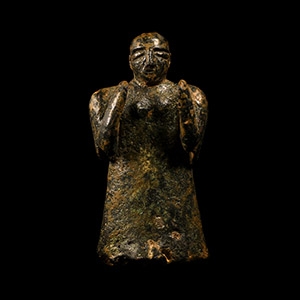
Old Babylonian Bronze Standing Worshipper
Early 2nd millennium B.C.Estimate: £1,000 - 1,400 (+bp*)
Opening Bid: £500
Hollow-formed with flared robe, arms raised and bent revealing bell-shaped sleeves, small breasts, squat head with lentoid eyes and band of hair to rear. 163 grams, 70 mm
Acquired before 1983. Ex London gallery, 1990s. This lot has been cleared against the Art Loss Register database, and is accompanied by an illustrated lot declaration signed by the Head of the Antiquities Department, Dr Raffaele D'Amato. -
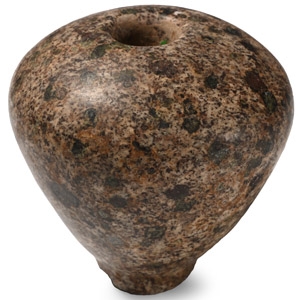
Western Asiatic Stone Macehead
3rd-2nd millennium B.C.Estimate: £100 - 140 (+bp*)
Opening Bid: £50
Piriform with narrow socket. 459 grams, 74 mm
From a West London, UK, collection, 1980-1990s. This lot has been cleared against the Art Loss Register database, and is accompanied by an illustrated lot declaration signed by the Head of the Antiquities Department, Dr Raffaele D'Amato.
