
Loading, please wait...
LOT 0236
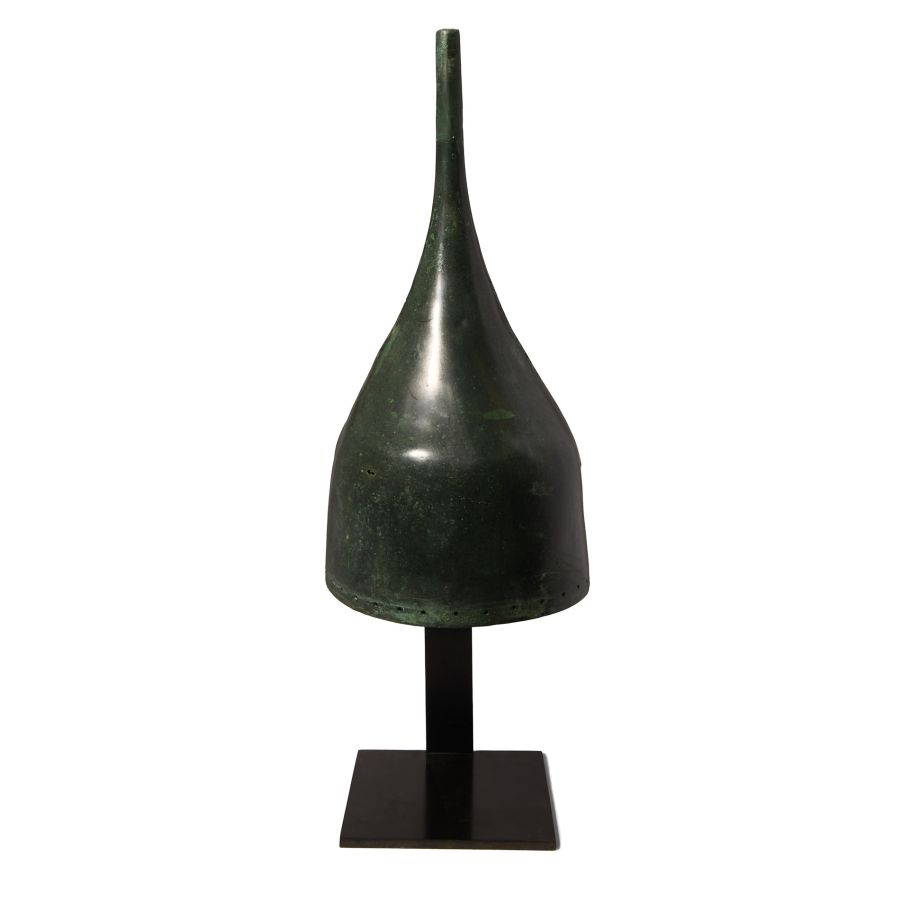
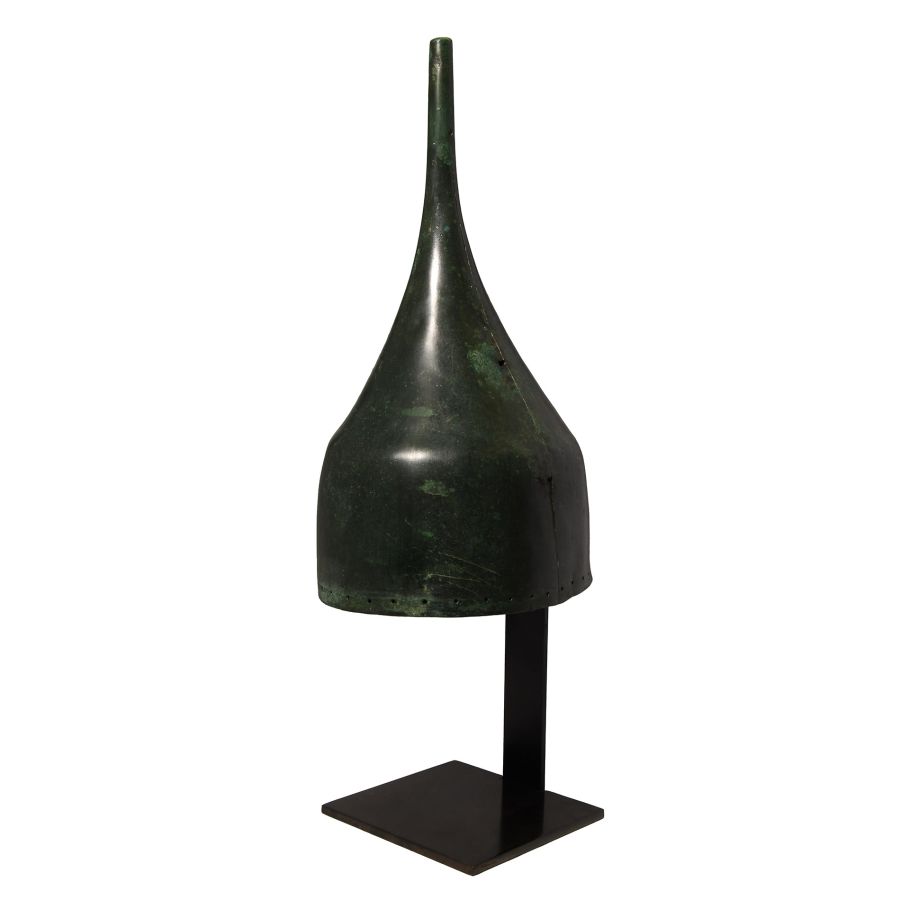
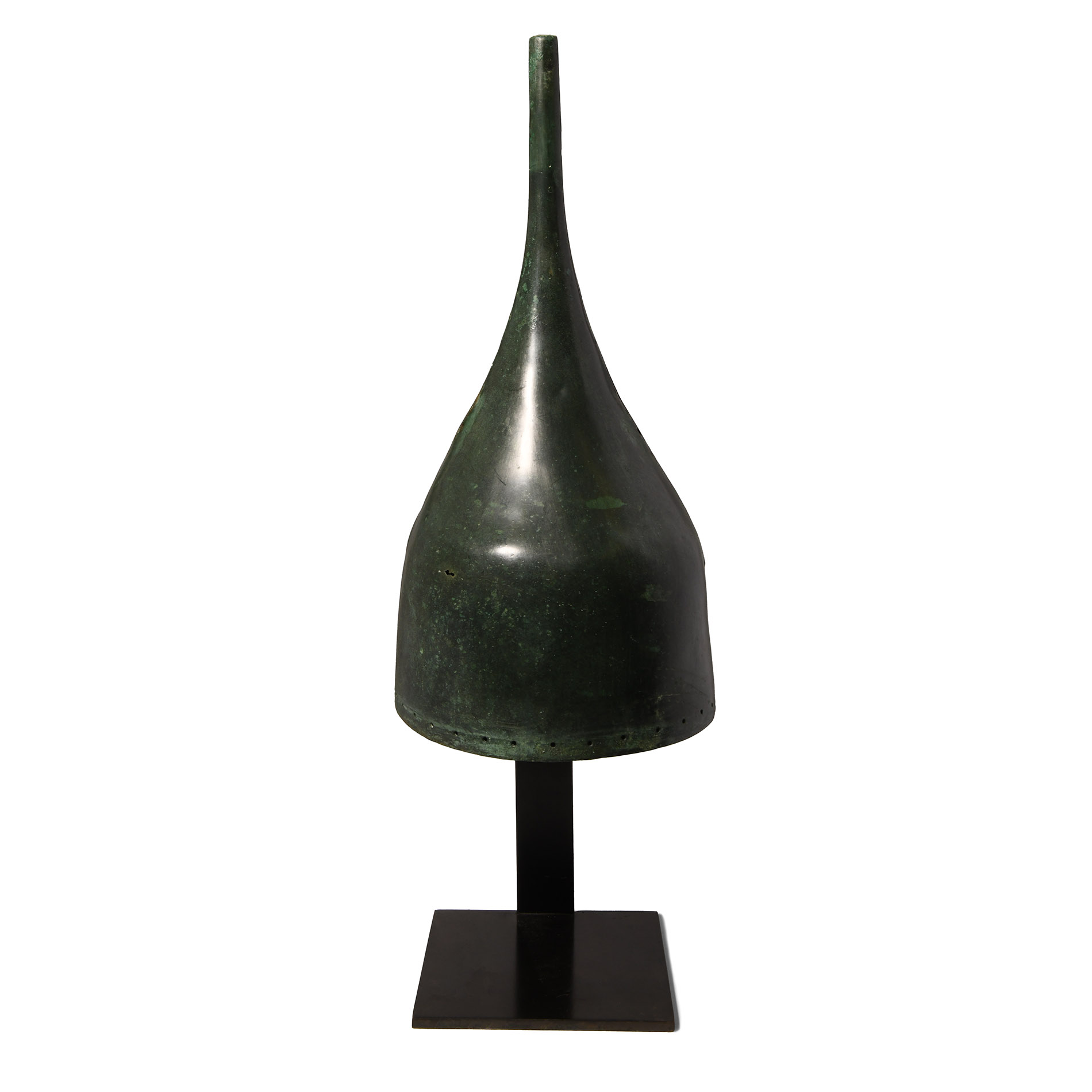
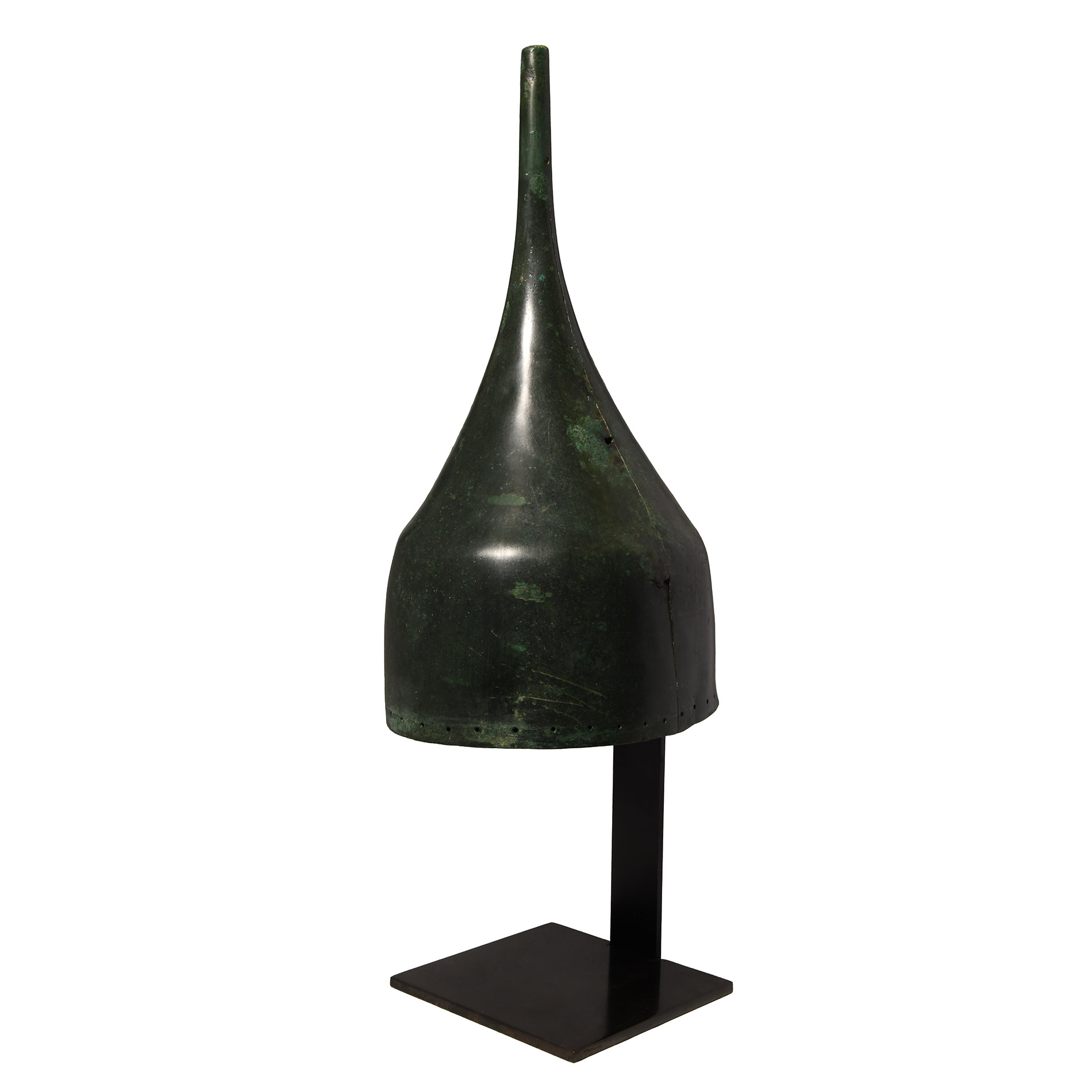
Neo-Assyrian Bronze Military Helmet
8TH CENTURY B.C.
21 3/4 in. (3.5 kg total, 55.5 cm high including stand).
With lateral seams, attachment holes to lower edge, bowl with tall conical peak; mounted on a custom-made stand.
ProvenanceAcquired on the UK art market.
From a private collection, 1980s.
Ex central London gallery.
The Kusmirek Collection, UK.
Accompanied by an academic report by Dr Raffaele D'Amato.
This lot has been checked against the Interpol Database of stolen works of art and is accompanied by search certificate number no.11765-203977.
Cf. Born, H., Seidl, U., Schutzwaffen aus Assyrien und Urartu, Sammlung Axel Guttmann, Mainz, 1995, pl.VI, VII, XIII-XV, and pp.134-149, for a near identical helmet in the Guttmann collection (AG204).
FootnotesFrom the reign of King Tiglatpilesar III (744-727 B.C.) or possibly later. The army of the Neo-Assyrian Empire consisted of large units of cavalry and skilled archers. Mobile workshops and smiths produced vast quantities of arrows and spears that were required while on campaign. The royal palaces of Nineveh, Ashur, and Nimrud were adorned with reliefs depicting Neo-Assyrian troops including foot soldiers in similar pointed bronze helmets. The helmet was originally bimetallic, made of bronze and iron. Although the iron section is now preserved only in fragments, having deteriorated long ago; the bronze half remains.
CONDITIONTimeLine Auctions follows a vetting process to ensure the authenticity and legality of all items, reinforcing our commitment to integrity and responsible trading. Each antiquity, antique, and coin lot undergoes thorough examination by a vetting committee of at least ten external specialists, professional trade association members, scientists, and archaeologists: Our Vetting Process
AUCTIONS:
TimeLine is a leading auction house specialising in antiquities, ancient art, collectables, natural history, coins, medals, and books. Our auctions offer museums, collectors, historians, and enthusiasts the opportunity to acquire unique and historically significant pieces.
-
.jpg)
German Closed Iron Helm
Circa 1560 A.D.Sold for (Inc. bp): £4,940
An armet with rounded one-piece skull raising to a roped medial comb, visor, prow shaped upper bevor and bevor attached by common pivots, each secured at the right side by a spring-catch, the visor with stepped centrally divided visor-slit and two gorget-plates. 2 kg, 31 cm high
Acquired on the European art market. The Kusmirek Collection, UK. Accompanied by a copy of an invoice. Accompanied by an academic report by Dr Raffaele D'Amato This lot has been checked against the Interpol Database of stolen works of art and is accompanied by search certificate number no.11767-203981.
The term armet is generally used to denote a visored helmet of particular construction, one in which large cheekpieces are hinged to the base of the bowl just above the ears and close in front of the chin. From about 1515 A.D., the Germans produced a variant armet where the downward extension of the skull was made much wider, reaching as far forward as the ears. The cheekpieces on this type of helmet opened sideways, on vertical hinges on the edges of this wider neck element. -
Amarlu Type Bronze Sword with Blood Channels
Late 2nd millenium B.C.Sold for (Inc. bp): £715
Formed with a long triangular blade, thick midrib with parallel fullers, rectangular guard, long tang with folded end. 668 grams, 73 cm
Acquired on the London art market, prior to 1980s. The Kusmirek Collection, UK.
This sword finds a good parallel with a bronze sword with bell-shaped pommel, today in the National Museum of Tehran. Originally these swords had separately made hilt which was then cast on the blade. These swords were more typical of the North-West Persian territory, especially in the Amlash and Gilan areas. -
Cased 1st Model Tranter 36 Bore Revolver Pair
1853-1854 A.D.Sold for (Inc. bp): £6,500
With 19.5cm (8¾") octagonal rifled barrels of 36 bore (marked to front of frame), solid Adams patent frames with foliate engraving marked 'ADAMS PATENT ' and serial numbers 20,368Y and 20,832Y with plain loading lever pins to left side, Tranter double trigger (providing single and double action), London proof marks to 5-shot cylinders and barrels, blued finish; in wood case with two hook latches and lock (no key) with accessories including loading lever (stamped 'TRANTERS PATENT 36), wood cleaning rod with extractor screw and two brass cleaning tips), wood handled turnscrew and nipple key, pewter oil bottle, steel wad cutter (marked CAST STEEL), brass-handled double bullet mould (stamped 'TRANTERS PATENT 36); Dixon powder flask, tin of Eley's Superior caps, tin of Tranter's Lubricating Composition, turned bone container with four spare nipples and three pre-made bullets with felt wads. 5.10 kg total, case 43 x 24 cm
Acquired Brighton dealer, 2020. Property of a Kent collector. This lot has been checked against the Interpol Database of stolen works of art and is accompanied by search certificate no.204131.
The Tranter revolvers based on the Adams solid frame were numbered from 20,000 and have the Y suffix. Sold as an exempt item under Section 58 (2) of the Firearms Act, 1968, to be held as a curiosity or ornament. No license required but buyer must be over 18 years of age. Overseas bidders should note that, due to UK regulations governing export of all firearms, overseas buyers will need to make arrangements for shipping this lot out of the UK directly, by air freight, with a specialist company or agent.
